
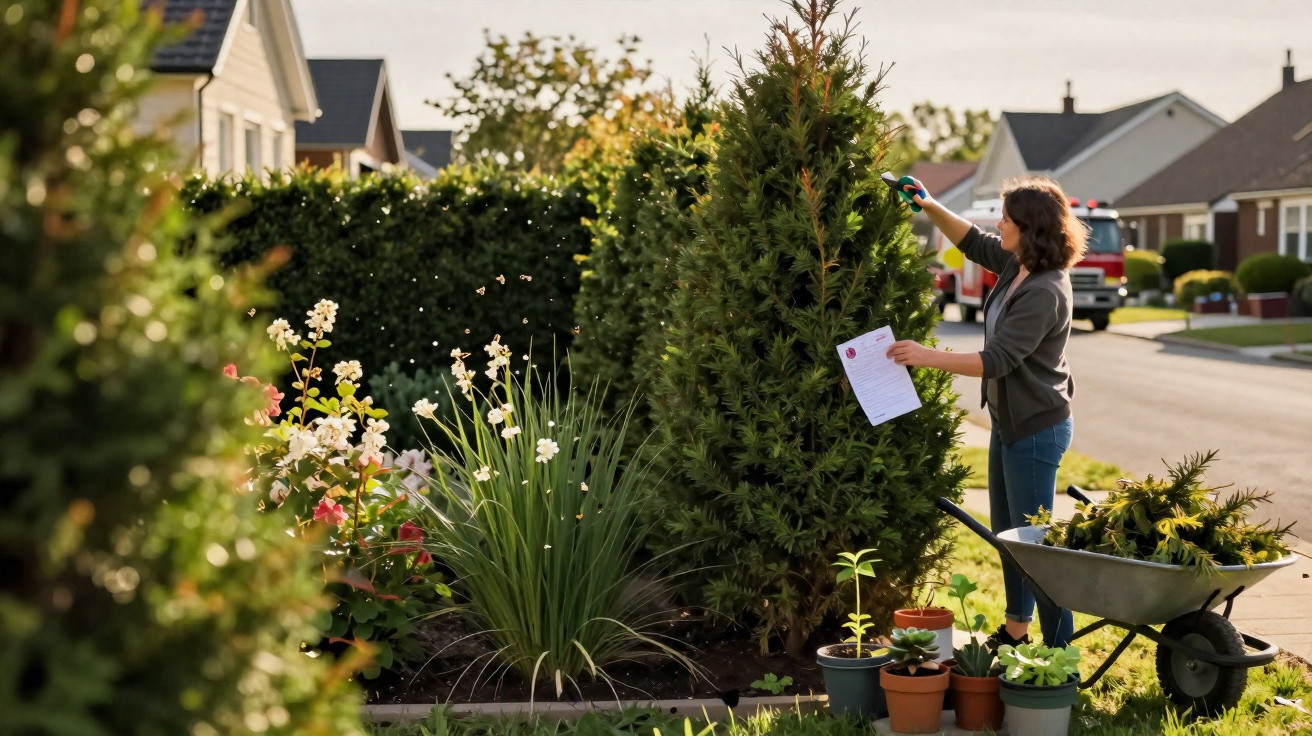
Anyone hoping to shield their property with an opaque green barrier increasingly encounters an invisible obstacle: local planning law. In many towns and villages, planning departments now give a clear answer: this hedge can no longer be planted here. One conifer species in particular is under scrutiny, affecting countless homeowners.
Why councils are turning against formerly standard hedges
In housing developments built during the 1980s and 1990s, the scene was much the same everywhere: terraced homes, carports and long, perfectly straight evergreen hedges, usually made up of Thuja. They were considered easy to maintain, permanently dense and ideal for keeping prying eyes out. Now, attitudes are changing in many town halls.
This is not the result of a new nationwide rule. Instead, local authorities are using their own development and landscape plans to exclude particular woody plants along roads, in new housing estates or at sensitive sites. The small print in these regulations sets out which plants are welcome and which are placed on the prohibited list.
In many local plans, the traditional Thuja hedge now appears under “undesirable or species to be avoided”.
Homeowners often discover this only when submitting a planning application, redesigning their garden or notifying the council about boundary planting. They may then find a requirement stating that hedges must consist of site-appropriate, preferably native woody plants, while uniform rows of conifers are no longer intended.
The planning powers: what councils can actually prohibit
Councils can specify in considerable detail what may grow in front gardens through their urban planning rules. This can include:
- requirements for hedge height and distance from the road;
- lists of recommended or compulsory tree and shrub species;
- bans on certain “problem plants” in new developments;
- rules governing planting around parking spaces and fences.
Anyone who disregards these requirements risks consequences. In theory, councils can:
- formally challenge an unauthorised hedge;
- require it to be removed or cleared;
- impose fines if no action is taken.
In reality, many planning departments take a practical approach. Existing older hedges are often left in place, whereas authorities are more critical of new planting introduced after an updated development plan has taken effect. They frequently offer transition periods or even grant schemes when residents voluntarily make their plots more wildlife-friendly.
Why the once exemplary Thuja hedge has become a problem
Conservationists and fire-safety specialists chiefly point to two issues: its effect on soil and its considerable fire risk. Thuja’s evergreen scale-like foliage contains substances that make the soil markedly more acidic. Over time, the pH level falls significantly and the ground beneath the hedge becomes increasingly barren.
Beneath an old Thuja hedge, the ground is often almost lifeless: hardly any earthworms, hardly any insects, hardly any soil life.
A mixed shrub hedge provides food and shelter for many bird and insect species, whereas a uniform conifer row offers very little habitat. Ornithologists describe it as a “green concrete block”. With populations of many songbirds declining, this type of planting is attracting increasing attention.
An unseen fire load between homes
The fire issue is even more pronounced. Conifers such as Thuja retain essential oils in their foliage. After prolonged dry weather, a small spark - from a lit cigarette, barbecue or overheated appliance, for example - can set the hedge alight within seconds. Closely planted rows that often extend for many metres can then act like a fuse running between a carport, façade and roof structure.
Fire services have warned for years against placing combustible planting directly beside buildings. In southern countries, conifer hedges are already prohibited at certain distances from homes. As drought periods become more frequent, this matter is now also entering the debate among German urban planners.
A further weakness: disease and age
There is another factor: many hedges planted decades ago are ageing. They are often weakened by fungal diseases, with entire sections drying out, turning brown and becoming brittle. Instead of a living privacy screen, the garden is left with a patchy and potentially flammable remnant - another reason why councils want a different approach when replacement planting is considered.
What garden owners can do when a Thuja hedge is no longer wanted
The first step is to check the paperwork. If a house stands in a new development or an area governed by planning rules, it is worth consulting the development plan or design code. These documents usually state clearly which hedge types are permitted. Anyone unsure should ask the planning department directly.
If this confirms that Thuja or similar conifers are no longer accepted, there are three options:
- retain the existing hedge for as long as it is not challenged;
- replace it gradually with more suitable woody plants;
- choose a different hedge type from the outset when undertaking a complete redesign.
Many specialists recommend replacement in any case, particularly where plants are old, diseased or sparse. This can reduce both fire risk and soil damage while increasing the garden’s biodiversity.
How to switch successfully to a wildlife-friendly hedge
Anyone replacing an old conifer hedge should not simply cut back the top growth, but should take a more thorough approach. Its roots leave behind depleted, compacted soil in which young shrubs struggle to establish themselves.
Without restoring the soil, even the most attractive native shrub will establish only with difficulty - the ground determines success or failure.
The following approach is generally recommended:
- Saw down the trunks and mechanically remove the root stumps, using an excavator or stump grinder.
- Do not shred all prunings and spread them directly beneath new shrubs; dispose of them separately or compost them only over the long term.
- Work plenty of mature compost into each linear metre of hedge to restore soil life.
- Depending on the starting conditions, incorporate lime or rock dust to gradually counteract acidification.
Only then should the actual replanting begin. Specialists recommend at least three or four different species, preferably native ones, to create a stable and resilient hedge.
Examples of robust, wildlife-friendly hedge shrubs
| Woody plant | Benefit |
|---|---|
| Hornbeam | Dense, easy to shape, tolerates pruning and is ideal as a structural base |
| Field maple | Highly adaptable, insect-friendly and has attractive autumn foliage |
| Hawthorn | Provides birds with food and nesting sites, while forming a dense protective hedge |
| Hazel | Produces food for people and wildlife, and softens the rigid appearance of a hedge |
Such a mix can create a living border within a few years that not only provides privacy but also brings birds, insects and small mammals back into the garden. By planning pruning carefully and carrying out heavier cuts in late autumn, gardeners protect the breeding season of garden birds.
Support often available from councils and regional authorities
Numerous regions have introduced grant schemes that help residents plant wildlife-friendly hedges or field hedgerows. Funding may be available for:
- buying shrubs and trees;
- soil preparation and planting work;
- materials for trunk protection and watering during the first few years.
The sums may initially appear modest, but they can significantly lower the cost of long property boundaries, particularly where councils or associations organise group orders. Anyone replacing an old conifer hedge should specifically ask about these schemes, as applications can often be made easily through the environmental or planning department.
What homeowners should check now
Anyone with an existing Thuja hedge need not panic. Nobody will remove entire streets of hedges overnight. Even so, a critical assessment is worthwhile, especially in densely built-up estates where timber carports, patios and sheds add to the fire load.
Useful questions include:
- Is the hedge very close to buildings or combustible extensions?
- Are there already clear signs of drought damage or fungal disease?
- How much has the soil within the hedge area changed, with hardly any plants and only brown needles remaining?
- Has the council issued guidance or letters about redesigning front gardens?
Anyone already considering garden renovation can include the move to a more diverse hedge in their plans. Many amateur gardeners report that this makes their property feel more alive: more birdsong, more butterflies and less uniform greenery.
Ultimately, the new rules reflect a simple idea: front gardens should provide more than privacy; they should also offer habitat and should not become a fire trap in an emergency. For homeowners, this means somewhat more planning when planting, but in the long run it delivers a garden that is more robust, varied and safe.

Comments
No comments yet. Be the first to comment!
Leave a Comment