
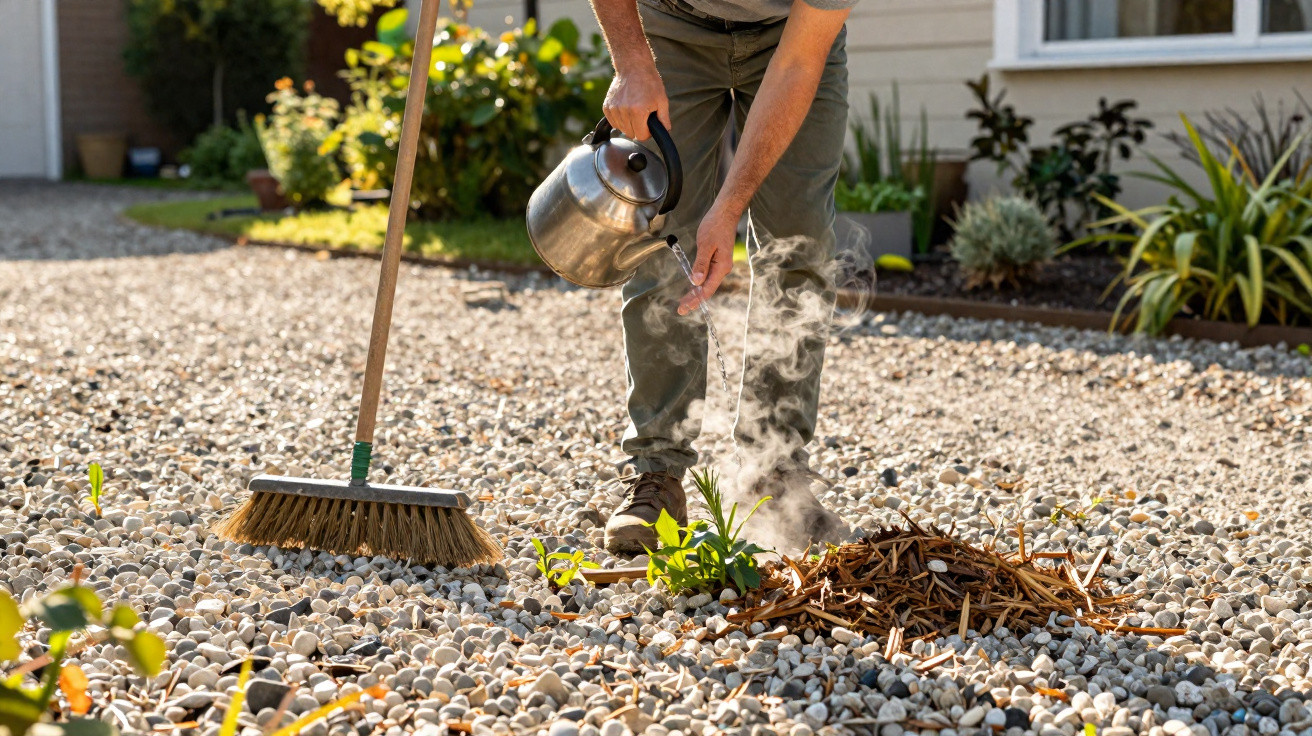
Anyone hoping to keep a driveway clean or a gravel path tidy in summer can quickly end up with backache or reaching for harsh chemical weedkillers. Yet smart preparation in spring is enough to prevent the worst weed growth – even in areas with strict water restrictions and bone-dry soil.
Why gravel paths become overgrown so quickly
At first glance, a gravel driveway seems ideal: modern, neat and easy to maintain. In reality, it often proves to be the opposite. The reason lies in the layer between and beneath the stones.
Over time, dust, leaves and dead plant matter collect there. What began as a clean surface develops a thin yet surprisingly fertile layer in which seeds can take hold. Wind, birds and even car tyres continually bring fresh seeds onto the driveway.
If the gravel layer is too shallow, or if it consists of very rounded pebbles, plenty of light also reaches the ground beneath. That is exactly what unwanted weeds need to get started. Species such as chickweed, purslane, dandelion and couch grass thrive in this loose surface.
“A gravel driveway does not automatically stop weeds. Only the right construction and maintenance make it genuinely low-maintenance.”
Summer weather then accelerates growth: alternating heat and brief thunderstorms, combined with the warmth stored by the stones, create ideal conditions for many wild plants. Without action, a pale path can soon become a strip of green.
Plant roots retain moisture in the soil, compact the surface and, in extreme cases, turn individual tyre tracks into slippery muddy stretches. At the same time, the temptation to use chemical products increases – with consequences for groundwater, soil life and insects.
Three natural strategies to prevent the problem
The key is to prepare the driveway so unwanted plants never get comfortable in the first place. Put in place before summer, three simple measures can make an enormous difference:
- build the gravel layer properly and use mineral mulch
- establish brushing as a regular maintenance task
- use boiling water selectively on persistent clumps
1. Mineral mulch as an invisible protective barrier
Every renovation should begin with a thorough clean start: remove existing plants and their roots as completely as possible before tackling the surface itself. Cutting corners at this stage simply creates twice the work later.
The real trick comes next – a well-planned base layer. A water-permeable but light-blocking membrane, often sold as geotextile or weed-suppressant fabric, forms the middle layer. It allows rainwater to drain into the ground while preventing light from reaching seeds in the soil below.
A layer of crushed gravel is then added on top. A particle size of around 6 to 14 millimetres works well. More important than the exact size is sufficient depth: five to seven centimetres is a sound guideline. Too little gravel immediately allows more light through, giving every seed a chance to germinate.
Carefully compacting the base and installing defined edging prevents gravel from spreading sideways or grass roots from creeping in from the lawn. A quick monthly inspection is worthwhile: remove leaves and organic debris with a rake or leaf blower before they can form a thin humus layer.
“The less organic material there is between the stones, the less growing medium the surface provides – and the less backache it causes.”
2. Make a brush your new favourite tool
Rather than pulling weeds laboriously while kneeling, much of the work can now be done standing up. Special joint-cleaning or all-purpose brushes with wire bristles or very stiff plastic bristles dislodge young plants and moss before they become firmly established.
Long-handled models, similar to brooms, are ideal. The technique is straightforward: work in circular movements across the affected areas while applying light pressure. Anyone making use of cool mornings, when dew leaves a little moisture behind, will soon notice how easily fresh shoots come away.
A brief session every two weeks is generally enough. The important thing is to sweep up and dispose of the loosened plant material straight away, or add it to the compost. If it is left in place, it can turn back into new growing material within days.
- Schedule brushing: every 10 to 14 days
- work in the morning or evening rather than in the midday heat
- wear sturdy shoes – gravel can slip easily
- remove loosened debris immediately rather than leaving it behind
3. Boiling water for the toughest cases
Some plants remain stubborn even after repeated brushing. A simple household remedy can help without using chemicals: boiling water.
Using a watering can, an old kettle or a saucepan with a pouring lip, direct the water straight at the base of the plant. Within seconds, the heat destroys the cellular structure of leaves and young shoots. This approach is particularly effective for annual species with fine roots.
Robust spreading plants and deep-rooted weeds such as couch grass or plantain often need a second treatment a few days later. Important: do not work in windy conditions or directly beside sensitive beds or lawn areas, otherwise the heat shock will affect the wrong plants too.
“Boiling water does not replace good preparation, but it is the perfect partner for membrane, gravel and a brush.”
How the three methods work together as a system
These measures are most effective when used as a coordinated routine rather than in isolation. Spring is the time for the practical work: remove weeds, inspect the base, add membrane where needed, and lay or top up an even gravel layer.
After that, only light ongoing care is needed. Do a short brushing round every two weeks, remove leaves and deposits thoroughly once a month, and apply boiling water to particularly resistant clumps when required – in most cases, that is all it takes.
Those living in areas with strict water restrictions benefit twice over: no extra watering is needed, no chemical products are required, and the driveway still remains largely clean. Water use is limited to what is already available in the household – many gardeners use the hot water left after cooking pasta or potatoes.
Practical advice and common mistakes with gravel driveways
One common misconception is that more gravel is always better. An excessively deep gravel layer allows tyres and shoes to sink further in, making walking and snow clearance more difficult. The five to seven centimetres mentioned above offer a good balance between protection and day-to-day practicality.
Anyone building a new driveway or carrying out a major renovation should also consider rainwater drainage. A slope of a few per cent is enough to prevent water collecting in dips. Standing water not only encourages algae and moss but also softens the base – ideal conditions for fresh seedlings.
Another classic mistake is neglecting the edges. Roots are especially likely to push sideways into the gravel from lawns or beds. Crisp boundaries, such as stone kerbs or metal edging, significantly slow this spread.
How other garden measures can strengthen the effect
Gravel areas can help reduce overall water use in the garden. By combining a driveway thoughtfully with drought-tolerant planted sections, it is possible to improve the microclimate while still lowering consumption. Shallow-rooted perennials along the edges take up nutrients from the soil before they reach the gravel.
In very sunny locations, it is worth considering heat-resistant stone. Dark chippings retain more warmth, while pale gravel reflects more light and does not heat up as much. This affects not only plant growth but also how the surface feels when walking across it barefoot or in thin shoes.
Where the area is large, certain sections can be deliberately left wilder – for example, a strip beside the road – while the actual driving area is maintained more strictly. This gives insects and wild plants a place while the functional space remains tidy. It also eases maintenance pressure: not every plant growing in gravel is automatically an enemy.
Over time, this creates a resilient system: the driveway remains usable and looks cared for, the water authority does not require additional consumption, and everyday garden maintenance becomes noticeably more relaxed – all without kneeling marathons or a bottle of poison in the shed.
Comments
No comments yet. Be the first to comment!
Leave a Comment