
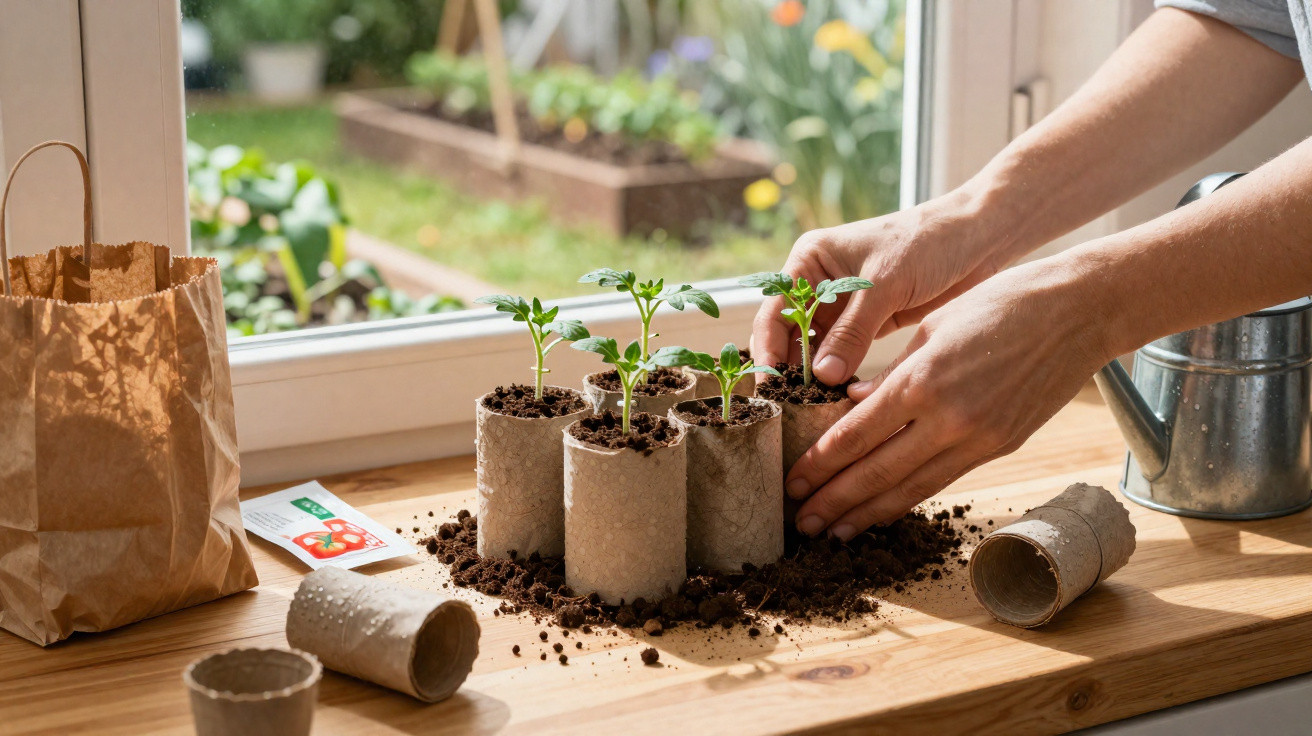
Empty toilet rolls routinely go straight into the bin in many homes. One online gardener, however, sees them not as waste but as ideal miniature pots for young plants. His straightforward idea is currently spreading on TikTok, prompting many people to view bathroom waste in an entirely new way.
From toilet roll to tomato patch
The setting is the bathroom rather than the garden: this is where the gardener collects used cardboard tubes in a box. Items that most people would throw away without thinking later end up on his windowsill, providing the starting point for the next tomato or courgette crop.
The process is remarkably easy. In a short TikTok video, he places a larger cardboard box on the table, cuts a rectangular window into one long side and adds a smaller opening. This small hole is later used for watering, so the whole box does not need to be moved.
He then lines up several clean toilet rolls closely together inside the box. Each tube is filled with loose seed compost and given a few seeds: tomatoes, courgettes or herbs such as basil and parsley. Within minutes, a complete mini nursery is ready.
What appears to be leftover rubbish becomes a neat little seedling station – practical, free and fully compostable.
The box is placed by a bright window or on the balcony. The rolls remain upright there until the first shoots appear. Once the young plants are strong enough, the gardener plants them in the soil together with the entire roll. The cardboard gradually breaks down underground, while the roots simply grow through it. This spares the plants the shock of transplanting and avoids the need for lots of plastic containers.
Why the method is proving so popular
Users are full of praise in the comments below the video. Many say they want to try the idea themselves next spring. For plenty of amateur gardeners, the approach tackles several issues at once: less waste, lower costs and the rewarding experience of harvesting their first home-grown tomato.
There is also a benefit that is often overlooked: people who garden regularly often feel more balanced. Studies show that people who work in their beds almost every day tend to feel better and experience less stress than those who never garden. The small ritual of filling the rolls with seeds and watching them germinate can feel almost meditative.
Step by step: turning toilet rolls into sturdy plant pots
Anyone wishing to recreate this trick does not need specialist equipment. Just a few simple steps are enough.
Materials that most people already have at home
- Empty toilet rolls, preferably unperfumed and with very little printing
- A cardboard box, such as an old delivery box
- Sharp scissors or a craft knife
- Seed compost or fine-textured potting compost
- Seeds of your choice, such as tomatoes, peppers, lettuce or herbs
- Water for gentle watering
Preparing and strengthening the rolls
To make manageable plant pots, cut the rolls in half. This creates small cylinders around six to eight centimetres high. That gives roots some room while keeping the pots compact enough for a windowsill.
For extra stability, make four short cuts at one end of each roll and fold the resulting flaps inwards until they form a base. This helps the rolls stand more securely and makes them less likely to lose their shape when watered.
Next, place the prepared rolls close together in a larger cardboard box. A broad cut-out can be made in one long side of the box, allowing light to enter from the side and making the seedlings easy to observe. A smaller opening is suitable for watering directly into the box, enabling the rolls to absorb moisture from below.
Sowing correctly: keeping young plants happy
The next step is to fill every roll with seed compost. This compost is very fine, low in nutrients and free-draining, allowing seeds to germinate evenly without the young roots being “burnt”.
Method:
- Fill the rolls with compost to just below the rim.
- Press the compost down lightly so that no large air pockets remain.
- Place one or two seeds in each roll, depending on the plant.
- Cover with a thin layer of compost; one to two millimetres is usually enough.
- Moisten using a spray bottle or a gentle stream of water.
Place the box somewhere bright but out of direct midday sun. The compost should stay lightly moist at all times, but never soaking wet. The cardboard walls also indicate the moisture level, becoming slightly darker when they absorb water.
From windowsill to bed: planting out successfully
Once the seedlings have produced two to three true leaves and look sturdy, it is time to move them. The major benefit of the rolls is that the plant does not need to be pulled from a pot. Simply lift the entire roll from the box and put it straight into a garden bed or container.
The roll should be almost completely buried in the soil, although the upper edge may remain slightly visible. Rain and soil organisms will break the cardboard down over time. Meanwhile, the roots can grow through it without difficulty and make their own way.
The young plant continues growing without transplant shock because its root ball remains undisturbed – a crucial point for sensitive crops such as tomatoes.
Why this method delivers several benefits
| Benefit | What it means |
|---|---|
| Cost saving | No bought plastic pots are needed, as the rolls are available anyway. |
| Less waste | Cardboard is composted in the garden instead of ending up in general waste. |
| Gentler on plants | There is no transplant shock because the root ball stays in its “pot”. |
| Space-saving | Many seedlings can fit closely together in a single box. |
| Relaxing ritual | Regular care and watching plants grow can have a calming effect. |
What to consider when using toilet rolls
As simple as the idea is, there are a few minor pitfalls. If the rolls become too wet, they may soften more quickly and topple over. A sturdy box and fairly careful watering are therefore helpful.
Rolls without heavy coloured printing or fragrances are a better choice, so as few unwanted substances as possible enter the soil. Standard rolls found in most homes are generally suitable for this purpose.
It is also sensible not to raise every type of plant in cardboard rolls. Vigorous varieties with strong roots, such as squash, may initially do well in them but relatively quickly need larger containers or space directly in the garden bed.
More ideas for relaxed, resource-conscious gardening
The toilet roll method fits perfectly into a lifestyle in which many people want to avoid plastic and reuse resources several times. Similar approaches work with cardboard tubes from kitchen roll, old egg boxes or uncoated paper cups.
This type of gardening is particularly accessible for beginners: there is no need to invest immediately in expensive equipment, early results appear quickly, and simple materials can be used to test which plants perform well on a balcony or in a small garden bed.
Anyone exploring the subject more deeply will soon encounter terms such as “seed compost”, “pricking out” and “direct sowing”. Seed compost is lightly fertilised, very loose compost in which seeds germinate well. Pricking out means carefully separating crowded seedlings to give them more room. With the toilet roll method, this separation is often unnecessary because only one or two seeds are placed in each roll from the outset.
Above all, the viral trick shows that gardening need not be expensive or complicated. With a little creativity, the bathroom becomes a quiet supply point for the next summer of vegetables – without buying new plastic and with a noticeable boost in satisfaction.
Comments
No comments yet. Be the first to comment!
Leave a Comment