
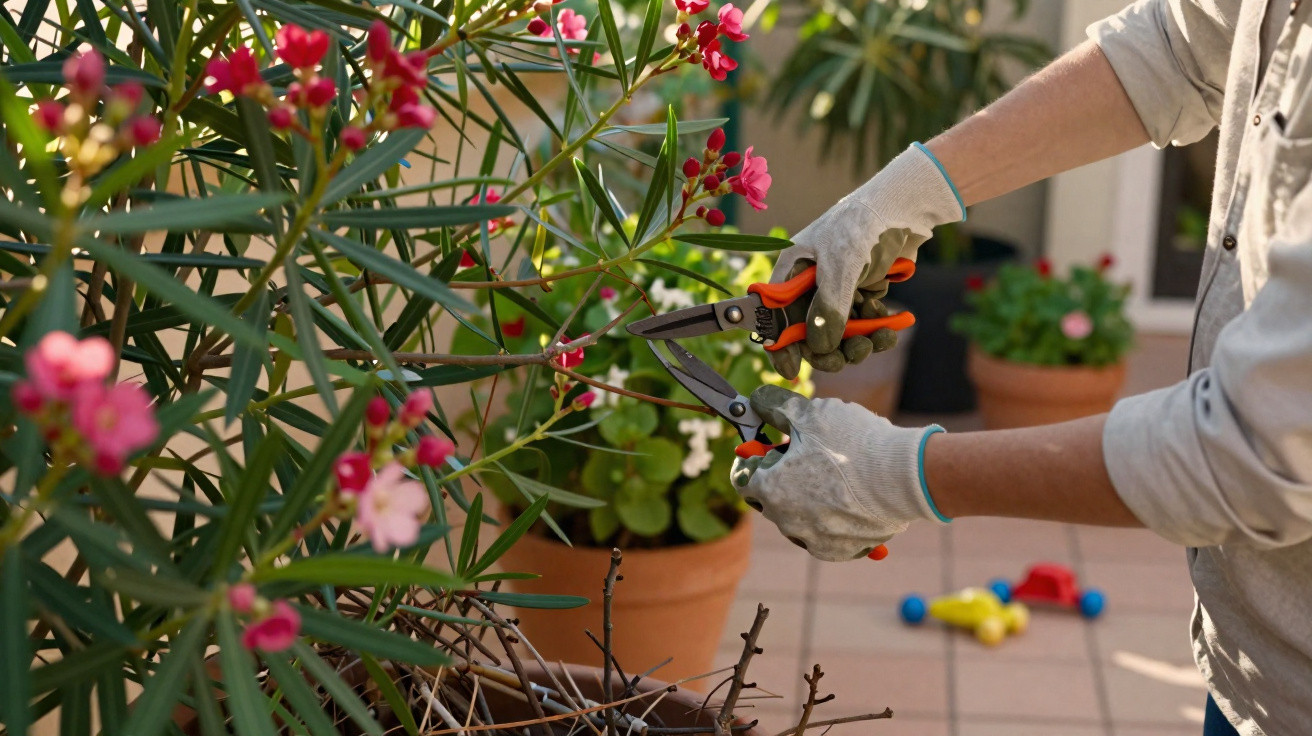
The evergreen container favourite, oleander, is considered undemanding: it loves warmth and sunshine, and grows remarkably reliably even with limited care. This is precisely why many amateur gardeners leave it untouched for years, then wonder why its display of flowers begins to fade. Spring pruning quietly, yet decisively, determines how abundantly the shrub performs in summer.
Why spring pruning determines summer flowering
Oleander produces flowers on the season’s young growth. Its flower buds are mainly found at shoot tips and are often already formed from late summer in the previous year. Cutting it back too hard in spring therefore removes a large proportion of the potential flowers.
“The ideal cut encourages strong new shoots without radically removing the existing flower buds.”
The aim is to strike a balance: retain sufficient older wood that already carries buds while encouraging fresh, well-lit growth. For spring, this results in a straightforward rule:
- trim back lightly rather than cutting back severely
- remove dead and diseased wood completely
- ensure air and light can reach the centre of the shrub
Following this approach will generally produce a dense, healthy shrub that continues to send out new flowers from June through to September.
The right time: when pruning benefits the shrub
The best timing depends heavily on the region and position. Oleanders are sensitive to frost, and temperatures below roughly minus five degrees Celsius can damage them. Pruning during a frosty spell puts the plant under double stress and may cause shoots to die back from frost.
Mild regions and sheltered positions
Those gardening on a warmer coast or in climatically favourable areas can begin earlier:
- Period: roughly mid-March to April
- Condition: no severe night frosts forecast
- Position: in borders, sheltered beside warm house walls, or on south-facing terraces
In these locations, the shrub is often already beginning to grow, so it responds well to moderate pruning and quickly produces fresh shoots.
Cooler areas and container-grown plants
In regions with harsher winters, the plant remains dormant for longer:
- Period: usually late March to April, depending on the weather
- Rule: it is better to wait an extra week than to prune too early
If the oleander is in a container and has spent winter in a cellar, garage or conservatory, prune it immediately after bringing it out of winter storage:
- place the plant outdoors in a bright, sheltered spot
- allow it to acclimatise for one or two days
- only then begin pruning
It is best to postpone drastic rejuvenation pruning until autumn, or until years when abundant flowering is not the highest priority.
Step by step: how to prune oleander in spring
Oleander may look harmless, but it is highly poisonous, including its milky sap. Even skin contact can be unpleasant, while swallowing any part of the plant is extremely dangerous, particularly for children and pets.
Preparation: safety comes first
- put on sturdy gardening gloves
- wear long-sleeved clothing
- clean and sharpen secateurs or loppers
- disinfect tools in advance, for example with alcohol or heavily diluted bleach
Clean blades reduce the risk of infection entering through the plant’s pruning wounds.
Basic pruning: remove dead and diseased wood
The first stage should always focus on plant health:
- cut back all blackened, frost-damaged shoots until pale, healthy wood is visible again
- remove completely dried-out branches at their base
- cut out clearly diseased or spotted areas generously
- thin out shoots growing inwards or crossing heavily
“An open shrub filled with light dries more quickly after rain – and this significantly slows fungal diseases.”
Finishing cut: shorten shoots only moderately
Once the shrub has been tidied, proceed with careful shaping.
Key points:
- shorten the plant by only around one third of each shoot’s length
- make cuts at a slight angle so water can run off
- always cut just above a pair of outward-facing buds
An outward-facing bud ensures that new growth develops away from the centre of the shrub, helping to maintain an attractive, open shape.
What to do with old, bare or frost-damaged plants
After a severe winter, some oleanders can look rather bleak: long bare branches, little greenery, and perhaps signs of life only near the base. A stronger intervention can help in this case.
A possible approach:
- cut old framework shoots back to around 30 to 50 centimetres above ground level
- shorten no more than one or two thirds of the main branches this severely at one time
- rejuvenate the remaining branches the following year so the plant is not left entirely without reserves
The result is likely to be sparse flowering that year, but the shrub will produce vigorous new growth, become denser and establish the basis for significantly more flowers the following summer.
Common mistakes when pruning oleander
| Mistake | Result | Better approach |
|---|---|---|
| Cutting back too hard in spring | Hardly any flowers in summer | Trim only lightly and spread rejuvenation over several years |
| Pruning in frosty weather | Frost dieback and a weakened plant | Choose a mild, frost-free day |
| Blunt or dirty secateurs | Crushed tissue and entry points for fungi | Sharpen and disinfect tools beforehand |
| Not thinning the shrub | A damp, shaded centre and more disease | Regularly remove crossing and inward-growing shoots |
Care after pruning: getting the most from flowering
Pruning is only one part of the process. Immediately afterwards, you can give the plant ideal support for healthy new growth:
- loosen the compost and carefully remove dead roots from container-grown plants
- if necessary, repot into a slightly larger container with fresh container compost
- begin watering gradually and avoid waterlogging
- from April or May, use a specialist flowering plant fertiliser at a moderate dose
A sunny, sheltered site prevents the new shoots from becoming leggy and encourages them to stay strong and compact, creating sturdier flower clusters.
Poisonous, beautiful and popular: what households with children should consider
Every part of the oleander is regarded as highly poisonous. Households with young children or free-roaming pets should weigh up the risk. Anyone wishing to keep the shrub should position it beyond reach, such as on a raised terrace or balcony.
When pruning:
- collect and dispose of cuttings immediately
- never burn or compost plant material where animals can access it
- wash hands thoroughly after finishing, even if gloves were worn
Practical examples of correct pruning
A typical example is a three-year-old oleander in a container, around 1.20 metres tall, with several bare shoots at the bottom and a dense crown. Here, moderate maintenance and shaping pruning is sufficient:
- remove one or two old, completely bare lower branches directly at the base
- shorten the remaining upper shoots by one third
- take out branches in the middle that rub against one another
The outcome is more light inside the shrub, improved air circulation and room for new growth, without reducing the quantity of flowers excessively.
A newly purchased young plant usually needs only minimal correction: prune damaged shoots and obvious misplaced growth only, allowing the plant to direct its energy mainly into growth and bud formation.
Which plants pair well with oleander
For a harmonious balcony or terrace, oleander is often combined with Mediterranean classics. Lavender, sage and thyme, each in their own pots, are suitable choices. They enjoy similar conditions: plenty of sun, free-draining compost and relatively sparing watering.
A combination with lower, continuously flowering summer plants in the foreground, such as calibrachoa or petunias, can also look striking. It remains important that every plant has its own pot, or adequate space within a large container, so that roots and water requirements do not compete.
Anyone who keeps these points in mind and chooses restrained shaping rather than drastic treatment in spring will be rewarded in high summer with an almost lavish display of flowers – no magic required, merely the right timing and a few considered cuts.



Comments
No comments yet. Be the first to comment!
Leave a Comment