
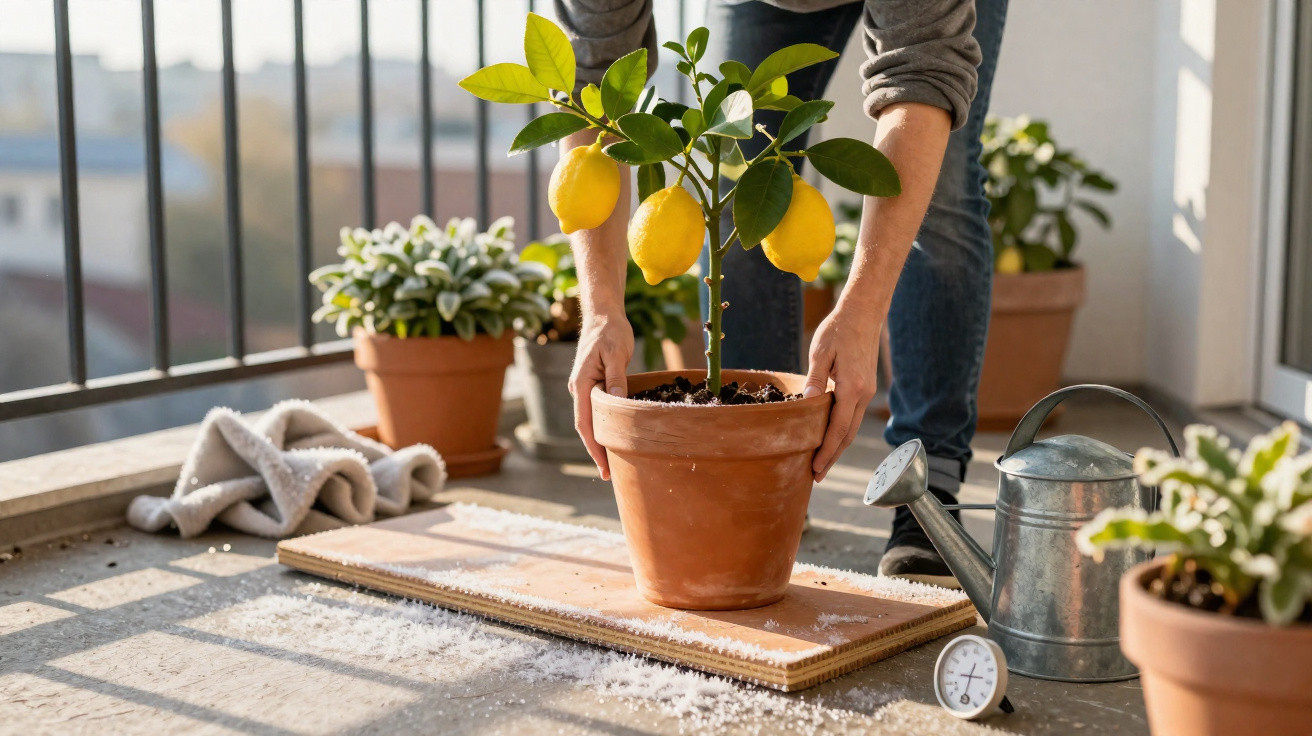
The reason is right beneath the pot.
Anyone who has successfully got their lemon tree in a pot through the winter often feels safe once spring arrives. Days lengthen, the foliage turns deep green again and fresh buds emerge – yet one cold night in March can ruin the plant within days. The hidden threat is not the icy wind, but the ground beneath it: the cold patio, balcony floor or stone steps on which the container stands.
Late frost in March: why a potted lemon tree is particularly vulnerable
Once the traditional winter period has ended, from February onwards, milder weather can easily mislead gardeners. Sunshine warms the balcony during the day, temperatures reach double figures and spring feels close at hand. However, this is often exactly when clear, cold nights with a light frost occur.
A lemon tree in a pot is especially sensitive to these conditions. It usually sits on concrete, tiles or stone, all materials that hold and transmit cold extremely well. The tree canopy may appear fairly protected, particularly if it is covered with horticultural fleece or positioned out of the wind. The root area at the base of the pot, however, receives the cold shock directly.
“For many lemon trees, the real frost damage does not strike from above but comes as a flow of cold through the base of the pot.”
As a result, the delicate root hairs, known as radicels, freeze and can no longer take up water. During the following days, leaves start to wilt or turn black. The tree may still look healthy in the evening, then appear scorched the next morning – a typical pattern where roots have suffered frost damage.
The unobtrusive shield: an insulating board beneath the pot
The most effective response to this concealed danger is remarkably straightforward: place an insulating board directly underneath the planter. It separates the pot from the cold surface and interrupts the so-called thermal bridge effect, whereby the ground draws cold into the container.
Which material is suitable?
Materials that conduct little heat and provide a little cushioning are particularly suitable:
- Polystyrene board – for example, from packaging or leftover insulation
- Thick cork – such as old table mats or insulation boards
- A thick wooden board with an additional thin insulating layer on top
- Rigid foam insulation board from a DIY shop, cut to size
The board should be at least 2 to 5 centimetres thick and extend 1 to 2 centimetres beyond the edge of the pot on every side. This ensures that the whole base of the pot is protected from direct contact with the cold surface.
Important: water must still be able to drain away
One common mistake is placing the insulation board so flat beneath the pot that the drainage hole becomes blocked. This leads to waterlogging and rot, which defeats the purpose entirely. A small adjustment is therefore needed to combine frost protection with proper drainage.
A practical solution at home:
- Cut three or four wine corks lengthways into two halves.
- Space the halves evenly across the insulation board beneath the base of the pot.
- Set the container on top, leaving a thin layer of air between the board and the pot.
The board then acts as a barrier against cold, while the halved corks lift the pot slightly and keep its drainage hole clear. It costs virtually nothing, takes only a few minutes and provides substantial protection against late frost.
“An insulating layer combined with a small air chamber beneath the pot: this pairing stops the surge of cold from the ground very effectively.”
How ground frost silently destroys roots in a pot
Agricultural researchers have pointed out for years that container plants are exposed to cold not only through the air, but above all through the surface below them. Stone, tiles and concrete absorb the cold of the night and release it gradually into the bottom of the pot. Temperatures can fall sharply within the relatively small root zone of a container.
Unlike trees planted in garden soil, a pot does not have a large volume of earth to act as a natural buffer. In a border, cold disperses; inside a container, it is concentrated. The consequences are as follows:
- The root ball cools quickly and unevenly.
- Fine roots freeze and collapse.
- Sap flow is interrupted, while leaf damage appears later.
This is especially common on south-facing balconies. During the day, sunshine heats the stone surface and encourages the tree to put on new growth. Yet on clear nights at minus two or three degrees, that same surface cools dramatically and transfers cold straight into the base of the container. Growth above ground may look vigorous while the roots below are effectively in a “freezer”.
Combined protection until mid-May: keeping a lemon tree safe
The insulating layer below the pot is the foundation of protection and should remain in place from late winter until at least mid-May. In many areas, frost nights can still occur until the period traditionally known as the Ice Saints, even when daytime conditions already feel summery.
Additional layers of protection when frost is forecast
If a colder night is predicted, protection can be increased quickly without having to wrap the entire tree completely:
- Place a fleece cover over the crown and branches, ideally supported on canes so that the material does not rest directly on the leaves.
- Move the pot against a sheltered, south-facing house wall, where warmth stored during the day can soften a light frost.
- Raise the container further, for instance on wooden blocks or a plant trolley, when the ground is exceptionally cold.
- Add a “second skin” around the pot: use a layer of bubble wrap for insulation, concealed with hessian, coconut-fibre mats or fabric offcuts.
Correct watering remains crucial. Before a frosty night, the root ball should be slightly moist but never soaking wet. A completely saturated root ball loses heat faster because water conducts cold more effectively than loose compost.
How much cold can a lemon tree in a pot tolerate?
Healthy lemon trees can briefly withstand temperatures of around minus six to minus seven degrees, provided that their overall protection is adequate. A light fleece cover offers roughly three degrees of additional security. Combined with a well-insulated base, this creates surprisingly stable conditions even when the thermometer briefly falls below zero.
Without this protective barrier underneath, however, all upper protection has only limited value. Cold then “creeps” upwards from the ground into the roots, while the crown appears to be safely wrapped. This is usually the reason a supposedly well-protected potted lemon tree suddenly dies in April.
Practical tips for balconies, patios and gardens
Slightly adapted solutions work well for different locations:
| Location | Recommended measure |
|---|---|
| Tiled balcony | Thick insulation board plus cork supports, with additional side protection from wind |
| Concrete patio | Insulation board plus a wooden pallet or plant trolley as a second level |
| Stone steps or wall | A small wooden slatted platform, then the insulation board, followed by the pot |
| Covered entrance | Insulation board, pot positioned close to the house wall, plus extra fleece in frost |
Anyone with several containers of Mediterranean plants – such as olive, mandarin or kumquat – can apply the same principle to all of them. It saves effort and prevents individual pots from quietly “freezing from below”.
Why the effort is genuinely worthwhile
For many amateur gardeners, a lemon tree in a pot represents summer, holidays and a small piece of the Mediterranean on the balcony. Frost damage just before the warm season is therefore particularly frustrating. A simple insulation board, a few cut corks and some attention to weather forecasts can prevent precisely that situation.
Those who protect the root zone as consistently as the crown will, in many years, be rewarded with sturdier and more vigorous plants. Flowers and fruit set remain more dependable, the tree recovers more rapidly after winter and it becomes less sensitive to fluctuating temperatures.
The essential point is this: it is not only the visible part of the plant that needs protection, but above all the inconspicuous area beneath the base of the pot. Taking the needs of a lemon tree seriously at this point removes the most dangerous stress factor during the change of seasons – and improves the chance of a generous lemon harvest right outside the door.


Comments
No comments yet. Be the first to comment!
Leave a Comment