
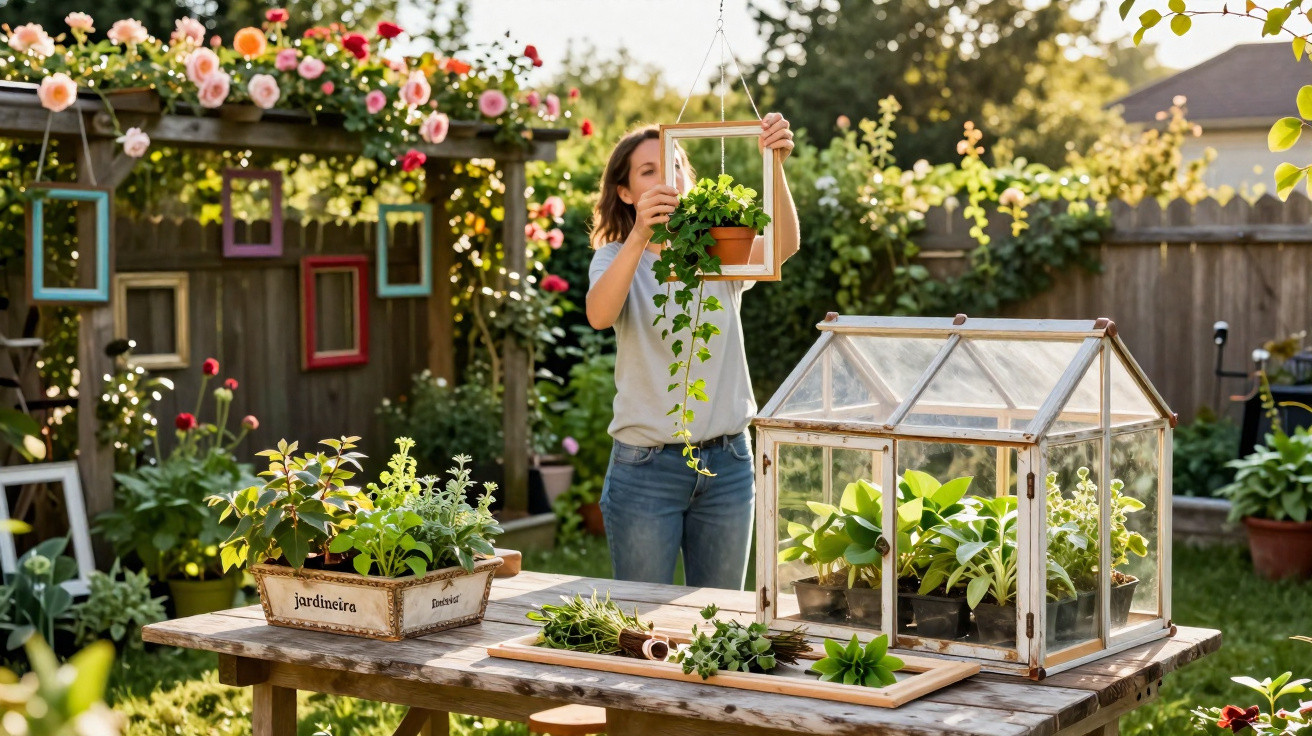
If you move home regularly, redecorate, or simply enjoy taking photographs, you will probably know the issue: a pile of old picture frames sits in a cupboard, kept for sentimental reasons but serving no real purpose. At the same time, gardens, patios and balconies often lack precisely the surface needed to display plants stylishly without taking up much space. Simple ideas from Great Britain now show how these forgotten frames can become remarkably versatile gardening aids.
Why picture frames are suddenly so valuable in the garden
Wooden frames may look delicate at first glance, yet many are sturdier than expected. They are usually made from solid wood or robust MDF, often still contain their glass, and can be screwed or glued together with very little effort. Those qualities make them useful building blocks for small garden projects.
Dust collectors can become sturdy mini shelves, planters, greenhouses or drying racks – and all with hardly any specialist tools.
The trend has emerged particularly from the typical terraced-house gardens and compact urban balconies of Great Britain. Every centimetre matters there, while upcycling cuts both costs and waste. Many of the ideas transfer directly to other settings too, from a balcony in a period Berlin building to a suburban garden in North Rhine-Westphalia.
Eight ways to turn old frames into plant furniture
1. A hanging shelf for one favourite plant
Small hanging shelves, which resemble a floating picture, offer the quickest way to get started. All you need is a frame with its glass still in place.
- Clean the frame thoroughly and leave the glass in position.
- Glue in a thin back panel made from plywood or sturdy card.
- Glue or screw two strong lengths of cord or sisal to the upper corners.
- Hang it up and place a lightweight plant pot in the centre of the glass.
This works especially well for small succulents, air plants or miniature cacti. The glass will support only light pots, but it creates a little display window for the plant.
2. Picture frames as a planter box
Four frames of the same size can make a surprisingly sturdy planter box. It works well for herbs, low-growing flowers or spring bulbs.
Here is the method in brief:
- Arrange four glass-free frames in a rectangle.
- Glue the vertical edges, reinforcing the inside with small timber blocks or brackets.
- Cut a wooden base panel to size and screw it on from underneath.
- If desired, paint the frames and base in colour.
- Line the box with sheeting, then add a drainage layer, compost and plants.
Different frame profiles quickly give these boxes a designer appearance, particularly when they are painted uniformly in black, white or a rich green.
3. A living succulent picture
A “plant picture” suits anyone with limited floor space but spare walls or railings. Make it from a deep frame, or from a frame fitted with a raised box.
The basic idea is that succulents grow in very little compost and can later hang vertically. They need support from a close-fitting mesh or grid to do this.
A typical construction is as follows:
- Close the back with a sturdy panel.
- Staple a layer of weed-control fabric or landscape fabric inside.
- Fill it with compost, then cover the front with wire mesh or plastic netting.
- Push young succulents through the mesh into the compost.
- Allow them to root while lying flat for several weeks, then hang the frame upright.
The result resembles an abstract artwork, yet changes naturally over time as the succulents grow, fill gaps and form patterns.
Small greenhouses and plant stations made from glazed frames
4. A mini greenhouse from six frames
Anyone with several glazed frames left over can build a small greenhouse that fits on a table or directly in a flower bed. It is ideal for young plants that still struggle with wind and cold.
Ideally, use six similar frames: four for the sides and two for the roof or lid. Join them into a box with small hinges or metal brackets. Gaps can be filled with wood filler, then exterior paint will protect the structure from rain.
A mini greenhouse like this provides a few extra degrees of warmth, softens the wind and keeps slugs away – a real benefit, especially in spring.
Inside, there is room for a small pot or even a long planter. It is particularly useful for tomatoes, chillies, peppers or delicate summer flowers that cannot go straight outdoors.
5. A stylish propagation station in a frame
Cuttings in glasses of water have become something of a décor trend. A picture frame can turn them into a permanent feature on the wall.
Remove the glass, glue in a back panel and drill two holes. Feed wire or string through these holes to hold a small glass or bottle in front of the frame opening. The rest is decorative: paint the frame or label it with short notes giving the plant name.
The effect is that the cuttings float in the frame like an art object – and remain in view rather than being forgotten in a glass somewhere on the windowsill.
6. A herb-drying rack from two wooden frames
Anyone who enjoys harvesting herbs knows the problem: where do the bunches go without making half the kitchen look like a washing line? Two sturdy wooden frames are enough for a space-saving hanging rack.
| Material | Use |
|---|---|
| 2 wooden frames (for example, 20×25 cm) | Basic structure for the drying trays |
| Fly screen or metal mesh | Open supporting surface so air can circulate |
| Staple gun or small nails | Securing the mesh to the frame |
| String or ribbon | Joining the two levels and hanging the rack |
Stretch mesh across the reverse side of both frames. Use four equally long strings to support the upper frame and four shorter ones to suspend the lower frame from it. The rack hangs freely, air reaches it from every side, and herbs dry evenly with less risk of mould.
Picture frames as colourful garden decoration
7. A rustic framed garden sign
For more personality in the garden, use an old frame as the basis for a sign. Rather than standard wording, it can feature humorous messages, family names or informative notes.
Create a distinctive one-off piece as follows:
- Paint the frame with chalk paint, then sand it lightly for a vintage finish.
- Fit a wooden board inside that can be written on with chalk or marker pen.
- Decorate it with artificial flowers, ribbons or small wooden figures.
- Hang it on a fence, shed or beside the front door.
Families with children in particular can enjoy this idea: the wording can change with the season or the mood, from a notice about ripe strawberries to a warning about thorny roses.
8. A colourful frame installation on a fence or pergola
Several unused frames can together form a light-hearted outdoor artwork. Simply remove the glass, paint the frames in bold colours, and attach them to a fence, trellis or pergola with wire or cable ties.
Fairy lights, small pots of trailing plants or dried flowers can be arranged between them. This creates a kind of outdoor “gallery wall” that brings life to otherwise drab corners.
An empty frame cannot make an ugly fence disappear – but it can cleverly draw the eye towards something more attractive.
What to consider when working with old picture frames
Old picture frames often have loose nails, fragile corners or sharp-edged glass. A quick safety check is therefore worthwhile before you begin. Glass should always be fitted securely and, if the project will be outdoors, sealed around the edges with silicone where necessary.
Weatherproof paint is particularly sensible for outdoor projects. Untreated timber quickly absorbs moisture, swells and cracks. An inexpensive protective coating from a DIY shop can significantly extend its lifespan and make the finished item more resilient to rain and strong sunshine.
Practical tips for small balconies and rented homes
Not everyone has their own garden. However, many of the ideas shown can easily be adapted for balconies or even indoor spaces. Hanging shelves, propagation stations and plant pictures need only hooks or secure wall plugs in a wall or railing.
If you rent your home, flexible options can often replace drilling: S-hooks on existing railings, frame planters hung over a balustrade, or free-standing trellises from which frames can simply be suspended. This leaves the building fabric untouched, and everything can be taken with you when you move out.
Why this trend suits sustainable gardening
Garden upcycling brings several benefits together. It saves money because costly decorations and specialist shelves from the garden centre are no longer needed. It cuts waste by keeping old frames out of bulky-waste collections. It also creates individual pieces that no neighbour can buy exactly the same way.
Many hobby gardeners say that projects like these make it easier to move on to larger DIY tasks. Anyone who has built a mini greenhouse from frames is more likely to attempt a raised bed, a rain shelter for tomatoes or a homemade potting table. That is precisely the appeal: a dusty keepsake becomes the beginning of a creative garden that feels a little more personal with every season.
Comments
No comments yet. Be the first to comment!
Leave a Comment