
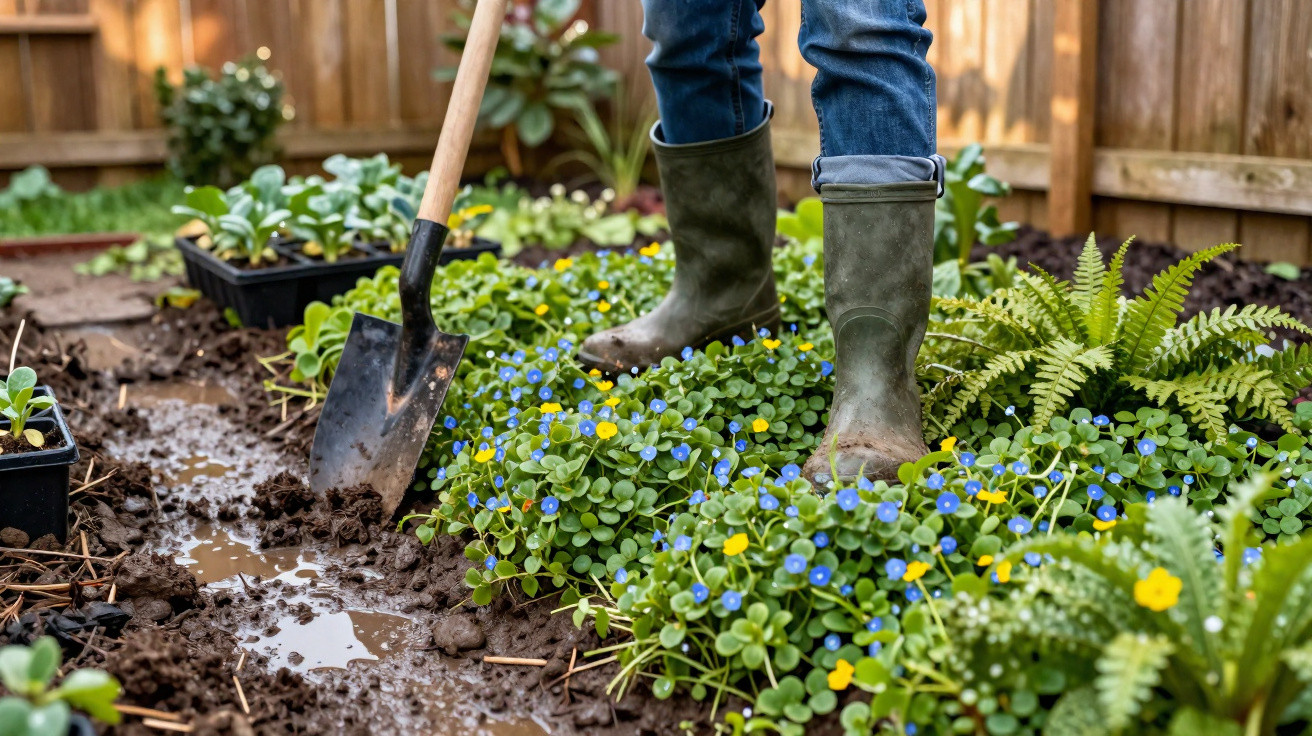
Many homeowners will recognise the problem: the soil is dense and clay-heavy, water sits on the surface for days, shoes become stuck, and children and pets bring mud indoors. Terms such as “drainage”, “soakaway” and “gravel trench” soon come up, along with bills running into four figures. Yet a wet, heavy garden soil can often be stabilised with tough ground cover plants, making it usable again without constantly needing to wear wellies.
Why ground cover plants can transform muddy gardens
Mud is most likely to develop where bare soil meets a compacted subsoil. Clay-rich earth clumps together and, when wet, can form an almost armour-like crust. Rainwater then runs across the surface, pools in low spots, carries away fine particles and makes the issue worse each time.
Roots act as a natural tool in these conditions. They open up the soil, create fine passages for air and water, while also holding the ground in place. This is precisely where moisture-loving ground cover plants become useful.
Ground cover plants that thrive in wet conditions turn exposed muddy holes into dense living carpets – stabilising the ground, absorbing some of the water and preventing further erosion.
Their foliage intercepts raindrops, softens their impact, spreads moisture more evenly and stops exposed earth from being turned into splashing mud. The result is fewer deep puddles, fewer slippery patches and ground that is generally more load-bearing.
The 11 best ground cover plants for wet, heavy soils
The focus here is on plants that do more than simply tolerate waterlogged ground: they actively enjoy it. Many spread via rhizomes or runners, establish themselves naturally and need very little care once rooted in.
1. Ostrich fern – a giant for damp, shady corners
The ostrich fern (Onoclea struthiopteris) thrives in cool, moist locations in partial shade or full shade. Reaching 60 to 90 centimetres in height, it gradually forms dense clumps that stabilise slopes and hollows remarkably well.
- ideal beside a shaded stream or along damp fence lines
- quickly adds structure to monotonous wet corners of the garden
- it dies back in autumn, but its roots remain in the ground to hold the soil
2. Palm sedge – a hardy lawn replacement for sun and wet ground
Palm sedge (Carex muskingumensis) copes surprisingly well with waterlogged, clay-rich soil. It has a grass-like appearance but is considerably more tolerant of wet conditions. In sunny, boggy areas, it can replace a conventional lawn, which would usually develop only rotten patches there.
3. Creeping Jenny – the trailing gap-filler
Lysimachia nummularia, commonly known as creeping Jenny, stays close to the ground and creates a continuous carpet. It loves wet soil, settles between stepping stones and works well around the edges of paths or patios where water collects.
It tolerates light foot traffic well, but not regular trampling. Anyone wishing to keep it contained should define bed edges clearly, as creeping Jenny will exploit every available gap.
4. Marsh marigold – colourful support beside water
Marsh marigold (Caltha palustris) is at home in truly wet places, such as ditches, pond margins or hollows where water remains after rain. It anchors damp banks, while its bright yellow flowers bring spring colour to otherwise grey, muddy areas.
Important: the plant is considered toxic when raw and does not belong on the plate, however picturesque it may look in a cottage-style garden.
5. American sweet flag – when the soil is almost open water
American sweet flag (Acorus americanus) can even tolerate several centimetres of water above the soil surface. This makes it suitable for ditches, infiltration areas and deep hollows where rainwater gathers. Its roots run through the muddy ground and stabilise it where other species would have long since failed.
6. Canadian wild ginger – a fragrant ground cover plant
Asarum canadense, often called Canadian wild ginger, forms low, dense carpets in shade. Its heart-shaped leaves cover the soil and prevent heavy rainfall from washing it away.
Its roots smell of ginger, but they are unsuitable for eating because they contain concerning compounds. This species clearly belongs in the “look, don’t eat” category.
7. Woodland phlox – flowering stabiliser beneath trees
Phlox divaricata, or woodland phlox, grows happily in partially shaded areas along damp woody borders. It combines two benefits: a stable, low root mat and delicate, fragrant spring flowers. It is ideal for turning slippery, bare patches beneath lightly shaded trees into flowering ground cover.
8. Foamflower – a delicate carpet for humus-rich damp soil
Tiarella cordifolia, known as foamflower, prefers moist, humus-rich soil in shade. It spreads by runners, forms dense cushions and flowers in spring with pale, foam-like flower spikes. Combined with ferns and wild ginger, it creates stable and visually varied underplanting.
9. Lesser periwinkle – a vigorous classic
Vinca minor, the lesser periwinkle, has been regarded as a solution for difficult slopes for decades. It tolerates dampness, shades the soil throughout the year and limits erosion on banks and patio edges.
Lesser periwinkle is considered invasive in some regions – anyone living close to woodland should control its growth and remove stray plants promptly.
10. Isotoma fluviatilis – a walkable carpet with drawbacks
Isotoma fluviatilis is often sold as “Blue Star Creeper” and forms a very low, fine carpet that can also withstand occasional foot traffic. In permanently damp soil, it can replace a lawn, for example on continually wet north-facing sides or around water butts.
Bear in mind that this plant spreads quickly and many of its parts are considered toxic. Families with young children or free-roaming pets should carefully consider where to use it.
11. Bugle – a blue-flowering problem solver
Ajuga reptans, commonly called bugle, is among the toughest ground cover plants. It handles damp meadow areas and partially shaded positions well, fills gaps quickly and produces blue-violet flowers in spring. It often appears in lawns as a “companion plant” – but in problem areas, it can be allowed to stay and take over.
How to plant ground cover plants correctly in wet clay
Simply placing young plants into a clay puddle is unlikely to bring much success. A few basic measures greatly improve the chances of establishing a living ground-cover carpet.
- never stand or work on completely saturated soil, as this compacts it further
- loosen the upper layer gently and break apart large clods
- incorporate mature compost to improve structure and soil life
- add a handful of coarse sand or fine grit to each planting hole
- plant in groups and keep spacing close so the carpets knit together quickly
- apply a light mulch between plants, such as leaves or bark compost
A little sand beneath the root ball will not provide “perfect” drainage, but it reduces the most critical problem: prolonged waterlogging directly around the roots.
Where ground cover plants are especially worthwhile in the garden
Not every corner needs planting. Targeted use makes most sense where wetness causes the greatest irritation or damage:
- at the base of downpipes and water butts
- in hollows along patio edges
- beside shaded house walls where the ground remains permanently damp
- on slopes that slip after rainfall
- at the edges of paths where water regularly overflows
Combining different species – taller ferns at the back, low carpet-formers along the edge and flowering perennials in between – creates not only stability but also an attractive, lively area.
Risks to consider: toxicity and vigorous growth
Several of the species listed are not entirely harmless. Marsh marigold and Isotoma are considered toxic, Canadian wild ginger contains carcinogenic substances, and lesser periwinkle can spread unchecked. Anyone with children or pets should ask the following questions:
- Do children need regular access to this part of the garden?
- Are there alternative plants without toxic potential?
- Can spreading be restricted with root barriers or regular cutting back?
Particularly along garden boundaries next to woodland or waterways, restraint is advisable with strongly spreading species to prevent them escaping into the wider environment.
What terms such as “wet clay” and “drainage” actually mean
Clay soils consist of extremely fine particles that bind together into a compact, almost impermeable mass when water is added. Air spaces are absent, so rainwater can barely soak in. Technical drainage generally directs water away through pipes and gravel, which can be expensive and may require permission.
Planted areas function differently: roots create pores, earthworms and micro-organisms gradually loosen the structure, and organic material improves water-holding capacity. The effect takes a little longer, but it produces a living, resilient soil that does not turn into a muddy wasteland with every shower.
The sooner homeowners introduce suitable ground cover plants in troublesome areas, the sooner they can create a garden that treats rainy periods not as a disaster but as fuel for strong, dense greenery – and paths that can once again be used without wellies.

Comments
No comments yet. Be the first to comment!
Leave a Comment