
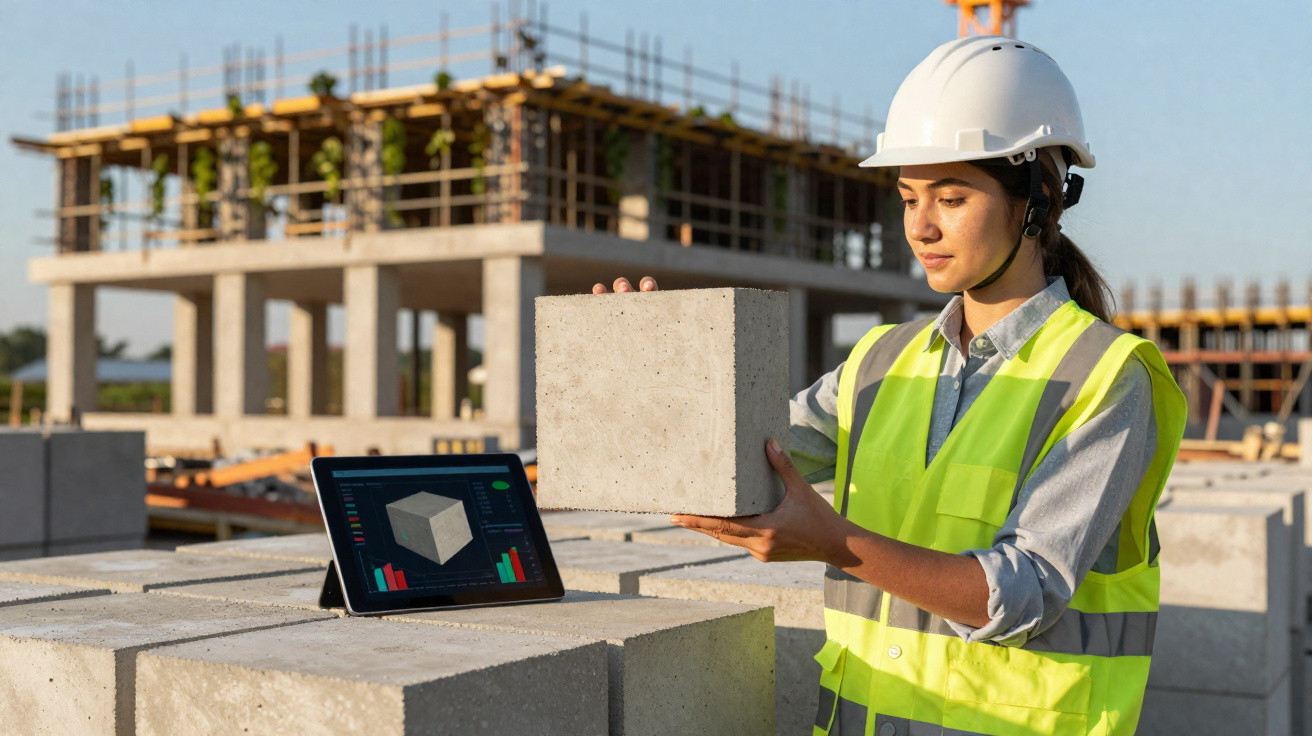
Researchers have shown that an innovative concrete binder can convert captured carbon dioxide into durable minerals without losing the strength needed for structural applications.
The discovery reframes concrete from a substantial emissions source as a material capable of permanently storing carbon within the built environment.
Concrete tested at scale
Load-bearing blocks and beams undergoing trials in Karlsruhe, a city in south-west Germany close to the French border, are demonstrating this carbon-storage capability under genuine structural conditions.
Professor Frank Dehn of the Karlsruhe Institute of Technology (KIT) is studying these components directly to see how the new binder captures carbon while bearing weight and withstanding stress.
Initial findings indicate that the mineral-bound carbon stays stable inside the concrete as it cures and is subjected to progressively greater loads.
These early results suggest the material could be suitable for structural use, while prompting questions over how much conventional cement it can replace without affecting long-term performance.
Cement’s carbon footprint
For most concrete, clinker-the kiln-fired component that enables cement to bind sand and stone together-is responsible for the bulk of its climate impact.
The required high temperatures account for part of this impact, while limestone creates further emissions when kilns release carbon dioxide during Portland cement production.
The decomposition of limestone is one reason cement clinker is linked to about eight percent of global carbon dioxide emissions.
A binder that reduces clinker use while retaining concrete strength addresses the issue at its principal source of pollution.
Supplies are shrinking
For many years, the construction sector reduced cement emissions by using supplementary cementitious materials: added powders that displace some clinker.
Fly ash from coal-fired power stations and blast-furnace slag proved effective because both were already produced by industry in vast quantities.
As coal generation is phased out and steel production evolves, however, these supplies are declining, leaving low-carbon concrete without its established alternatives.
This shortage has shifted what was once a secondary concern to a key challenge, making new mineral feedstocks considerably more appealing.
How carbon is stored
C-SINC, the European project responsible for the new mixture, relies on magnesium silicates-magnesium-rich minerals that react with carbon dioxide.
Through accelerated mineralisation, a process that converts gas into solid minerals, the magnesium-rich particles lock carbon into magnesium carbonate.
Industrial emissions can provide some of that carbon, meaning the concrete both lowers emissions and stores captured gas.
This carbon-binding process lies at the centre of the technology’s potential, while also setting the practical limit on how much clinker can be replaced in the mixture.
Why storage lasts
After carbon has been incorporated into a carbonate mineral, it is much less likely to escape again than gas compressed and stored underground.
“The CO2 isn’t just stored, it’s chemically bound in a mineral. It remains firmly bonded, so it can’t escape over very long periods,” said Dehn.
Earlier research found that processing olivine, a widely occurring magnesium-rich rock, can produce both a silica-rich cement replacement and carbon-containing magnesium carbonate.
Permanence is essential, since a climate solution that released carbon after several decades would achieve far less than the researchers intend.
Computers narrow mixes
Developing workable concrete mixes normally involves lengthy cycles of trial and error, so C-SINC is using algorithms to reduce the number of options.
Machine learning, software that identifies patterns from training data, is one important tool and can identify promising formulations before teams cast test batches.
Simulations can then predict how the binder may perform as concrete cures, develops cracks and supports loads over time.
Computer-based screening cannot replace physical trials, but it may prevent months being spent pursuing weak formulations.
Stress tests matter
Concrete intended for actual buildings must achieve more than simply curing: it needs to support loads, withstand weather and protect steel.
“We’re doing that on a small scale, and in real large-scale structural elements as well,” Dehn said.
Care is particularly important with unfamiliar binders, as slight chemical differences can change cracking behaviour, water movement and the risk of corrosion.
A carbon-storing mix that fails prematurely would not be practical at the scale required by the industry.
Europe backs scaling
Europe has committed nearly four million euros to C-SINC over four years, reflecting confidence that the concept extends beyond clever chemistry.
The consortium brings together universities and a precast concrete manufacturer, combining academic research with industry to advance the material towards practical construction applications.
That partnership offers a quicker route for the research into factories, standards development and full-scale building products.
Pace is crucial because climate-friendly concrete will not cut emissions substantially unless manufacturers can produce it affordably and at volume.
Limits still matter
Even promising magnesia-based cements-binders centred on magnesium compounds-continue to face questions around durability and large-scale deployment.
Certain magnesium formulations are less alkaline, or chemically basic, which means steel reinforcement and weathering must be assessed carefully.
Researchers must also demonstrate that the material can work with current supply chains, regulations and mixing practices without raising costs excessively.
The obstacles of durability, cost and regulation do not invalidate the approach, but they underline why present testing is urgent.
Future of carbon concrete
Concrete will not turn into a carbon sink immediately, but ongoing trials indicate that the industry now has a credible chemical pathway.
Should full-scale testing continue to verify strength and durability, future buildings may store some of the pollution that was previously generated in making them.





Comments
No comments yet. Be the first to comment!
Leave a Comment