
A modest garden visitor can suddenly become a source of amazement in spring: tiny, colourful, bold – and capable of behaviour that seems almost unbelievable.
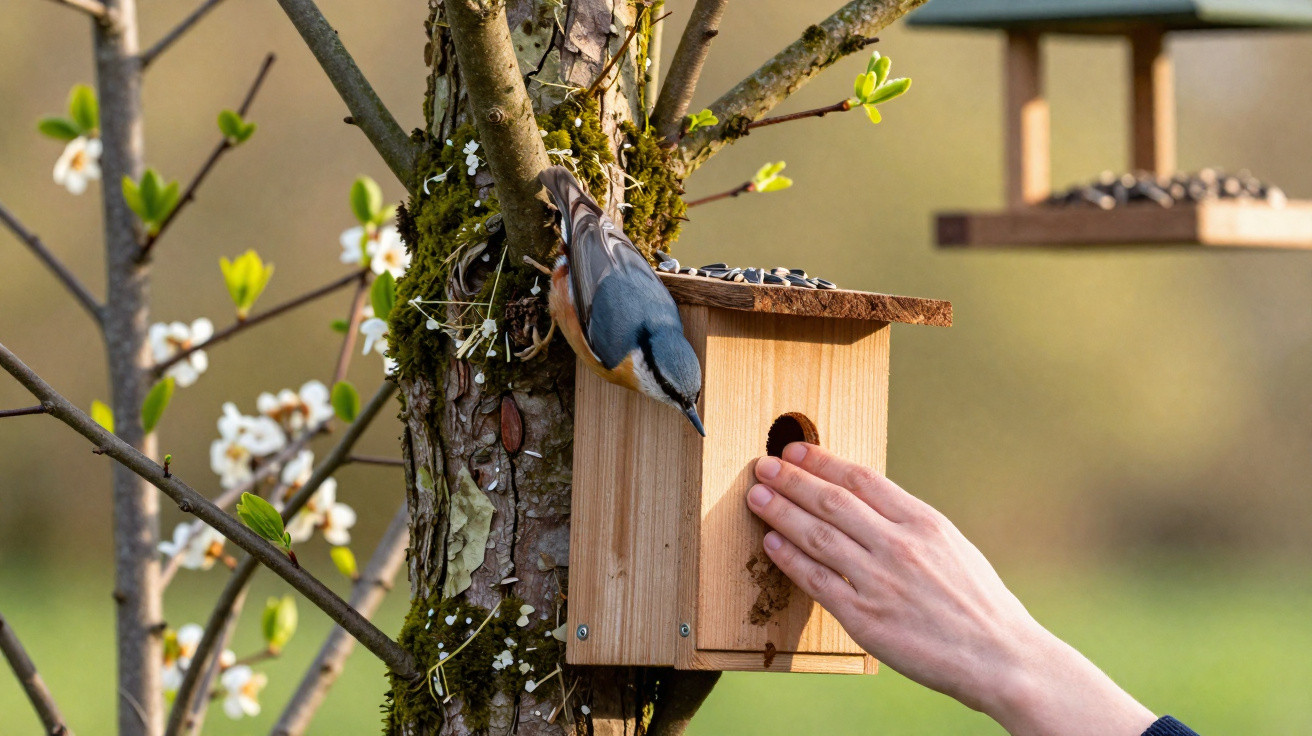
Anyone who looks more closely at mature garden trees in April may witness a small natural marvel. A stocky bird with a blue-grey back, orange belly and black eye stripe darts down the trunk – head first. This is the nuthatch, more precisely the Eurasian nuthatch, whose return to gardens marks spring in many areas.
A bird with a mask: identifying the Eurasian nuthatch
The nuthatch is a songbird, yet it stands apart at first glance. Its body is compact, its tail fairly short, and its bill is pointed and strong. Its upperparts are blue-grey, while the underside ranges from warm orange to rusty brown.
“Its defining feature is the black stripe across the eye – like a little robber’s mask.”
This distinctive “mask” makes it easy to tell apart from tits or sparrows. Once you start watching for that stripe, it is difficult to mistake the bird for another garden species.
Tree-trunk acrobat: the only bird able to climb head down
The Eurasian nuthatch becomes truly striking when it starts moving. Whereas tits generally cling to twigs and slender branches, the nuthatch works its way across the vertical surface of a trunk.
- It climbs upwards much like a woodpecker.
- It can run back down effortlessly while upside down.
- It clings to bark as though its feet were fitted with tiny hooks.
Its strong legs and long, curved claws make this possible. They grip deeply into the bark, keeping the bird secure even when it searches for food head down. It also makes frequent short calls: a sequence of dry, bright notes used to mark its territory.
“If you repeatedly hear quick, high calls coming from a tree in the garden during April, there is a good chance that a nuthatch has moved in.”
Why Eurasian nuthatches appear in gardens in April
Spring is the breeding season for nuthatches. From April onwards, they can increasingly be spotted in gardens and parks in many regions. However, this bird does not settle just anywhere; it has very particular requirements for its home.
Mature trees are crucial. The Eurasian nuthatch is a characteristic inhabitant of deciduous woodland, traditional orchards and old parkland. Trees that have been allowed to grow for decades develop natural cavities, cracks and branch holes. These are exactly the places where the nuthatch looks for nesting sites.
What a garden needs to keep nuthatches around
An occasional visit to a bird feeder is rarely enough. Nuthatches look for an established territory that they can use for many years. Three factors are especially important:
- Mature trees: beech, oak, fruit trees or lime trees with cracks, gaps and cavities.
- Natural features: dead wood, substantial branches and areas that have not been excessively tidied.
- Peace and quiet: as little disturbance as possible directly around the nesting cavity.
Nuthatches do not excavate their own nest holes in tree trunks. Instead, they use existing cavities, such as old woodpecker holes or natural crevices. They then alter the entrance in a particularly distinctive way.
Using mud to create the perfect entrance
Once a nuthatch has found a suitable cavity, it begins an unusual renovation. It gathers damp soil or mud and carries it in its bill to the opening. There, it gradually reduces the entrance until only a narrow gap remains, just large enough for the bird to enter.
“With a thick layer of mud, the nuthatch almost walls up its nest cavity – a natural burglary defence against larger birds and nest predators.”
This “walled-up” entrance is a clear indication of an active nuthatch nesting site. Anyone who notices one on an old garden tree should leave that area undisturbed.
How the Eurasian nuthatch’s diet depends on old trees
Trees are not only central to the nuthatch during breeding. It also finds most of its food on bark. During spring and summer, it probes every crevice with its bill and extracts whatever may be hiding there:
- Insects
- Spiders
- Larvae and small beetles
Its diet changes in autumn and winter. At that time, energy-rich foods become more important, including nuts, seeds and kernels. The bird often wedges these supplies into bark crevices or cracks, then hammers them open with its bill in a similar way to a woodpecker.
Supporting nuthatches properly at the bird feeder
Nuthatches often visit feeding stations in winter when suitable food is available. Good options include:
- Unsalted nuts, such as walnuts, hazelnuts and feed-grade peanuts
- Sunflower seeds
- High-quality fat and energy blocks containing seeds
It will usually take a piece of food, fly away with it, secure it somewhere and deal with it quietly there. For this reason, its feeding spot may not always be immediately obvious beside the feeder itself.
Tips for making a garden nuthatch-friendly
Anyone hoping to keep this bird in the garden permanently does not need to create a flawless nature reserve. A few straightforward measures are often enough to improve the chances considerably.
Keep mature trees
Not every decaying branch presents a danger. Where it is safe to do so, retain old trees and trunk remains. This is where the cavities needed by nuthatches can form.Leave dead wood in place
A few fallen branches or an old trunk behind the garden shed can support countless insects. These provide food for nuthatches and other birds.Use nest boxes thoughtfully
Where no old trees are available, sturdy cavity nest boxes can help. The entrance hole should be relatively small, and there should be scope for the bird to narrow it using mud. Some nuthatches accept this alternative.Avoid poisons and accept less perfection
Insecticides, heavily manicured lawns and smooth ornamental trees remove the foundations of a nuthatch’s habitat. A less “perfect” garden provides far greater benefits for biodiversity.
Why the Eurasian nuthatch is valuable to the ecosystem
Nuthatches often occur alone or in pairs and, compared with noisy corvids, are easy to overlook. Nevertheless, they perform an important role in the garden ecosystem. By eating large numbers of insects and larvae from bark, they help support healthy tree stocks.
Other species also benefit from the variety of structures found in a nuthatch-friendly garden, including woodpeckers, tits, bats and solitary bees. Designing a garden in which a nuthatch can thrive automatically creates habitat for many other wild animals.
Practical guidance for garden owners
Those paying closer attention to nuthatches in April should follow a few simple rules:
- Do not prune or fell nesting trees in spring.
- During the main breeding period, keep cats away from areas close to trees as much as possible.
- Clean nest boxes only outside the breeding season.
- Clean feeding stations regularly to prevent disease.
The Eurasian nuthatch is protected in many countries. It must not be caught, kept or disturbed. The aim is not to make it tame, but to give it space in which it can live independently. A naturally designed garden offers the best basis for this – and rewards people with fascinating wildlife observations right outside their door.

Comments
No comments yet. Be the first to comment!
Leave a Comment