
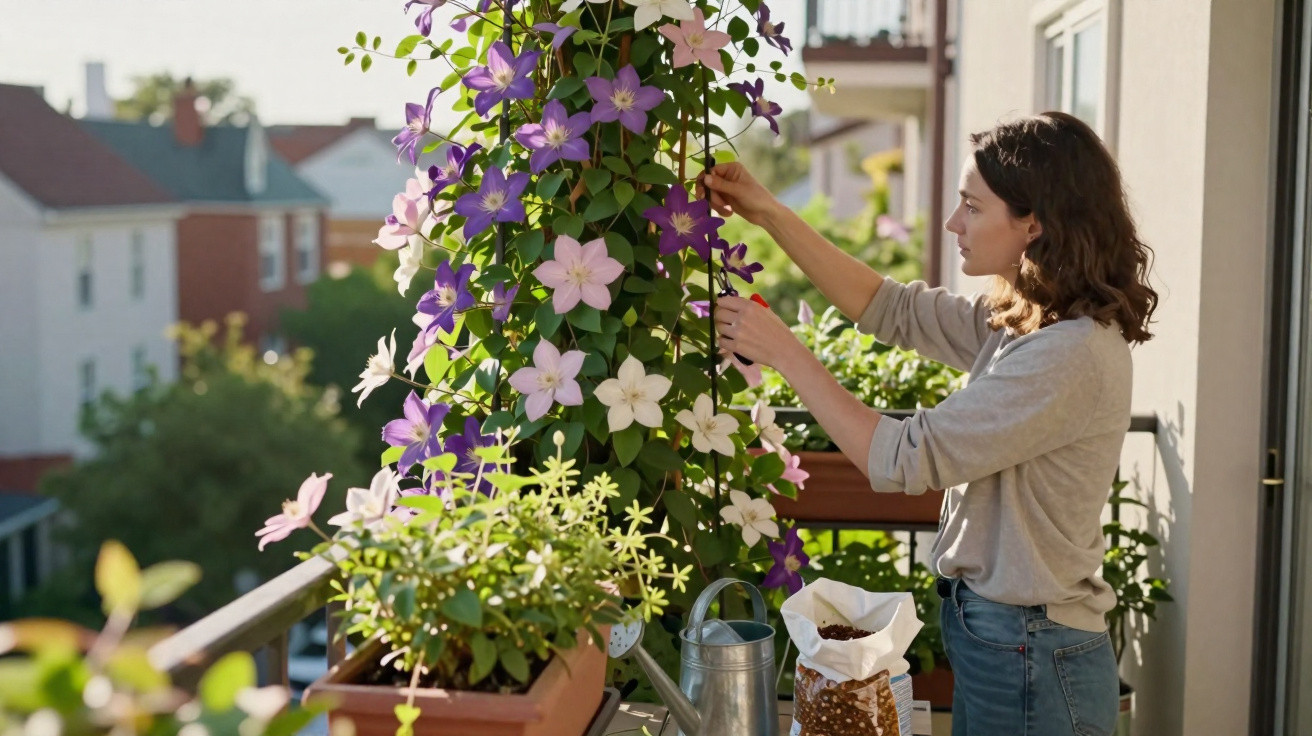
This climbing plant solves exactly that problem.
Anyone with only a narrow balcony, a tiny terrace or a miniature courtyard will know the dilemma: every flowerpot gets in the way, proper beds are out of the question, and in the end there is still just a strip of grey wall. One particular group of climbing plants shows how these areas can be shifted almost entirely into the vertical plane – with remarkably little effort yet a spectacular result.
Why a vertical flower wall saves so much space
In densely built-up towns and cities, every centimetre of floor space often matters. Traditional shrubs, rose arches and large containers can quickly obstruct walkways. Compact climbing plants solve this lack-of-space problem by growing almost entirely upwards while taking up very little width.
Dwarf Clematis varieties, often called dwarf clematis, are particularly interesting here. They stay far shorter than the familiar huge clematis plants, yet can still cover a trellis, railing or narrow frame from top to bottom with flowers.
“The principle is simple: the floor remains almost clear, the flowers climb up the wall – and a bleak area becomes a colourful focal point.”
Many of these modern cultivars grow to only around 1 to 2 metres high. That makes them ideal for a city balcony: tall enough to cover a wall or balustrade, but not so overwhelming that everything looks overgrown or the neighbours are completely screened off.
Modern dwarf Clematis: small plants, large flowers
What makes these compact varieties so appealing is that their growth remains manageable, while their flowers are anything but small. Unlike many climbing plants that flower profusely only at the top, dwarf Clematis produce blooms from the base of the plant right through to the tips.
This is especially important where space is tight. Bare stems at the bottom can soon look bleak on a mini balcony, because this part of the plant is directly at eye level when sitting down. The newer varieties have therefore been bred specifically to flower as densely and continuously as possible.
Visually, the choice spans everything from soft pastel shades to bold pink. Some varieties pair white petals with coloured stripes, while others change over the flowering period from a pale blue to almost pure white. Anyone wanting to brighten a dark backyard or shaded wall will usually choose pale or strong pink varieties, which stand out especially well against grey render.
Planting in pots and balcony planters
The plants do not need much to thrive long term, but a few points must be right. Before the choice of variety, the container is the most important consideration.
The right pot size and compost
- Pot volume: at least around 10–15 litres, preferably more
- Several drainage holes in the base are essential
- High-quality, loose compost for container plants
- A proportion of coarse material, such as expanded clay or grit, to improve drainage
Clematis prefer cool roots and airy shoots. This is why a larger pot is worthwhile, even if the plant itself does not grow particularly tall above ground. In undersized containers, the compost dries out extremely quickly, which can be a real issue on exposed, windy balconies.
One tried-and-tested approach is to plant smaller companion plants around the edge of the pot, such as mat-forming perennials, trailing petunias or other low-growing summer flowers. They shade the compost, disguise the often rather plain pot and help to keep the root area cool.
Trailing Clematis for balcony railings and windowsills
As well as the classic upright dwarf varieties, there are Clematis that behave like small flowering bushes in hanging pots. They rarely exceed half a metre in height, grow in a more rounded form and let their shoots tumble loosely over the edge of the container.
These types are particularly suitable for:
- railing-mounted hanging planters on narrow balconies
- hanging pots suspended from ceiling or wall hooks
- windowsills with lightly cascading growth
A typical display features countless small, bell-shaped blooms opening gradually over several months. Decorative seedheads then develop, resembling small fluffy pom-poms and giving the balcony planter structure well into late summer.
Supports: what dwarf Clematis really need
Clematis have leaf stalks that naturally wind around thin canes or wires. Even so, compact varieties grow more successfully when they are given a clear structure to follow.
Suitable supports include:
- slim bamboo canes in the pot
- a small wooden or metal trellis placed directly against the wall
- metal frames or obelisks inserted into the container
- tensioned lines or thin wires running along a balcony railing
The plants cannot grip thicker elements, such as handrails or posts, quite as effectively. In these places, it helps to secure the shoots loosely with plant ties at the outset. Once the basic structure is covered, the new tendrils will take care of the rest themselves.
“Anyone who provides a clear guiding structure from the moment of planting prevents chaotic growth – the balcony looks cared for rather than overgrown.”
Watering, feeding and pruning: keeping compact climbers in top condition
Water correctly – without waterlogging
Compost dries out much more quickly in pots than it does in a border, especially in midday sun. However, Clematis do not tolerate permanently wet roots either. The rule of thumb is: keep it evenly moist, never waterlogged.
- Check with a finger: water when the top layer of compost feels dry.
- Pour away excess water from the saucer after a few minutes.
- In very hot weather, it is better to give a little water in the morning and evening than too much at once.
When temperatures rise well above the mid-twenties Celsius, the foliage may temporarily turn yellowish. This does not automatically mean the plant is dying. Many Clematis then enter a kind of resting phase. More water will not help in this situation – if anything, it is more likely to cause damage by leaving the roots sitting in wet compost.
Feeding for a long flowering period
For abundant flowering in pots, a targeted nutrient boost is worthwhile. A fertiliser with a higher potassium content is particularly useful, such as one intended for tomatoes.
A practical routine:
- Start feeding when the first buds become visible.
- Continue feeding at intervals while new buds are forming.
- Stop no later than shortly before the main flowering period, so the plant does not focus solely on leaf growth.
This mild “stress situation”, created by stopping nutrient supply shortly before flowering, can encourage the plant to set more blooms rather than producing only new shoots.
Pruning and care through the year
Dwarf Clematis in pots usually do not require a complicated pruning schedule. Many gardeners manage well by tidying up the plant once a year:
- Remove dried or damaged shoots after flowering.
- Shorten any excessive length slightly.
- Thin out crossing shoots or shoots growing inwards.
A complete cutback to just above ground level is not always necessary, depending on the variety. If in doubt, it is better to prune moderately and observe how the plant responds the following year.
Choosing a position: sun, partial shade and pot companions
Clematis generally like “cool feet and a sunny head”. On a balcony, this means the root area should receive light shade, while the upper part can enjoy plenty of light.
Ideal positions include:
- east- or west-facing balconies with morning or evening sun
- south-facing spots with some shade around the roots, for example from other pots
- bright courtyards where sunlight reaches the wall for part of the day
For companion plants in the same pot, choose shallow-rooting, relatively undemanding species. More vigorous partners may compete with the Clematis for water and nutrients in a container.
Who benefits most from dwarf Clematis
These compact climbing plants are particularly worthwhile where space, time and patience are limited. They are a good choice for people who:
- have only a very narrow balcony or tiny terrace
- want to disguise an unattractive wall, drainpipe or bare railing
- do not want to carry large containers
- still value a genuine abundance of flowers despite having little space
Especially in rented homes, where planting into the ground is not permitted, vertical planting works like a small trick. It makes use of areas that previously lay unused and creates a major visual improvement without restricting room to move.
Anyone looking into the subject more closely soon realises that it is not only about a beautiful flower wall. These plantings also create habitat for insects, soften the view between concrete and glass, and noticeably alter the microclimate of a balcony – even across only a few square metres.

Comments
No comments yet. Be the first to comment!
Leave a Comment