
The reason is almost never the food.
Many amateur gardeners put up nest boxes, scatter sunflower seeds and meticulously tidy the lawn. They then wonder why the striking great tit is hardly ever seen. One unobtrusive native shrub, which many people remove through lack of knowledge, can change that in a short time.
Why few great tits visit despite a full feeding station
Almost everyone recognises the situation: tits and sparrows crowd around feeders during winter. As soon as spring begins, things fall quiet. The immediate assumption is often: “I must not be feeding enough” or “They do not like my food.”
In reality, it is not the quantity of seeds that matters, but how rich the garden is in insects. In spring, great tits (Parus major) do not need sunflower seeds; they need caterpillars, midges, beetles and spiders – in substantial numbers.
“For just one brood, a pair of great tits must bring in up to 500 insects each day – seeds are of little help here.”
A closely mown lawn, exotic ornamental shrubs and dense arborvitae hedges may look neat, but they offer insects virtually nothing. Without insect larvae, great tits simply lack a nursery food supply, so they move to more natural gardens.
The overlooked answer: black elder in the garden
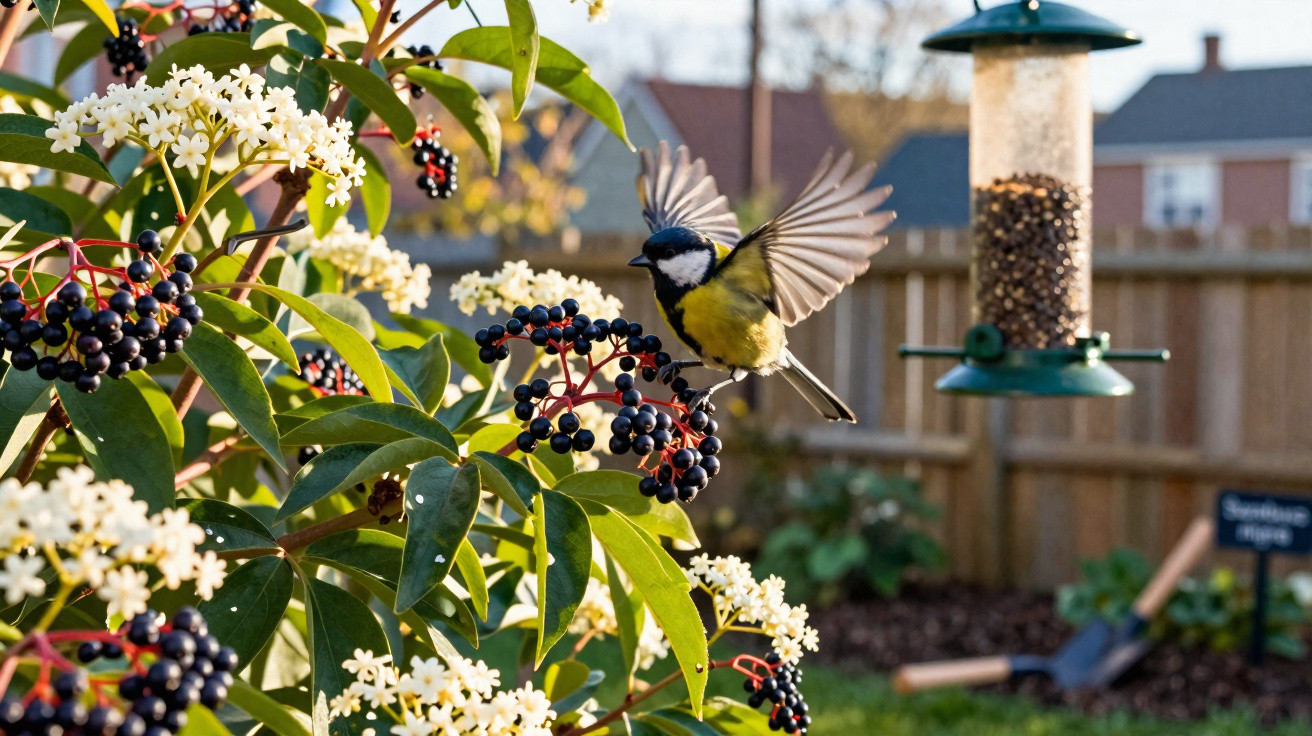
Many regard native black elder (Sambucus nigra) as a “wild hedge” that would be better removed. That is a mistake. Nature and bird conservation organisations specifically recommend it because it provides three things at once: food, cover and a hunting ground.
Growth, position and benefits
Black elder is a native shrub found almost everywhere in Central Europe. In a suitable position, it will readily reach three to five metres in height within three to four years, developing an open, branching crown. This loose growth habit is especially valuable for birds.
- Height: around 3–5 metres after a few years
- Position: sun to partial shade
- Soil: ordinary garden soil, including heavy or somewhat calcareous soil
- Benefits: habitat, food source and shelter in one
Its branches contain dense areas for nests as well as open sections from which birds can hunt insect prey. Dead wood, bark fissures and old shoots also provide refuge for numerous insect species. This is precisely where great tits later find their protein-rich food for their young.
Why black elder is a genuine “all-inclusive buffet” for great tits
In spring, black elder aphids frequently colonise elder shrubs. To many gardeners, this initially looks like an infestation that needs controlling. For great tits, however, it is a feast.
“What appears to be an ‘aphid plague’ is actually a species-appropriate food source for tits, ladybirds and more.”
During the breeding season, young birds require soft food rich in protein. This is where aphids and other elder-dwelling creatures become important. Adult birds systematically work their way through the shrub, carrying prey back to the nest minute after minute.
Later in the year, elder flowers and ripening berries add further food:
- Spring: aphids and other insect larvae as a protein source
- Summer: insects, spiders and populations of pollen-visiting insects
- Late summer/autumn: oil-rich berries as an energy reserve before winter
The dark elderberries in particular provide plenty of energy. Great tits are not the only birds to use them: blackbirds, thrushes and other garden birds also build up fat reserves from them. Anyone with a fruiting elder in the garden will often hear a real chorus of birds in late summer.
Great tit profile: needs and urban garden pitfalls
At 13.5 to 15 centimetres in body length, the great tit is one of the larger tit species. It has a black head with white cheeks, yellow underparts and a distinctive black “tie” running down its breast. It is considered adaptable and occupies almost every habitat, from woodland to back gardens.
Even so, many urban areas leave it short of food for its young. Typical issues include:
- Uniform lawns without flowering plants
- Thuja or cherry laurel hedges with little insect life
- Ornamental plants treated with pesticides
- Cleared beds with no winter shelter for insects
The breeding period shows how quickly this can become a bottleneck: female great tits generally lay five to twelve eggs. The chicks hatch after a little over two weeks and are fed intensively for up to three weeks. If caterpillars and other insects are absent during this phase, some chicks starve in the nest.
“A single large elder shrub can make the difference in a ‘sterile’ front garden between silence and a lively family of tits.”
Planting black elder: step by step
The best planting period is from November to March, provided the ground is not frozen. Acting now lays the foundations for next spring’s birdlife.
- Choose a position: Select a sunny to partially shaded spot with enough room above and to either side.
- Dig the planting hole: Make it roughly three times as wide and deep as the root ball.
- Loosen the soil: Break up the lower layer slightly so the roots can establish well.
- Work in compost: Mix two to three spadefuls of well-rotted compost into the excavated soil.
- Plant the shrub: Set the elder so that the top of the root ball is level with the surrounding soil.
- Backfill and firm: Replace the soil and gently tread it down so that no air pockets remain.
- Water thoroughly: Apply around ten litres of water, even if it is raining, as this flushes air from around the roots.
Elder establishes robustly and tolerates many mistakes. Only waterlogging and extreme dryness immediately after planting should be avoided. During extended dry periods in the first two years, it is worth giving it an occasional thorough watering.
A common problem: replace Thuja hedging with black elder
New-build areas in particular often contain metres of Thuja or cherry laurel hedging. These plants provide privacy, but almost no food for native insects – and therefore none for tits either.
A practical approach is not to remove the entire hedge at once, but to replace individual sections. Removing two to three metres of Thuja or cherry laurel and planting one or two elders in their place often produces the first effects the following year.
“Just a few metres of native shrubs are enough to get the food chain in the garden moving again.”
Other measures can help alongside this:
- Put up a nest box for great tits close to the elder’s trunk
- Leave moss patches in the lawn rather than driving them out with lime and fertiliser
- Avoid insecticides in the garden
- Leave dead branches and stems lying or standing until at least mid-March
This creates overwintering shelter for insects, which become prey for young birds in spring. A seed feeder still has its place, particularly in winter, but it cannot replace a living ecosystem.
What garden owners should also know about black elder
Black elder is useful not only to birds, but to people as well. Its flowers and berries can be made into syrup, jelly or juice. Ripe berries should always be heated, as eating them raw can cause stomach problems. For birds, they pose no issue when naturally ripe.
Where space is limited, elder can also be grown as a standard tree or included in a mixed hedge with other native woody plants such as rosehip, blackthorn or cornelian cherry. The more diverse the planting, the more stable the ecological balance becomes.
There is another advantage: elder delivers visible results quickly. Within only a few years, the garden looks less sterile, more insects buzz through the air, and birds make use of the new structure. Children in particular can watch this with amazement – from the first tit calls in the morning to mixed flocks gathering at the berries in late summer.
So if you feel that your garden has been “tidied to death” and remains birdless despite all your efforts, do not first turn to expensive specialist food. A spade, a young elder shrub and a little patience will achieve more than any designer feeding station.


Comments
No comments yet. Be the first to comment!
Leave a Comment