
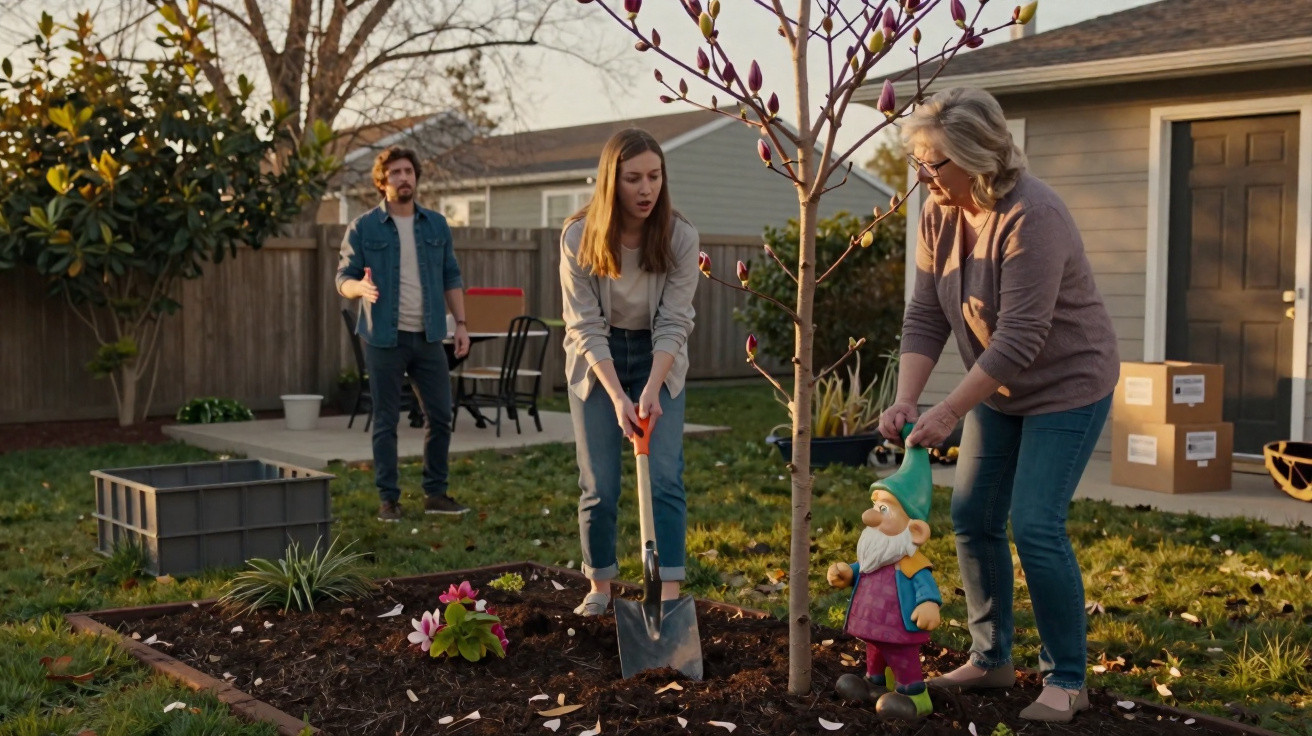
Everything had supposedly been arranged perfectly: a peaceful Saturday, a new garden and a special magnolia to represent a fresh start. But instead of tranquillity, a familiar storm arrived – in the shape of a mother-in-law who interfered without invitation, ignores boundaries and believes she knows best. A day of planting turned into a serious family dispute that ultimately changed far more than the layout of one flower bed.
A garden of her own: a lifelong dream
After years in a cramped block of rented flats, with a tiny balcony and two forlorn geraniums, the couple finally moved into their own house on the edge of town. For her, it was much more than a new address. It was the first place in her life where she wanted to make her own decisions.
The garden soon became her passion project. While other people watched series during winter, she read guides on soil, shrubs and perennials, sketched planting beds, checked the sun and wind exposure, and carefully ordered plants. At the heart of every plan was a distinctive Japanese magnolia. It was expensive, delicate and beautiful – and intended for precisely the right spot on the lawn, directly in view from the living room.
The garden was her sanctuary, but also a quiet declaration: this is where I decide, not other people.
After years in a corporate job, facing constant assessments and interference from above, she needed somewhere nobody would tell her what was “right”. That was exactly what this garden was meant to become.
The perfect day – until an engine roars into the drive
The first day of spring begins exactly as it should. Sunshine breaks through the haze, mugs of coffee steam, they are wearing old jogging bottoms, and birds chirp quietly. The couple are looking forward to a weekend without visitors, phone calls or appointments. Just the two of them, the garden and the magnolia.
Then an engine rattles into the drive. A car door slams and the garden gate creaks. Bożena, her husband’s mother, is standing outside the patio doors. She has arrived without warning, looking stern and carrying heavy bags. She holds supermarket bags in her hands, while behind her a neighbour carries an enormous item wrapped in plastic.
Her arrival feels less like a visit than an operation. The greeting is brief and loud. Her explanation is clear and entirely unsolicited: she had guessed that “the young ones” would have no fertiliser, that they would need help with the gardening. Today, she says, is the perfect day for garden work – done her way.
The shock: a garden gnome and foul-smelling flower beds
When the plastic-wrapped bundle is opened, she receives the first blow to her sense of style: a huge, brightly coloured plastic garden gnome. A bright red hat, a lantern and a grinning face – everything she had never wanted in her carefully planned natural garden.
There are also sacks of fertiliser, soil smelling of manure, and packets of marigold seeds: those vivid orange, pungent flowers she remembers from every 1980s allotment – and has never liked.
A tacky gnome instead of a delicate magnolia – two garden worlds collide head-on.
She tries to remain calm. Politely, she explains that there is already a design, that the plants have been ordered, and that she has not planned for either a gnome or marigolds. Her mother-in-law responds with mockery and a lecture. “What do you know about gardens? You only ever lived in a block of flats. I have twenty years of allotment experience.”
When experience becomes an argument for conflict
This has stopped being only about flowers; it is about power. The older generation invokes experience, while the younger one wants to follow its own path. The remarks sound familiar:
- “I only want to help.”
- “Things were different in the past; this is how we have always done it.”
- “Those internet ideas do not work in practice.”
- “It is all just fashion.”
With every comment, the garden owner feels increasingly distant from the supposedly well-meaning “help”. What is presented as support feels like a takeover.
An old conflict comes to a head in the flower bed
Their history makes the situation even more charged: the mother-in-law has interfered uninvited before – with the wedding decorations, furniture and colours. Now she is standing in the garden, using a commanding tone and directing everyone over which spade to use.
Her husband, normally a confident project manager at work, slips into old habits. He avoids eye contact and speaks soothingly. He wants to avoid an argument, tries to mediate and suggests hiding the gnome “somewhere at the back”. For his wife, this is the defining moment: it is not the gnome that hurts her, but the lack of support.
This is not about a plastic figure. It is about respect in your own home.
Then the breaking point comes: the mother-in-law picks up a spade and drives it straight into the carefully prepared planting spot for the magnolia. The specially enriched soil is thrown aside. She announces that she will plant “proper” flowers here – her marigolds. The magnolia, she says, would be “better somewhere around the edge”.
When one thrust of a spade exposes every old pattern
That single thrust of the spade represents years of quiet retreats and swallowed remarks. This time, she has had enough. In an unusually firm voice, she tells her mother-in-law to put down the tools.
She states it plainly: this is my house, my garden, my decision. The older woman has never heard her speak in that tone. The atmosphere instantly shifts from patronising to offended. Tears glisten and accusations pour out: “Ungrateful”, “I only wanted to help”, “You do not speak to your husband’s mother like that”.
Such statements often cut deeply because they are designed to create guilt. This time, however, she holds her ground and turns the argument around: nobody would simply rearrange furniture in her mother-in-law’s flat. In the same way, she will not accept unwanted interference in her garden.
The husband caught between his mother and his wife
Everything is decided now. The mother-in-law expects her son to defend her. His wife hopes that, for the first time, he will visibly stand beside her. The air is tense, and the seconds seem endless.
Many couples know this classic triangle: one partner is caught between loyalty to their family of origin and their new family. Anyone who keeps trying to balance both sides risks damaging the relationship. In this case, he makes a clear choice.
He stands beside his wife – literally and in principle – and sets boundaries with his mother for the first time.
He clearly tells her that she has gone too far, that she should have called first, and that the garden is not a building site to be redesigned according to her ideas. He offers to send her home in a taxi and says they will visit her at another time, as planned – but not today.
What this scene says to many couples
The mother-in-law responds with silence, an icy expression and a performative victim role. She packs up the fertiliser and soil again, while the garden gnome is silently placed outside the gate. There is no hug and no goodbye. Only the loud slam of the car door.
Two exhausted people and a patch of disturbed lawn are left behind. The woman feels weary but relieved at the same time. For the first time, she feels that her husband has genuinely chosen “her side” – not against his mother, but in favour of their shared home and their boundaries.
What may sound like an ordinary garden scene touches on an issue present in many relationships:
- Where does “well meant” end and disrespect begin?
- Who truly makes decisions in a shared home?
- How early should couples set boundaries with parents?
- How much influence from in-laws is still healthy?
The magnolia as a quiet promise
Once the mother-in-law has left, they return to their original plan. They restore the bed, carefully take the magnolia from its box and plant it in the prepared soil. With each spadeful of earth placed over the roots, they feel something within them settle into place.
The magnolia does not merely stand in the garden – it represents the beginning of an adult “us”.
The first day of spring unfolds differently from how they had planned, yet it marks a turning point. For the first time, the couple consistently set boundaries with the outside world – and in doing so become stronger together. The garden becomes not only a refuge, but also a visible result of their shared decisions.
What others can take from this story
Conflicts with in-laws often begin with small things: curtains, parenting, Christmas visits or, indeed, garden plans. Usually, the underlying issues are:
- Control: Who decides what the “right” way to live should look like?
- Letting go: Parents may unconsciously struggle with their children choosing their own paths.
- Boundaries: Couples have never clearly said what is acceptable to them – and what is not.
Clear agreements between partners are helpful before matters escalate: who says what when Mum appears at the door without warning? Which decisions belong solely to the couple? When is help requested, and when is it not?
A garden is surprisingly well suited as a trial run for setting such boundaries. Anyone who learns to say “no” there will find it easier to do so later with bigger issues. And sometimes it takes a tacky garden gnome for a couple to realise just how much their shared patch of ground truly means to them.



Comments
No comments yet. Be the first to comment!
Leave a Comment