
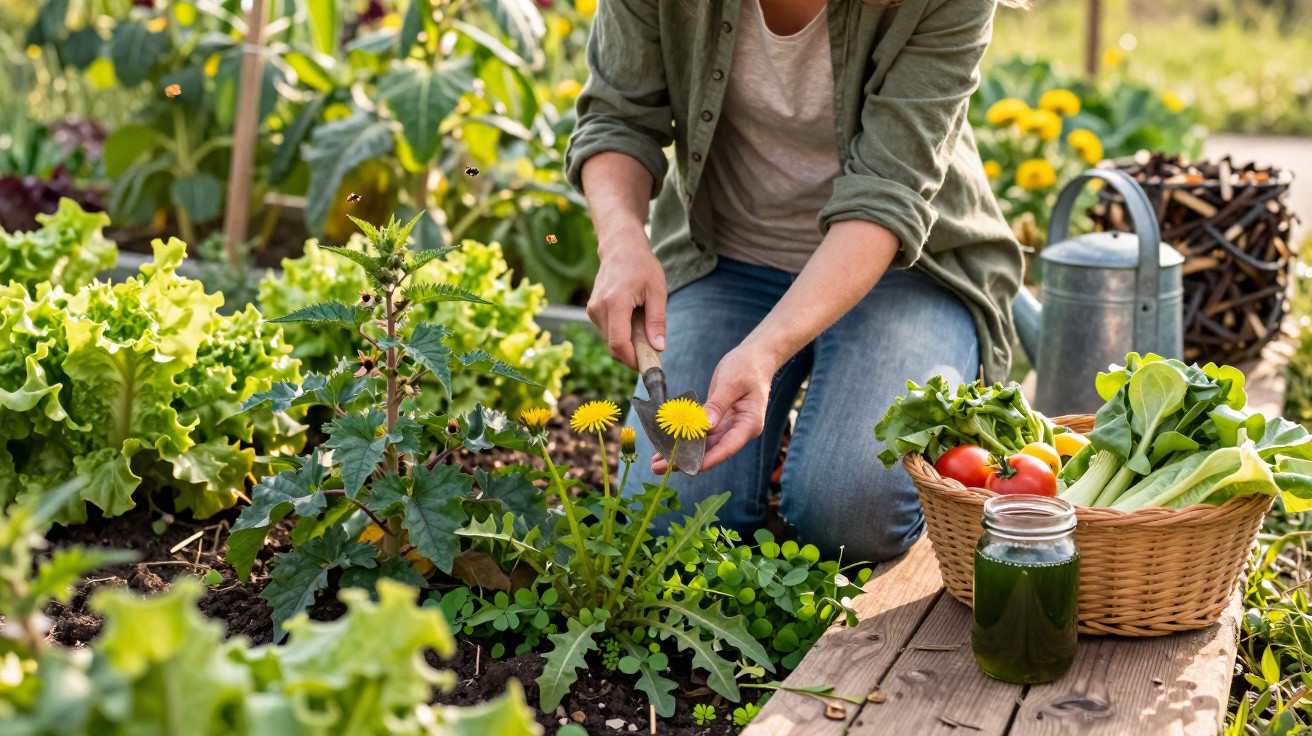
Every spring, the same scene plays out: as soon as dandelions, clover or nettles appear anywhere, out come the hoe and spade. Lawns are expected to look immaculate and beds to appear “tidy”. Yet gardening this way means sawing off the branch supporting your own vegetable garden. These three supposed troublemakers are, in fact, among the most valuable allies for living, fertile soil.
Why gardeners target the wrong enemies
For decades, advertising imagery has shaped our idea of the perfect garden: lush green lawns, beds without a single “unwanted plant”, and everything clinically neat. Chemical weedkillers and artificial fertilisers provided the tools to achieve it. What was overlooked is that many plants labelled as “weeds” perform jobs in the soil that would otherwise cost money – or that no tool can do at all.
Anyone who banishes dandelions, clover and nettles completely gives up free soil aeration, natural fertiliser and a paradise for pollinators.
Rather than automatically pulling out every unfamiliar plant, it is worth looking more closely at what it does. Three species stand out in particular: dandelions, clover and nettles.
Dandelions: yellow-clad soil engineers
Dandelions are probably the most disliked plants in British gardens. Their yellow flowers are visible from a distance, while their seed heads seem to spread everywhere. The real marvel, however, takes place below ground.
The plant develops a strong taproot that penetrates deep into the soil. It breaks through compaction, loosens soil layers and creates fine channels through which water and air can circulate more freely again. No garden fork reaches as far or works as persistently.
At the same time, dandelions provide a kind of free soil test:
- A few isolated plants suggest relatively healthy, nutrient-rich soil.
- A large-scale spread points to heavily compacted soil or an excess of animal-derived organic matter.
Above ground, dandelions offer another benefit: they are among the earliest food sources for solitary bees and honey bees. While fruit trees and perennials are still dormant after winter, their yellow flowers already supply abundant nectar and pollen. For colonies weakened by the cold season, this can be crucial for survival.
From “weed” to free vegetable
Many people forget that dandelion is also an exceptionally nutritious wild vegetable. Its young leaves contain plenty of fibre, beta-carotene, folate, iron and calcium. They can be eaten raw in salads, lightly steamed as a vegetable side dish, or mixed into herb quark.
The flower buds can be made into aromatic “dandelion jam”, which has a honey-like flavour. The stems can also be used in the kitchen, much like other leafy vegetables. Allowing dandelions to grow therefore brings not only healthier soil, but fresh vitamins too – for free.
Clover: a miniature fertiliser plant in the lawn
In many residential areas, clover in the lawn is still regarded as a blemish. Yet it was once a perfectly normal ingredient in lawn seed mixtures. Clover was only systematically removed with the arrival of selective herbicides – conveniently for those selling artificial fertiliser.
This plant has an ability that agricultural businesses around the world strive for: it can fix nitrogen from the air. Special bacteria live on its roots and convert gaseous nitrogen into a form that other plants can use as a nutrient. When clover dies back or is cut, this nitrogen enters the soil and becomes available to lawns and beds.
A lawn containing clover often stays greener, denser and needs less artificial fertiliser than a conventional uniform lawn.
During increasingly frequent dry spells, clover has another advantage: its roots reach considerably deeper than those of typical lawn grasses. This allows it to access water even when the surface has long since dried out. While an ordinary lawn looks brown and sparse, patches of clover remain green and lively.
More insects, less watering
Clover’s white or pink flowers attract bees, bumblebees and butterflies. Mowing them down constantly removes an important food source for pollinating insects – and indirectly weakens your own vegetable garden, which depends on pollination.
A few simple measures can help integrate clover usefully into everyday gardening:
- Mow the lawn higher, at 5–7 cm, so clover is not completely shredded.
- Avoid fertilisers that are heavily nitrogen-based, as they encourage grass at clover’s expense.
- During dry periods, water less often but thoroughly; deep-rooted species such as clover benefit from this.
Nettles: prickly, but a blessing for wildlife and beds
Few plants provoke as much cursing as the nettle. Anyone who has grabbed one with bare hands will not forget the sensation. Behind its stinging hairs, however, lies one of the most valuable wild plants for a wildlife-friendly garden.
As an indicator plant, the nettle reveals a great deal about its location: it favours very nutrient-rich soils, usually high in nitrogen and decomposing organic matter. Where it grows in abundance, it signals an oversupply of nutrients. By absorbing them, it acts as a natural buffer. Later, when the plant dies or is added to compost, those stored nutrients return to the soil in a finely distributed form.
For wildlife, nettles are a small hotspot. Around 30 animal species depend directly on them, including striking butterflies such as the peacock, small tortoiseshell and red admiral. Without nettles, these butterflies lack food plants for their caterpillars and quietly disappear from our gardens.
Liquid fertiliser and pest control in one
Nettles have long held cult status in wildlife-friendly gardens because they can be made into highly effective plant feed. Chopped shoots are steeped in water and left to ferment for several days or weeks. The result is a nitrogen-rich liquid fertiliser full of microorganisms.
Applied heavily diluted to the soil, it strengthens plants and encourages growth. Sprayed onto leaves, the liquid acts as a protective barrier against aphids and other sap-sucking pests. At the same time, a small strip of nettles near the garden attracts ladybirds and other natural aphid predators, which then patrol the vegetable beds as well.
How to integrate “weeds” cleverly into your vegetable garden
The question is not, “How do I get rid of them?”, but rather, “Where can they work without getting in the way?” With a little planning, dandelions, clover and nettles can be included in any garden.
| Plant | Ideal location | Main benefit |
|---|---|---|
| Dandelion | Path edges, lawns, but not directly in beds | Soil aeration, bee forage, wild vegetable |
| Clover | Lawns, paths, gaps between planting | Nitrogen supply, drought resistance, insect food |
| Nettle | Boundary areas, near compost or hedges | Butterfly habitat, liquid fertiliser, nutrient storage |
Even a small nettle patch covering just a few square metres beside a fence or compost heap is enough to provide a home for numerous insect species. Cutting it before it sets seed prevents excessive spread. Ideally, the cut material should go into the compost or the liquid-fertiliser bucket.
For dandelions in vegetable beds, leave a few plants at the margins or in the lawn, but remove those growing directly among young vegetables. This allows bees and soil to benefit without lettuce and carrots facing unnecessary competition.
What gardeners should learn anew about “weeds”
The term “weed” simply does not exist in botany. From a professional perspective, these are wild plants suited to particular locations and with specific roles. Many indicate soil conditions, loosen compacted layers or supply nutrients. Those who fight them indiscriminately are often fighting the very helpers that could compensate for gardening shortcomings.
Using them thoughtfully does not mean allowing the garden to become overgrown. It means distinguishing between zones: areas where vegetables and ornamental plants take priority, and margins where “weeds” are allowed to perform their services. Over time, this combination creates more stable, resilient gardens that need fewer chemicals, less water and less fertiliser.
The value of these helpful plants becomes especially clear during dry, hot summers. Clover keeps areas green, dandelions open compacted soil, and nettles help beneficial insects survive. Understanding these processes not only saves money and effort, but usually results in a better harvest as well – without constantly battling every supposedly “wrong” plant.

Comments
No comments yet. Be the first to comment!
Leave a Comment