
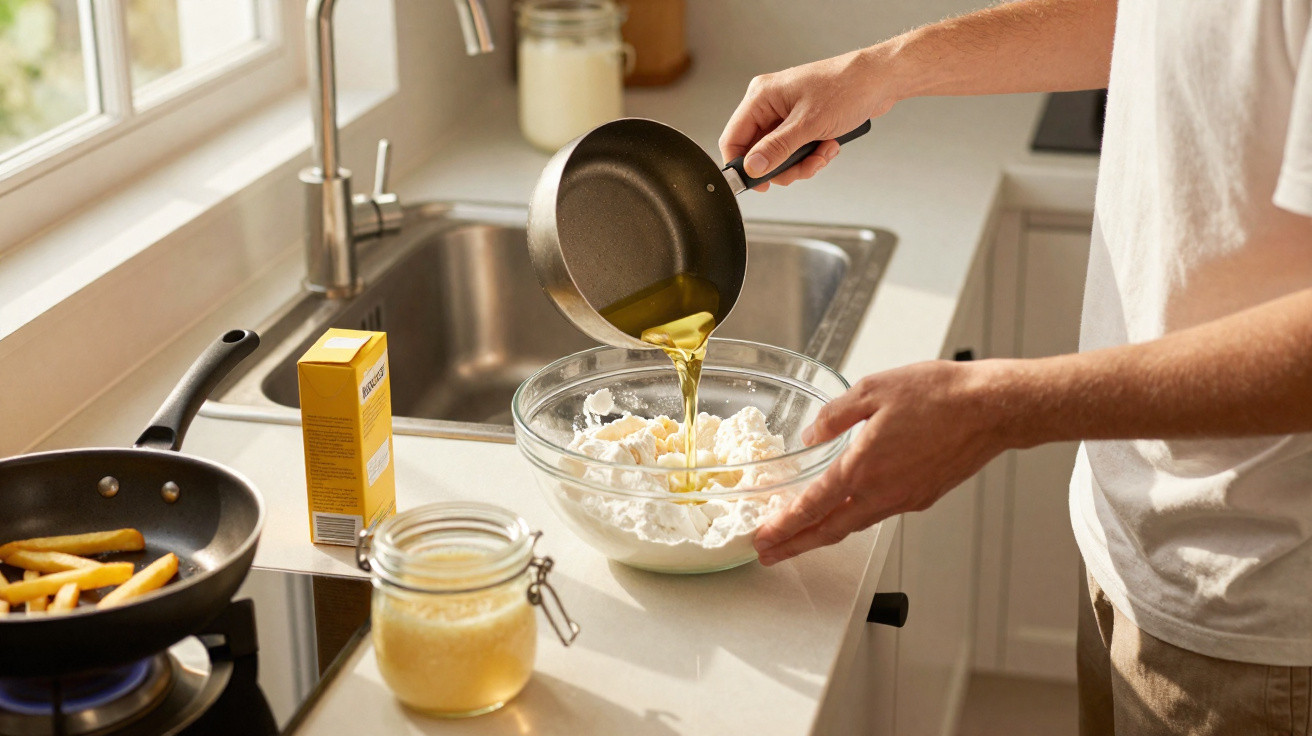
Anyone who fries food regularly or enjoys deep-fried dishes will know the issue: eventually, the sink starts draining slowly, makes gurgling noises and gives off an unpleasant smell – and in the worst cases, an emergency plumber has to be called. This is precisely the situation that prompts a tradesperson to show a customer a straightforward yet highly effective trick: an unassuming kitchen powder can help dispose of used frying oil safely, without damaging drains, pipes or the environment.
How frying oil can damage the drain
For many home cooks, the logic seems obvious: let the oil cool briefly after frying or deep-frying, pour it down the sink, run plenty of hot water afterwards, and the problem has gone. What happens inside the pipes, however, is very different.
At first, the warm liquid passes easily through the drainpipe. But as soon as it encounters cooler water and the relatively cold pipe walls, it begins to solidify. A greasy coating forms, clings to the surface, thickens over time and gradually narrows the pipe.
Food debris from the sink adds to the problem: crumbs, pasta, pieces of vegetables and protein residue. These particles stick to the fatty layer. Each further amount of oil makes the blockage grow until water can no longer pass through. At that point, professional equipment is often the only solution.
“Even a few millilitres of frying oil per wash-up can cause pipes to become clogged over time and lead to expensive call-outs.”
Typical warning signs in the kitchen
Before a pipe becomes completely blocked, the drain usually gives clear warnings:
- Water drains noticeably more slowly than it used to.
- The sink gurgles as the water runs away.
- A rancid or greasy smell rises from the drain.
- Water may occasionally remain in the basin for a short time before disappearing.
Anyone who ignores these signs and continues pouring oil into the pipe risks a back-up eventually reaching the kitchen or bathroom, complete with foul odours and greasy deposits.
Hidden danger in the sewers: fatbergs and environmental damage
The issue does not stop at the front door. What begins in a household drain continues into the municipal sewer system. There, fats from countless homes combine into huge lumps. Technicians refer to them as fatbergs because some of these formations weigh several hundred kilograms and can block entire pipes.
Such masses do not only put pressure on the sewer network; they also make the work of wastewater treatment plants more difficult. Removing fats from wastewater requires considerable effort. If some of it reaches rivers or lakes directly, it forms a film on the water’s surface that affects oxygen exchange and wildlife.
“Every litre of cooking oil that ends up in the toilet or sink worsens wastewater quality and increases the operating costs of water companies.”
The plumber’s tip: bind cooking oil with cornflour
Rather than simply blaming the customer, the tradesperson offers a surprisingly simple solution. His helper is a powder found in almost every kitchen cupboard: cornflour, also known to many by the brand name Maizena.
Why cornflour works so well with frying oil
Cornflour can bind fats and liquids. It acts as a thickener in sauces, while with frying oil it helps the contents solidify. This turns the liquid into a compact, relatively dry mixture that can be disposed of easily with household rubbish.
The method is simple, although it requires a little time:
- After deep-frying, leave the oil in the pan or deep fryer for several minutes until it is only lukewarm.
- Carefully pour the liquid into a heat-resistant container.
- Add one to two tablespoons of cornflour for roughly 0.5 litres of oil.
- Stir slowly with a spoon or whisk until no lumps remain visible.
- Leave the container at room temperature.
Within around 24 hours, the oil-and-cornflour mixture becomes a thick, semi-solid mass. It can then be scooped out with a spoon, placed in a bag or old container and disposed of with general household waste. Nothing leaks in the bin, and not a drop enters the pipe.
What should you do with larger quantities of frying oil?
For people who only occasionally fry chips or schnitzel, the cornflour solution works well. In households where deep-frying is frequent or a large deep fryer is used, however, several litres can quickly build up. Other options are more suitable in those cases.
Taking it to a recycling centre or collection point
Many local authorities accept used cooking oil at recycling centres. The liquid is collected in special containers for further processing, for example into biofuel or industrial fats. Anyone unsure about local arrangements should check with their council or local waste service to find out whether, and how, this option is available.
Useful guidance includes:
- Pour old oil into tightly sealable bottles or containers.
- Label containers clearly so that nothing is confused.
- Do not mix in harsh chemicals or cleaning products.
- Store containers somewhere cool and dark until they can be taken to the collection point.
This turns a waste problem into a valuable raw material that remains in circulation.
Other mistakes that put pressure on kitchen drains
Frying oil is not the only cause of trouble. Other habits can also damage the drain and encourage blockages. Many happen through lack of awareness, but they are easy to avoid.
| Problematic material | Effect in the drain |
|---|---|
| Coffee grounds | Settle like sand in bends and traps |
| Rice, pasta | Swell in water and narrow the pipe |
| Flour, dough residue | Combine with fat to form hard clumps |
| Wet wipes | Do not break down and form connected bundles |
| Leftover paint, varnish | Stick to pipe walls and are toxic to the environment |
Using a sink strainer and consciously disposing of waste with household rubbish can prevent many problems from the outset.
Why this trick saves money in the long term
A professional call-out can quickly cost a three-figure sum, especially in the evening or at weekends. Anyone who needs a drain cleared several times a year may spend enough to buy new kitchen appliances with ease. By comparison, the method described here needs only a few spoonfuls of cornflour and a little patience.
“A packet of cornflour costs only a few pounds. A single blocked pipe costs many times more.”
There is also the convenience factor: people who dispose of their oil in a controlled way are far less likely to face faulty drains, unpleasant odours and chaos in the kitchen.
Practical additions for everyday use
Alongside binding oil with cornflour, several routines can be incorporated easily into everyday kitchen life:
- Replace frying oil completely after it has been used several times and dispose of it in one collected batch, rather than pouring small amounts down the drain.
- Wipe cooled residues of cooking fat straight from pans or saucepans with kitchen roll, then throw the paper away with the fat on it.
- Once a week, run some hot water – not boiling water – with a small squirt of washing-up liquid through the drain to loosen fresh fat residue.
Those who deep-fry often and regularly may want to set aside a small space in a cupboard for empty bottles or jars used to collect old oil. This ensures that not a drop ends up where it does not belong.
Risks, limits and useful combinations
The cornflour method is not a replacement for proper disposal where very large quantities are involved. Nobody should deal with several litres of oil at once without keeping the recycling centre in mind. The oil must also be properly cooled before mixing: liquid that is too hot can splash and burn hands.
Households with children should keep containers of cooling oil out of reach and should not use drinks bottles, to prevent mistakes. Tenants may also find it worthwhile to check their tenancy or building rules, as some property managers provide specific guidance on handling food waste and fats.
Combined with a sink strainer, occasional cleaning intervals and taking larger quantities to the recycling centre, this creates a reliable system: pipes stay clear, the home remains free from lingering odours, and the environmental impact is significantly reduced – all thanks to a plumber who spoke plainly before producing the right trick from his sleeve.




Comments
No comments yet. Be the first to comment!
Leave a Comment