
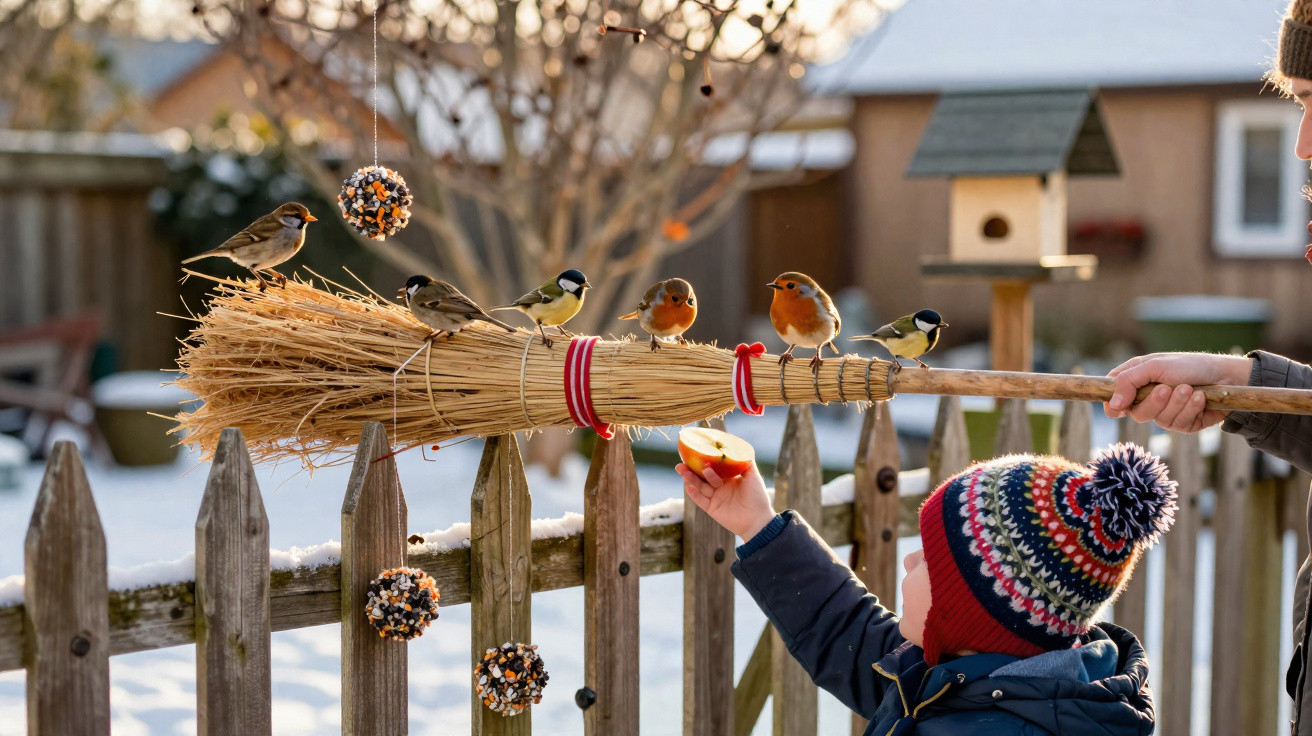
Most people think of bird feeders, fat balls and expensive products from the garden centre when winter arrives. Yet the answer for many garden birds is often gathering dust at the back of the shed, forgotten and seemingly worthless: an old broom. Positioned and stocked correctly, it can become a remarkably effective lifeline for tits, sparrows and robins.
Why winter is so unforgiving for garden birds
As temperatures drop, small birds quickly reach their limits. Keeping their body temperature stable uses a huge amount of energy, while much of their natural food supply disappears at the same time:
- Snow covers seeds, leftover plant material and insects.
- Frozen ground makes finding food more difficult.
- Bare shrubs offer little shelter from wind and predators.
- Longer nights mean spending more time in cold, darkness.
Many bird species only make it through winter if they can find extra feeding sites and safe places to rest. This is precisely where a broom comes in, serving as both a feeding station and a miniature shelter.
“An old broom can provide food, a resting place and shelter at the same time – a small block of flats for winter birds.”
How an old broom becomes a lifeline
It may sound odd at first, but it works surprisingly well: a discarded broom can be placed so that birds are able to land on it, hide in it and feed from it. Its bristles or bundles of twigs create an open yet dense structure, making them ideal for securing food and providing cover.
The best place for the broom
Location is crucial. A sheltered spot that still provides a clear view is ideal:
- Push it into a dense hedge, with the bristles facing upwards.
- Hang it from a branch at a slight angle, allowing birds to perch securely.
- Lean it upright against a house wall, preferably away from the wind.
- Place it beneath an overhanging roof so that the food stays dry.
Important: do not hang the broom directly above a frequently used patio. Birds prefer quiet and avoid constant movement.
What to hang from or tuck into the broom
With only a few simple steps, the broom can become a fully stocked feeding station. Suitable treats for winter birds include:
- Fat balls or homemade fat-based food balls without nets
- Unsalted sunflower seeds and seed mixes
- Halved apples or pears
- Raisins or unsulphured dried fruit
- Chopped nuts, unsalted and without shells
Tie these foods to the bristles with string or push them directly between the fibres. This keeps them dry and off the ground, offering better protection from mice and rats.
“Anything kept off the ground stays fresh for longer – and lowers the risk of disease and unwanted rodents.”
Shelter, food and a lookout: why birds love brooms
A broom offers far more than simply a place to feed. For birds, it fulfils several purposes at once:
| Function | Benefit for birds |
|---|---|
| Protection from wind | The bristles break up draughts, so birds lose less heat. |
| Hiding place | They can quickly conceal themselves among the fibres. |
| Perch | It provides a good vantage point for keeping watch over the garden. |
| Food holder | Food remains dry, clean and easy to reach. |
Small species in particular, such as tits and sparrows, readily use these structures because they can dart between the fibres in an instant when necessary. Birds of prey and cats find it considerably harder to reach them there.
How to prepare your broom properly
Before using it, carry out a quick check to ensure that the broom genuinely helps rather than becoming a hazard.
Points to check
- There must be no sharp, protruding screws or wires.
- Secure it firmly so that nothing falls down in windy weather.
- Do not use a heavily soiled broom or one contaminated with chemicals.
- Keep it far enough from large windows to prevent collisions.
If you wish, the broom handle can also be put to use by attaching small pieces of wood, corks or a miniature nesting aid. This gradually creates a multi-level “bird station”.
More life in the garden: what a broom station can bring
Many amateur gardeners say that their gardens suddenly feel more alive once they create improvised places to feed and rest. Children enjoy watching tits hang upside down from the bristles. Older neighbours start conversations, either because they are trying the same idea or sharing tips of their own.
“An old cleaning tool becomes a meeting place – for birds and people.”
Those who top up the food regularly and keep an eye on the area will soon see which species visit most often. Over time, this builds an understanding of what the garden truly needs: more shrubs, different types of food or perhaps additional water sources.
Other everyday objects that help birds
The broom is only one example of how apparently useless items can be given a worthwhile new purpose. With a little imagination, many objects can become helpful features for wildlife:
- Old rakes: climbing and landing aids for birds and insects
- Broken handles: perches for feeding areas or flowerpots
- Small spades: miniature water basins set shallowly into the ground
- Wooden boxes: windbreaks or a base for a feeding station
The benefits are obvious: you save money, reduce waste and at the same time create structures that make it easier for animals to survive.
Tips for healthy feeding without unwanted effects
Anyone hoping to help birds should follow a few basic rules, ensuring that good intentions do not create problems:
- Put out only as much food as will be eaten in a day.
- Do not use leftovers such as salted pieces of bread or seasoned food.
- Check regularly for food that has gone mouldy or clumped together.
- Clean dirty areas around the broom to help prevent disease.
Fat-based food in particular can spoil quickly on mild days. It is therefore better to add smaller quantities more often than to attach a large supply all at once.
Why children especially benefit from the broom idea
For families, a broom station is an ideal introduction to wildlife-friendly action. Children can:
- Mix and attach food themselves.
- Keep observation lists: which species arrive, and when?
- Take photographs and record changes in the garden.
This naturally leads to conversations about biodiversity, climate and responsibility. It also lowers the barrier to engaging with other environmental issues later on.
When one simple action becomes a signal for greater nature conservation
An old broom in the garden may look unremarkable, but it sends a clear message: we are paying attention to what is happening around us. Helping birds in winter also indirectly protects the garden itself. Many of these species eat pests in spring and summer, pollinate plants and help maintain a healthy balance.
Anyone who repurposes an old broom today may notice within just a few days how quickly word spreads – not only among neighbours, but also among the regular feathered visitors. Suddenly, it is no longer merely a cleaning tool hanging there, but a small lifeline in the white, quiet winter garden.

Comments
No comments yet. Be the first to comment!
Leave a Comment