
It smelled neither of artificial fertiliser nor damp coffee grounds, but simply of ordinary, slightly moist soil. I was standing on an elderly neighbour’s balcony, where her geraniums looked as though they had an exclusive contract with a gardening magazine. Not a single yellowing leaf, no fungus gnats, nothing. Just rich green foliage and flowers glowing almost outrageously brightly. When she noticed me staring, she laughed, disappeared into the kitchen and returned carrying an old screw-top jar. Inside was an unremarkable brown powder. No brand, no label, no ‘organic premium’ slogan. “This,” she said, “is my little secret.” It was not fertiliser from the garden centre, nor some remedy promoted on Instagram. It was something much simpler – and that is exactly what makes it so intriguing.
The ingredient that existed before artificial fertiliser
We all know the situation: you are holding a half-dried-out houseplant, urgently searching online for ‘miracle fertiliser’, then adding some random product to your basket. DIY and garden-centre shelves are packed with options, from chemical NPK bombs to costly organic elixirs. Then there are coffee grounds, celebrated in every other gardening tip as a cure-all. Plenty of plants survive them; some quietly fade away. Yet hardly anyone mentions that the most unassuming old method outperforms both. It costs next to nothing and comes from something we would throw away anyway.
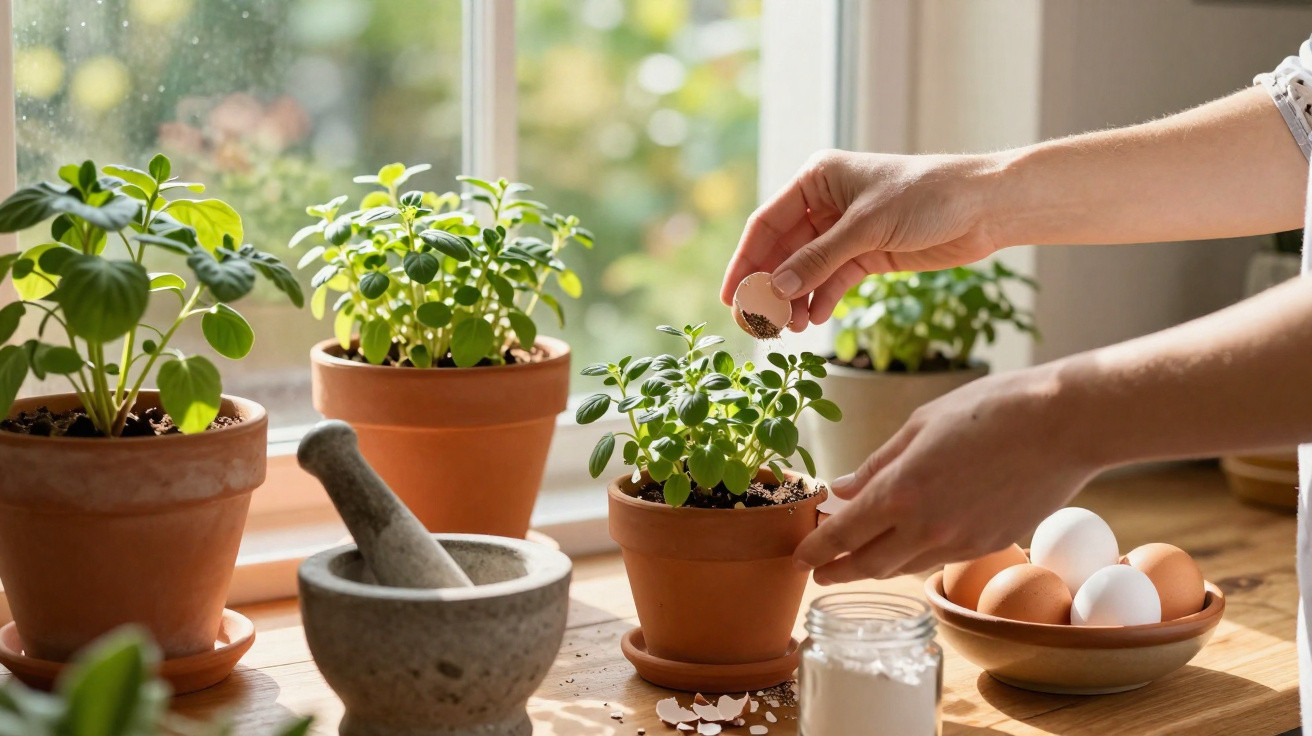
My neighbour with the film-star geraniums revealed her secret at the kitchen table: dried, finely crumbled eggshell compost. There is no fancy name or fashionable buzzword. She saves eggshells from breakfast, gives them a quick rinse, lets them dry, crushes them roughly, and combines them in a small box with soil and a little kitchen waste. The mixture sits on her balcony for weeks, partly forgotten and partly watched. What seems like rubbish gradually turns into a kind of mineral-rich humus booster, which she calls “her foundation”. There are no coffee grounds in a pot growing mould, and no artificial fertiliser that can be overdosed in seconds. There is only time, micro-organisms and calcium in abundance.
Viewed objectively, it makes a striking amount of sense. Plants do not live on ‘fertiliser’ in the branded-product sense; they depend on soil that can breathe, retain resources and replenish them. Eggshells contain calcium carbonate as well as trace elements. Combined with organic matter and soil life, they become a form of slow nutrient supply. There is no sudden feeding, nutrient shock or chemical cocktail. Roots receive what they need gradually while the soil retains a stable structure. That is the key difference: coffee grounds are often tipped into pots while wet and in overly thick layers, while artificial fertiliser is applied on a hunch. Eggshell compost works quietly in the background, at a pace more reminiscent of a woodland than a laboratory.
How to make the ‘eggshell booster’ at home
The method seems almost too straightforward to work. Collect your empty eggshells, rinse them briefly under water, and leave them to dry completely on a plate or baking tray. Then crush them with a pestle and mortar, a rolling pin or simply inside an old tea towel. Do not turn them into dust; aim for coarse fragments, roughly like crushed cornflakes. Mix these pieces in a small box or bucket with loose soil and a small amount of kitchen waste: a little vegetable peeling, tea, and a tiny piece of cardboard. Rather than packing it down, layer everything loosely. Leave the container in an airy, dry spot and give it a quick stir every few days. After several weeks, it becomes a crumbly mixture with a gentle earthy scent, ready to be worked sparingly into your potting soil.
Let’s be honest: nobody actually does this every day. And nobody needs to. A common mistake is trying to achieve in two days what soil wants to do over weeks. Many people pile too much eggshell straight around the roots, hoping for a turbocharged result. That often leaves soil sticky and plants stressed. Another classic error is using completely unwashed shells with egg residue, which can start smelling mercilessly in summer. It is better to proceed slowly, modestly and without fuss. The aim is not ‘miracle fertiliser’, but a kind of mineral backup. Plants should feel nourished rather than ambushed. You are also allowed to forget that your little compost box exists from time to time.
At one point, my neighbour said something I have not been able to forget:
“I don’t fertilise; I feed the soil – and then it looks after the plants.”
- You make use of a waste product found in almost every household – eggshells – rather than expensive bottles from the garden centre.
- You avoid the coffee-grounds trap: no mould, no fungus gnats and no compacted, acidic crust of soil in the pot.
- You gradually develop a stable soil structure that holds water more effectively and gives roots room to breathe.
- You reduce the risk of calcium deficiency, which often appears as brown leaf tips and rotten patches.
- You move towards a plant-care routine based more on a natural cycle than on products and promises.
Why modest routines genuinely make plants strong
Once you start saving eggshells, your perspective on your own plants subtly changes. You pay less attention to the fertiliser label and more to the soil itself: does it still smell alive? Does it feel crumbly, or more like concrete? Instead of buying more supplies in a panic, you fill the screw-top jar with dried shells, occasionally stir your mini compost and scatter a handful into a pot every few weeks. There is no drama and no ‘I really must do this now’. It is simply a calm, repeatable action. That is where the real magic lies: in a routine small enough to last.
Anyone who has seen a tired houseplant slowly push out new shoots after a few weeks of this soil care develops a different relationship with the word ‘fertiliser’. Suddenly, it becomes clear that eggshells are not the only secret ingredient. It is also the quiet willingness to give the soil time, rather than constantly tinkering with the leaves. You begin to notice subtle differences: which plant responds quickly, and which takes half a year? Along the way, you also gain a story worth sharing – on the balcony, in the communal hallway or in the family WhatsApp group. After all, nothing is as convincing as a pot visibly coming back to life.
| Key point | Detail | Reader benefit |
|---|---|---|
| Eggshells instead of artificial fertiliser | Dried, crumbled eggshells act as a slow nutrient source in the soil | An affordable, gentle alternative to chemical fertilisers, with less risk of over-fertilising |
| Compost mix instead of pure coffee grounds | Mix eggshells with soil and a small amount of kitchen waste, then leave it to mature | Less mould and fewer fungus gnats, plus a more stable soil structure for healthy roots |
| Routine instead of impulsive action | Work in small, recurring steps rather than intense one-off efforts | Practical everyday care that produces stronger, more resilient plants over the long term |
FAQ:
Question 1: How often should I work eggshell compost into the soil?
Mixing a thin layer into the top layer of soil approximately every 4–6 weeks is usually more than enough.Question 2: Can I use it for houseplants in winter too?
Yes, but use it more sparingly: work in only a very small amount in winter, as many plants are then in a resting phase.Question 3: Do the eggshells really need to be washed?
A quick rinse is enough to reduce odour and the risk of mould; thorough scrubbing is unnecessary.Question 4: Can I still use coffee grounds?
Only in very small quantities, thoroughly dried and mixed into compost – not scattered pure over the surface of potting soil.Question 5: How can I tell if I have ‘fertilised’ too much?
If the soil remains wet for a long time, smells musty or leaf edges turn brown, take a break and water only with plain water.


Comments
No comments yet. Be the first to comment!
Leave a Comment