
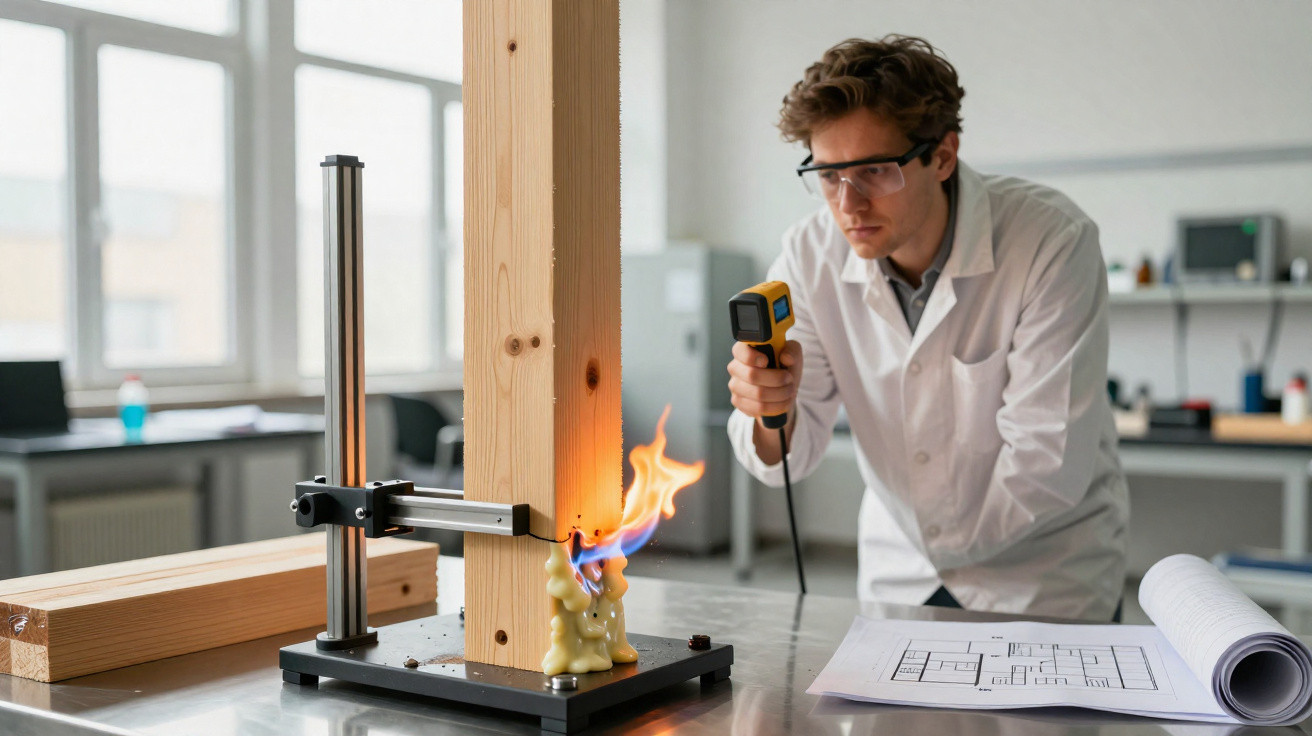
Scientists have established that fire-protective coatings applied to timber do not start protecting the wood as soon as a fire begins.
Before a coating completes its insulating protective layer, the outer 15 to 20 mm of timber may already have suffered enough heat damage to retain little load-bearing capacity.
Timber and fire protective coatings
When coated timber panels were exposed to fire, the first visible protective expansion did not occur until the wood directly beneath the surface had already become intensely hot.
At The University of Queensland (UQ), Stavros Spyridakis demonstrated that this delay was inherent in the activation process of the coatings.
Before providing insulation, each coating needed to soften and expand, leaving an interval in which the timber could lose strength.
This makes the opening phase of a fire especially important: protection is still forming while the timber has already begun to weaken.
Why swelling matters
As heat increased, the coating became intumescent, expanding into a carbon-rich layer that reduced the rate at which heat travelled inwards.
However, because this layer developed gradually, the timber continued to take in energy while its chemistry was changing.
This process is known as pyrolysis: heat-driven chemical decomposition before combustion that reduces strength and releases flammable gases.
Protection consequently developed over time rather than appearing immediately, altering how engineers need to assess early fire damage.
A faster trigger
On timber, the coatings activated under less severe heating than equivalent products generally require on steel surfaces.
Laboratory tests identified an activation point of roughly 13 to 15 kilowatts per square metre for the opaque coatings, and around ten for the transparent version.
Comparable thresholds identified in earlier research were above 20 to 23, indicating that timber enables these coatings to respond sooner.
Nevertheless, earlier activation did not prevent the wood below the coating from first heating to a hazardous level.
Heat and timber fire coatings
By the point swelling first became visible, the timber near the coated face had already reached approximately 165 to 182 °C.
Separate research on wood indicates that lengthy exposure above 66 °C can result in permanent strength reduction before charring starts.
Under fire conditions, a structural member may therefore lose useful capacity before the expanded foam can insulate it.
Once this was understood, attention shifted from the behaviour of the coating to concealed structural deterioration within the timber.
Clear coating limits
Although the transparent coating activated at lower temperatures, it also began to deteriorate sooner than the two opaque coatings.
Material testing showed that it retained about 21 percent of its original mass, compared with 43 and 55 percent for the opaque coatings.
A recent paper by the same research group had already shown that clear coatings became less effective under more intense heating.
The clear finish offered greater visual appeal than durability during a fully developed room fire.
What timber loses
Once swelling was complete, the first 15 to 20 mm of timber retained little significant mechanical capacity.
Temperatures further into the section remained much lower, meaning that most of the remaining timber preserved a large proportion of its initial strength.
An official chapter on wood explains why thick timber can often withstand fire: char restricts the inward movement of heat.
The new finding reduced that safety margin by showing that the outer zone may be severely damaged before the protective coating achieves full performance.
Why steel differs
Steel generally draws heat away from a coating, whereas timber retains more of that energy close to the exposed surface.
As less heat is conducted back through the material, a coating on timber reaches the conditions required for swelling more quickly than a comparable coating on steel.
Previous steel experiments established this difference, while the new timber testing made the contrast difficult to overlook.
Engineers must therefore treat the substrate, rather than coating formulation alone, as a central element of the fire-protection challenge.
Design rules change
Cross-laminated timber is widely used for structural floors; these thick panels comprise bonded timber layers arranged in alternating directions.
After the first layer has weakened, the layer beneath may not be able to take the load fully, particularly under bending.
Designers often regard board coverings as immediate protection, but these coatings acted more like timed systems than instant barriers.
Safety calculations may consequently need to include an allowance for early damage before subsequent charring is considered.
Rethinking fire coatings for timber
This does not mean thin coatings are without value, as they still slow charring and may delay timber ignition during the early growth of a fire.
For architects, this maintains the possibility of exposed mass timber, including large engineered timber panels and beams, without suggesting that appearance and safety are the same thing.
The message for engineers was clearer: every design check should consider timing data alongside coating thickness and product type.
Improved evidence does not make the choice simpler, but it makes the trade-offs much easier to identify.
The study reframed thin fire coatings as timed systems in which chemistry, substrate and durability together determine when protection actually starts.
Future design rules will be more effective if they recognise this initially weakened zone as genuine damage, rather than empty material waiting to become char.






Comments
No comments yet. Be the first to comment!
Leave a Comment