
Brown leaf edges, dried-out shoot tips and hardly any new growth: this is the reality for many Japanese maples in German gardens. Those who water and fertilise but still face a struggling little tree are usually overlooking one crucial care task in early spring. March in particular offers a small window in which the tree’s whole season can be influenced for the better.
Why Japanese maples need special care in March
Japanese maples (Acer palmatum) have a very fine, shallow root system. Their roots sit only a few centimetres beneath the soil surface and react extremely sensitively to temperature fluctuations and drought. Late spring frosts, the first hot days in April and May, or strong winds can all place them under considerable strain.
Garden owners see the consequences only in the canopy above:
- Brown, scorched leaf edges
- Small shoots that dry out from the tip backwards
- Hardly any growth despite regular watering
- A thin, unimpressive canopy of foliage
This is particularly deceptive: even those who diligently reach for the watering can may unknowingly place the tree under further stress. Alternating between soaking-wet soil and soil that dries out severely again unsettles the delicate roots. This is exactly where the key March care measure comes in.
“A simple layer of mulch applied at the right time in March stabilises the root environment and lays the foundation for visibly healthier growth.”
Mulching is the key: woodland soil for an ornamental tree
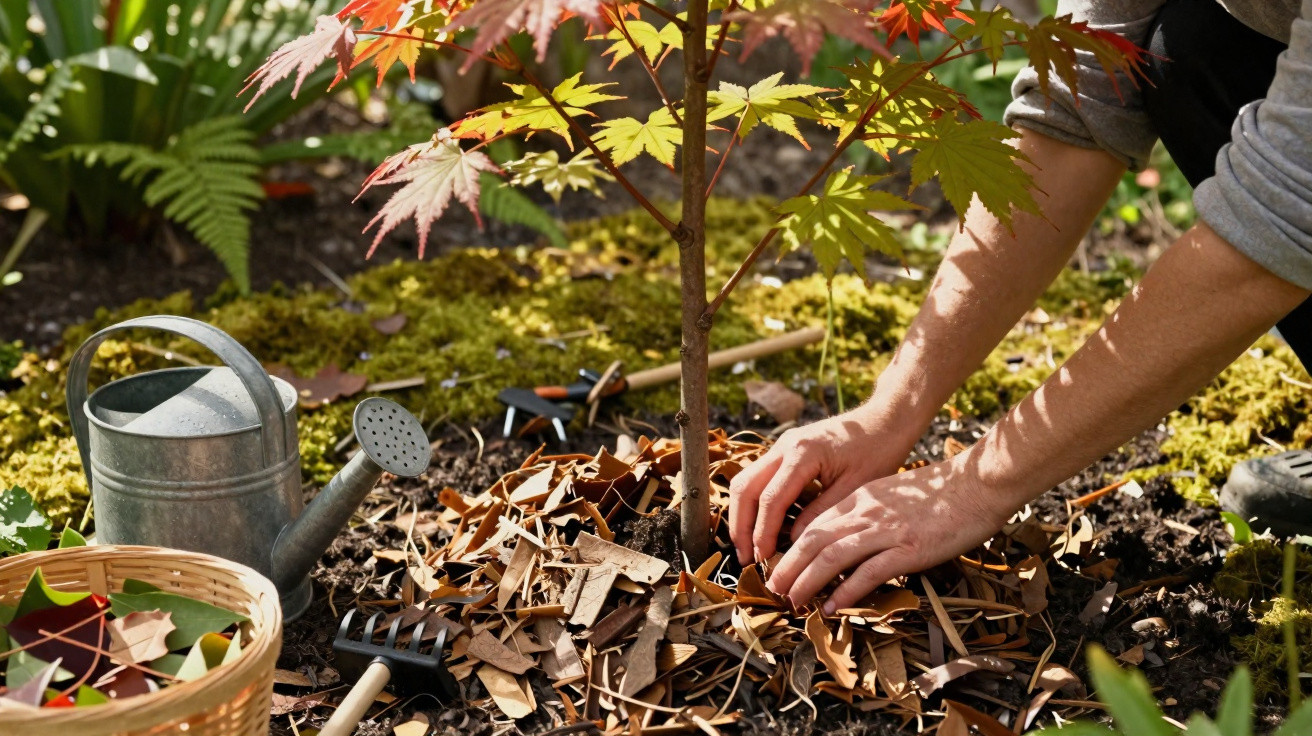
In its native habitat, the Japanese maple usually grows at the edge of open woodland or beneath larger trees. There, its roots are protected by a permanent layer of leaves, bark fragments and fine humus. This setting is surprisingly easy to recreate in the garden by applying organic mulch deliberately.
Mulch has several beneficial effects:
- It protects shallow roots from late frost and heat.
- It keeps the soil consistently moist without encouraging waterlogging.
- It suppresses competition from weeds.
- It gradually supplies nutrients, much like woodland soil.
- It improves soil structure over the long term.
For this reason, many tree nurseries and garden centres recommend adding a fresh layer of mulch around the tree each spring - ideally in March - or renewing the existing layer.
Step by step: how to mulch your Japanese maple properly in March
Prepare the soil without damaging the roots
As soon as the ground is frost-free in March, start the preparation work directly around the base of the tree:
- Remove weeds: Carefully pull out wild plants by hand so that no root remnants are left in the soil.
- Loosen the soil lightly: Use your hand or a small hand cultivator to break up the top 2–3 centimetres. Do not work any deeper, as this could damage the maple’s fine roots.
- Check old material: Inspect any remaining old mulch. Heavily decomposed material can be worked into the soil, while matted layers are best removed.
Apply the correct mulch layer
The second stage is the actual mulching. The choice of material and the depth of the layer are decisive.
Recommended depth for garden soil: around 5–8 centimetres. For container-grown plants, 3–5 centimetres is usually sufficient.
“The base of the trunk must always remain visible and clear - mulch should never be placed directly against the trunk, otherwise rot and fungal problems may develop.”
For this reason, always leave an uncovered ring of around 10 centimetres around the trunk. The mulch should begin only outside this “collar” and cover the ground out to the edge of the canopy - in other words, the area where rainwater and irrigation naturally fall.
Which materials suit Japanese maples - and which do not
Japanese maples thrive best in slightly acidic, humus-rich soil. Mulching materials that resemble natural woodland soil are therefore ideal.
| Suitable | Better avoided |
|---|---|
| Composted pine bark or bark-mulch mixes | Dark chippings or gravel in full sun |
| Well-rotted leaves, such as beech, oak or maple leaves | Fresh grass clippings in thick layers |
| Woodchip from untreated woody material | Plastic sheeting or fleece laid directly on the soil |
| Mature, crumbly garden compost applied in a thin layer | Coloured decorative mulches from DIY shops |
Fresh grass clippings rot quickly, removing oxygen in the process and potentially encouraging mould. Plastic sheeting prevents air exchange and blocks the natural formation of humus. Dark gravel increases heat build-up around the already sensitive root area - a real stress test for the tree.
Water wisely: how mulch supports moisture balance
With a suitable mulch layer, the soil stays evenly moist for longer. This does not mean you no longer need to water, but the intervals can be adjusted sensibly.
Guidance for garden soil:
- Normal spring/summer: Water thoroughly around twice a week, ensuring that moisture reaches the deeper root zone.
- Prolonged dry periods: Increase this to three or four times a week, depending on the location and soil type.
It is important to water less often but deeply, rather than merely dampening the surface every day. Mulch prevents moisture from evaporating immediately and ensures that water genuinely reaches the fine roots.
Japanese maple in a container: special considerations for watering and mulch
Japanese maples grown in containers respond even more sensitively to both drought and waterlogging. A thin mulch layer can work wonders here too, but it must not be too deep. Three to five centimetres is entirely sufficient in a pot.
After every watering, check the saucer or outer pot and empty out any standing water. Waterlogging around the roots is one of the most common reasons for container-grown maples to weaken. In summer, mulch protects the potting soil from overheating; in spring, it helps buffer sharp temperature fluctuations.
Common mistakes in March care - and how to avoid them
Many problems result from well-intentioned but misunderstood care. These include:
- Mulch that is too deep directly against the trunk:

Comments
No comments yet. Be the first to comment!
Leave a Comment