
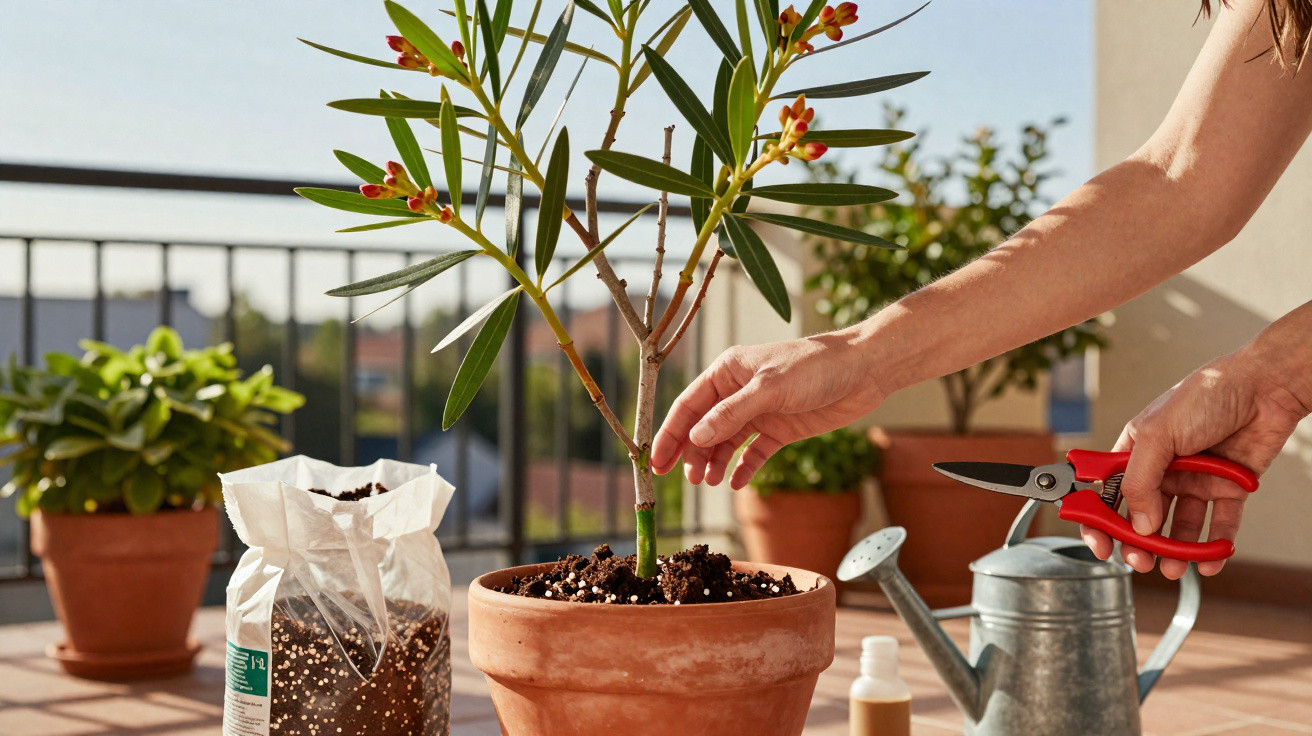
With the right approach, however, the shrub can make a remarkably strong recovery.
When gardeners bring their oleander out of the garage, cellar or winter quarters in spring, the sight is often alarming: scorched leaves, brown shoots and, sometimes, an entire shrub that appears completely dried out. This Mediterranean long-flowering plant is especially vulnerable to frost in cooler areas or when grown in a container. The encouraging news is that a clear plan involving assessment, careful acclimatisation outdoors, targeted pruning, root care, nutrients and appropriate watering can usually turn it back into a lush ball of flowers.
Checking oleander in spring: is the shrub still alive?
Before reaching for the secateurs, watering can or fertiliser, assess the plant's condition. Many oleanders that look dead still have plenty of life within them.
The bark scratch test
Using a fingernail or a small knife, lightly scratch the bark:
- If the tissue underneath is green and moist, the shoot is alive.
- If it remains brown and dry, that branch has died.
Test several areas, including lower down near the base. The upper sections are often frost-damaged, while the lower part has survived winter well.
Buds at the base provide another indication. Small, slightly swollen bumps on the shoots show that the oleander is ready to grow again. Even where the upper canopy looks miserable, these buds can rebuild the whole shrub.
When to move it outdoors
Patience saves more oleanders than any specialist fertiliser. Putting the plant outside too early exposes it to late frost, which can use up all its reserves.
Use two simple markers as a guide:
- no overnight frost is forecast
- night-time temperatures remain reliably above roughly 10°C
Depending on the area, this is usually between late March and mid-April. In exposed or colder locations, it may be later. It is better to leave it protected for a few extra days than allow it to freeze once too often.
A gentle return to outdoor conditions
Oleander loves sunshine, but it does not cope well with a cold shock or sun scorch after weeks in the dark.
Acclimatise gradually rather than placing it straight into full sun
At first, place the container in partial shade for a few hours each day. Gradually extend its time outdoors and move it into a slightly sunnier position. Only once the leaves feel firmer again and show no damage should the shrub be moved to its permanent sunny spot.
If the oleander is planted in the garden, remove winter protection, fleece or leaf covering in stages. Watch the weather forecast closely during this period: a brief cold spell is enough to ruin young shoots.
The key to recovery: gentle changes in temperature, plenty of light and no surprise frosts.
Spring pruning for oleander: decisive, not reckless
Once frost is no longer a threat, it is time for the secateurs. Pruning determines whether the oleander produces vigorous new shoots and, later, flowers.
Remove dead shoots thoroughly
Cut back every black, soft or completely dried-out branch to healthy wood. Healthy wood has a green, slightly damp layer beneath the bark. Make an angled cut just above an outward-facing bud to create an open canopy.
Branches that cross or grow inwards should also be removed. This lets more light reach the centre and gives fungal diseases less opportunity to take hold.
Cut severely damaged plants back hard
If the whole oleander looks burnt, a drastic cut-back can save it. Many amateur gardeners hesitate, but the shrub usually tolerates this well:
- shorten it to around 30 to 40 centimetres above ground level
- use clean, sharp secateurs
- cut as close as possible above a strong bud
The trade-off is that flowering is often less impressive that year. In return, the plant develops into a sturdy young shrub with plenty of fresh shoots, ready to perform strongly the following summer.
Roots and growing medium: no abundant flowers without a fresh foundation
Especially in containers, compost is depleted after one or two years. Compacted roots, waterlogging and a lack of nutrients place further strain on an already weakened oleander.
When repotting is worthwhile
The roots will tell you what is needed:
- roots are growing out of the drainage holes
- the compost barely absorbs water, which instead runs down the sides
- roots form a dense ring around the edge of the pot
In these cases, a larger container is the only solution, but do not overdo it. A pot only a few centimetres wider is sufficient. Oleander prefers to be slightly pot-bound rather than surrounded by too much compost.
The ideal mix for Mediterranean roots
The shrub prefers free-draining, fairly lean growing medium that sheds excess water effectively. A proven mixture contains:
- flowering-plant compost
- coarse sand or fine grit
- a little well-rotted compost
A layer of expanded clay pellets or gravel at the bottom of the pot provides drainage. In garden beds with heavy clay soil, work in sand or grit to prevent waterlogging.
If the container is already very large and difficult to move, remove at least the top five centimetres of compost and replace it with fresh, nutrient-rich growing medium.
Fertilising and watering: the boost for summer flowers
Oleander is a heavy feeder. Anyone who simply lets it "get on with it" after winter is wasting its potential.
The right fertiliser at the right time
From March to around September, the shrub benefits from regular nutrients. Fertilisers with a high potassium content are particularly suitable. Potassium strengthens plant tissue, encourages flowering and makes the plant more resilient.
A practical routine:
- add liquid flowering-plant fertiliser to the water every one to two weeks
- or apply a slow-release fertiliser in spring and give a light additional feed from June
Important: never fertilise bone-dry growing medium. Water it thoroughly first, then feed it. Otherwise, the roots can be scorched.
Water: plenty, but never permanently wet
A recovering oleander requires regular watering but cannot tolerate constant wetness. For container plants, allow the surface of the compost to dry slightly between waterings. Then water slowly at the root ball until water emerges underneath, and empty saucers after a few minutes.
Garden-planted shrubs need around two substantial waterings a week at the height of summer, depending on heat and soil conditions. A mulch layer of gravel or coarse bark retains moisture for longer and protects roots from extreme temperature fluctuations.
The combination of free-draining soil, abundant light, suitable watering and potassium-rich nutrition can turn a winter casualty into a summer star.
Light, position and common mistakes that cost flowers
Without sunshine, there will be no spectacular display of flowers. Oleander needs several hours of direct sun every day, ideally against a sheltered south- or south-west-facing wall. There it benefits from radiated warmth while remaining reasonably protected from wind.
These mistakes hold oleander back
- moving it outside too early, causing frost damage to new shoots
- abruptly transferring it from winter quarters into intense midday sun
- leaving it constantly wet in a saucer, leading to rotting roots
- anxiety watering: watering far too frequently for fear it will dry out
- "shock fertilising": pouring high doses onto dry compost
Gardeners who correct these pitfalls early often see something close to a small miracle: within a few weeks, a depressing skeleton becomes a vigorous, densely leaved shrub that starts producing bud after bud from May or June.
What else to consider when handling oleander
Oleander is beautiful, but it is also a poisonous plant and should not be treated carelessly. Every part of the plant contains toxic substances. Many gardeners wear gloves when pruning so that the milky sap does not touch their skin. Do not put prunings on the compost heap if pets could chew them; dispose of them safely with general waste instead.
As a Mediterranean plant, oleander combines particularly well with lavender, rosemary or rock rose in containers. Grouping several large pots creates a small southern-style landscape on a patio or balcony, flowering for a long time and attracting bees. An assortment of flower colours, from white and pink to deep red, makes the display even more lively.
Anyone facing the same problems every year after winter should reconsider the location. A permanently fitted wheeled plant caddy makes it easier to move large containers into winter quarters. In areas at high risk of frost, a consistently sheltered position, such as an unheated conservatory, can greatly reduce stress for both plant and gardener.
Comments
No comments yet. Be the first to comment!
Leave a Comment