
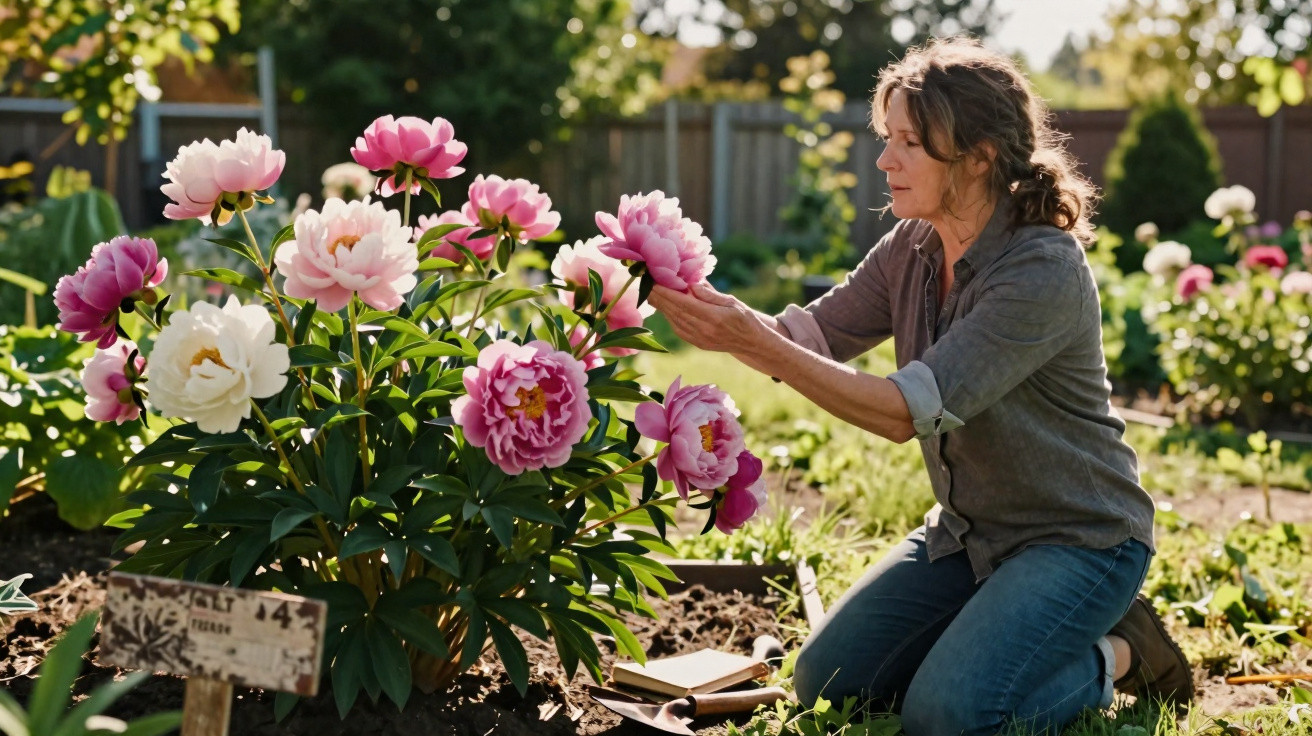
It was one of those first warm days in May, when the air already tastes of summer but the ground still smells of April. In my neighbour’s front garden stood three old peonies: hefty, grey-green shrubs that had produced nothing but leaves for years. “They never flower,” she would always say, half-jokingly threatening to pull them out. Then, one morning, I stood in front of that border and could hardly believe my eyes: a sea of plump, fragrant blooms, as if someone had flicked a switch. No gradual change, no “They’re slowly producing more.” Just: boom. It felt almost like a small gardening scandal. You cannot help wondering: what had these plants been doing all those years, and why have they suddenly burst into flower?
The quiet patience of peonies – and their dramatic entrance
Anyone who has lived with peonies for a long time knows that peculiar mix of disappointment and hope. You water them, hoe around them and perhaps even speak to them in private – and the plants repay you with, well, foliage. Lots of foliage. Not a bud in sight. They sit in the border like stoic green statues while tulips, roses and hydrangeas put on their displays around them. Then, often after years, comes that one spring when dozens of buds suddenly emerge, as though they had arranged it between themselves. That contrast is part of their charm: peonies are not merely flowers; they are a small lesson in radical patience.
Gardeners all over the country tell versions of the same story. Take the garden of an older woman in a village, where a peony had occupied the same spot for more than twenty years. It was planted when the children were small, produced only leafy growth for years and was eventually half forgotten. “It doesn’t do anything,” people would say. Then came the year when the old cherry tree was felled and the border was thoroughly dug over. The following spring brought thirty vivid pink flowers all at once. Neighbours stopped to stare, children took photographs, and strangers rang the bell to ask how she had managed it. She simply shrugged. Yet her expression held that quiet amazement we all recognise when nature suddenly becomes generous.
There is no accident behind this apparent whim, but rather a very particular life cycle. Whether herbaceous or tree peonies, peonies devote an enormous amount of energy to their root systems. During the first few years, the plant works largely underground, building reserves, branching out and establishing itself in the soil. Flowers are a luxury rather than a necessity. Buds also form very low down on the shoots. If the plant has been set too deeply, receives too much fertiliser or grows in even moderately shady conditions, its efforts shift entirely towards growth rather than flowering. The famous explosion of blooms after years is actually the result of thousands of tiny, invisible decisions made by the plant.
What really makes peonies flower
If you have a peony that has stayed silent for years, there is no need to pray; it needs to be understood. The most important factor is planting depth: on herbaceous peonies, the “eyes” – the buds on the root – should sit beneath only around 3–5 centimetres of soil. Any deeper, and they enter a kind of permanent adolescence. With tree peonies, the graft union should be just below ground level or even directly above it. Light is another key factor: peonies need at least half a day of sunshine, and preferably more. A change from “too shady” to “enough light” can trigger the famous flood of buds as early as the following year. Then there is peace and quiet: peonies love consistency and hate being moved.
Many amateur gardeners respond impatiently by cutting wildly, applying fertiliser with abandon or relocating the plant every two years. That is exactly what holds it back. A moderate, potassium-rich feed in spring is entirely sufficient, and compost is often generous enough on its own. Nitrogen-heavy lawn feed applied right beside the border? That is a guarantee of plenty of leaves and few flowers. Let us be honest: nobody follows a perfect feeding schedule and carries out a meticulous site inspection every day. That is why a sober assessment helps: how long has the plant been there, how deep is it sitting, and how much sun does it truly receive in May and June? Sometimes simply allowing less grass to grow along the edge, or lightly thinning a shrub, is enough to let in more light – and suddenly the peony gets serious.
An experienced gardener once put it like this:
“Peonies are like old friendships. You do not need to tend to them constantly, but you must not keep rearranging them either.”
That approach leads to a short checklist which surprisingly often results in an explosion of flowers:
- Check the position: at least 4–6 hours of sun, no waterlogging and no location directly beside the invasive roots of large trees.
- Inspect planting depth: if the peony has failed to flower for years, carefully remove soil until the buds sit nearer the surface.
- Give it peace: avoid repeated moving or annual division, and limit cutting to faded blooms and old foliage in autumn.
When twenty silent years suddenly make sense
Anyone who has seen an old peony, previously silent, suddenly become a diva will look at it differently afterwards. Years of “disappointment” abruptly gain a story: the beginning was too shady, the hedge competed for resources, or there was that one dry summer without watering. Then perhaps a single circumstance changes everything – a fence that lets in more light, a mild winter, or an autumn when nobody buried the plant too deeply. In retrospect, it can seem almost logical that it has chosen this moment to begin. Even so, it feels like a gift when the buds open and that heavy, sweet scent spills across the border.
| Key point | Detail | Benefit for the reader |
|---|---|---|
| Planting depth | Buds should sit only a few centimetres below the soil surface | Explains why many peonies produce “only leaves” for years |
| Position & light | At least partial shade with prolonged direct sunshine | Makes it possible to plan targeted, small garden changes rather than discarding the plant |
| Patience & stability | No frequent relocation, gentle care | Removes the pressure and shows how long-term flowering truly develops |
FAQ:
- Why has my old peony suddenly flowered after many years? Conditions at the site may often have improved unnoticed: more light, less root competition or a more favourable winter. At the same time, the root system may have become strong enough to direct energy into flowers rather than growth alone.
- Can I simply move a “silent” peony? It is possible, but risky. Peonies are sensitive to relocation. If it is genuinely in the wrong place – too shady, too wet or far too deep – one careful move in autumn may help. Afterwards, however, the plant will need several years to recover again.
- How long does it take for peonies to flower for the first time after planting? In favourable conditions, herbaceous peonies often produce their first blooms after 2–3 years, while tree peonies are more likely to need 3–5 years. Incorrect planting depth or insufficient light can extend this considerably.
- Should I cut off faded peony flowers? Yes, as this reduces the plant’s workload by preventing it from putting energy into seed production. Leave the stems in place until the foliage dies back in autumn, because they are still storing strength for the following season.
- How much fertiliser do peonies really need? Less than many people think. One application of mature compost in spring, plus perhaps a little potassium-rich fertiliser, is enough. Too much nitrogen encourages foliage growth alone and can suppress flower formation for years.






Comments
No comments yet. Be the first to comment!
Leave a Comment