
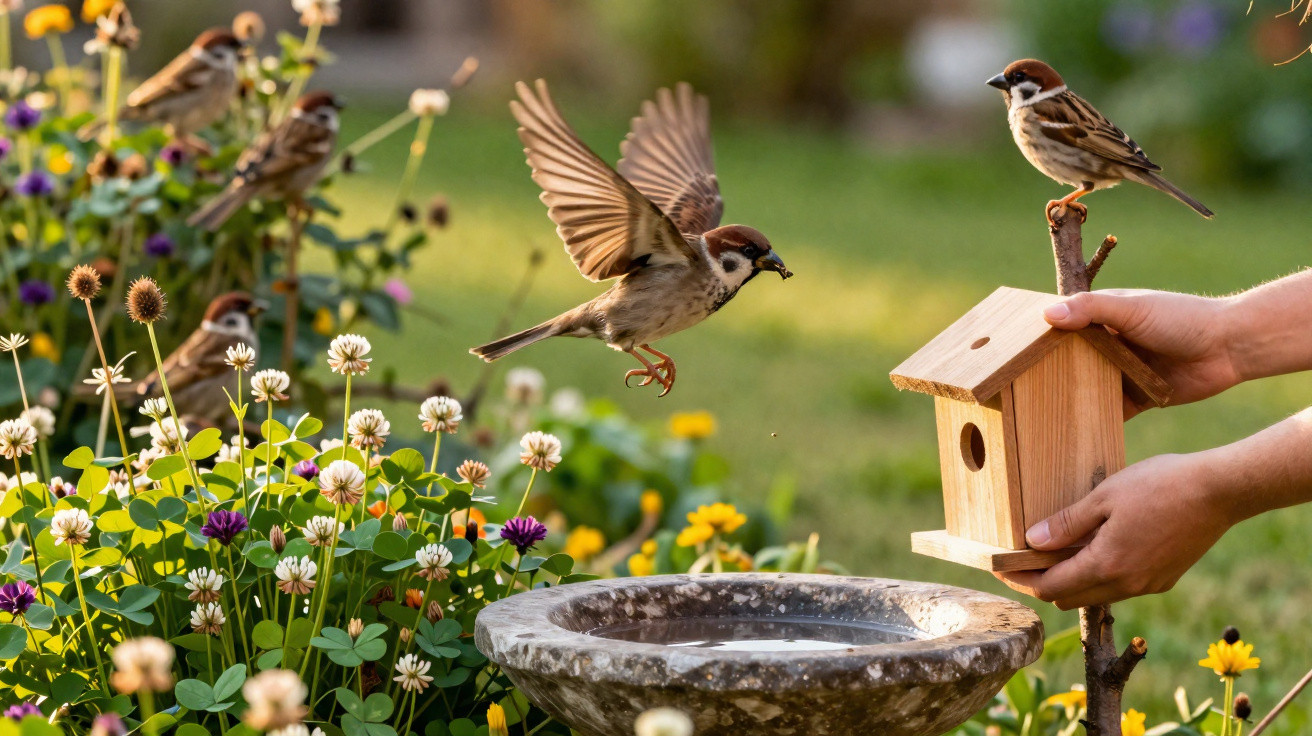
While everyone looks forward to the first days of spring and delights in robins and tits, another bird is usually undervalued: the house sparrow, better known simply as the sparrow. The French Bird Protection League (LPO) is now strongly stressing that this supposedly “problem” bird is a key part of a healthy, thriving garden ecosystem.
A bird with a poor reputation
For decades, sparrows were regarded as agricultural pests. They eat grain, peck at seeds and arrive in flocks – so the verdict was quickly reached: get rid of them. That perception became deeply rooted and still persists today, including in private gardens.
Many amateur gardeners continue to view sparrows as competitors for seed or as unwelcome permanent visitors at the bird feeder. Yet this perspective is far too narrow. It comes from a period when agricultural yields took priority over everything else and ecological relationships received little attention.
Labelling the sparrow as “useless” or “harmful” completely ignores its role in nature’s balance.
LPO specialists describe this as a strongly anthropocentric viewpoint: the bird is judged solely on whether it reduces or increases yields. Scientifically, however, the situation is different. In stable ecosystems, no species is considered “useless”. Every one makes a contribution – including the sparrow.
A faithful neighbour to people
The house sparrow is one of the few wild birds that has adapted closely to human life. It nests in gaps in walls, beneath roof tiles and in hedges near homes. It uses towns, villages and gardens as habitat, and has lived alongside people for centuries.
Paradoxically, this closeness has harmed its image: where sparrows are common, they seem ordinary, almost dull. Many people would rather watch a striking robin sitting dreamily on a fence than a group of sparrows squabbling in the bushes.
Even so, the sparrow is immensely valuable to the garden ecosystem. It does not eat seeds alone; at one crucial time of year, its diet consists largely of insects.
Why the sparrow manages your insect team
In spring and early summer, young sparrows need especially high levels of animal protein. The adult birds collect caterpillars, larvae and other insects in the garden to feed them. What may seem like only a few beakfuls adds up to impressive quantities over a breeding season.
A pair of sparrows can feed thousands of insect larvae to their young – without the gardener needing to lift a finger.
Insects the sparrow particularly likes to eat
- Caterpillars of butterflies and moths that nibble fruit trees and vegetable leaves
- Beetle larvae that can damage roots or foliage
- Aphids and other sap-sucking insects on roses, beans and perennials
- Flies, mosquitoes and small spiders living in grass and hedges
The sparrow does not replace a complete pest-control strategy. However, it helps prevent typical garden pests from multiplying explosively. Rather than applying chemicals that also harm beneficial species, the bird works quietly in the background every day, free of charge.
How the sparrow keeps your garden ecosystem stable
Anyone who tends a garden knows the basic problem: once the balance tips, everything tips with it. A mass outbreak of aphids? Fungal diseases often follow. Too many caterpillars? The fruit harvest suffers. A bird such as the sparrow acts as a natural buffer here.
LPO experts emphasise that the house sparrow helps keep insect populations “within acceptable limits”. It does not eliminate them entirely – and that would be disastrous, as birds, hedgehogs and many other animals depend on insects for food.
| Sparrow’s role | Benefit in the garden |
|---|---|
| Insect hunter | Reduces pest pressure on fruit, vegetables and ornamental plants |
| Seed collector | Reduces seeds from unwanted wild plants while still supporting biodiversity |
| Prey for birds of prey | Forms part of a stable food chain that sustains raptors in residential areas |
| Nutrient provider | Bird droppings return nutrients to the soil and support micro-organisms |
The sparrow therefore acts as a quiet intermediary: it eats enough to limit damage, while leaving sufficient insects for other species to avoid going hungry. This creates the dynamic balance a living garden needs.
Why the sparrow is disappearing nevertheless
People living in large cities may feel that sparrows are everywhere. Numerous studies, however, show a clear decline, exceeding half the population in some regions over just a few decades.
The reasons are clear:
- Sealed surfaces replacing gardens and brownfield sites
- Renovation work that removes nesting opportunities in roofs and façades
- Uniform gravel gardens with no food or cover
- Intensive farming and pesticide use in rural areas
The LPO and other conservation organisations believe this is putting the house sparrow under pressure. From their perspective, every green oasis around a home serves as a small refuge – and every garden owner is therefore, often unknowingly, making a choice for or against this species.
How to make your garden sparrow-friendly
Anyone who no longer sees the sparrow as a nuisance can create a genuine paradise for it with only a few measures. At the same time, this benefits many other bird species and insects.
More structure, less perfection
Sparrows love dense hedges, climbing plants and secluded corners. A completely styled garden with gravel, artificial turf and isolated evergreen specimen plants feels like a desert to them.
- Leave one area with wild plants and long grass.
- Plant native shrubs such as dog rose, hawthorn or privet.
- Avoid extensive gravel and concrete wherever possible.
Nesting places and food – done properly
Sparrows like to breed in colonies. Single nest boxes are often insufficient; several boxes placed side by side, or special multi-chamber “sparrow terraces”, are better.
A simple rule applies to food: seed mixes are useful in winter and early spring, while during the breeding season an insect-rich garden offers more than any feeding station. Insect-friendly perennials, flowering herbs and unsprayed fruit trees become a lasting source of caterpillars and beetles.
Why the sparrow is more than merely “nice”
Taking the LPO’s arguments seriously makes one thing clear: the sparrow is not merely an “quite nice” garden animal, but a building block of resilient ecosystems. It helps to offset human interventions, at least in part, by slowing insect populations when they become excessive.
The more we intervene to correct things in gardens, the more dependent we become on natural allies such as the sparrow.
In a future of more frequent heatwaves, dry spells and extreme weather events, plants will face further stress. Weakened plants are more quickly affected by pests. A stable network of predators, including the sparrow, can make the difference between “annoying” and “catastrophic”.
What changes when you see the sparrow differently
Imagine a typical spring day in the garden: you sow lettuce, inspect the buds on fruit trees and hear a chorus of birdsong in the background. Among tits and blackbirds, small brown birds dart through the bushes, briefly land on a bed and disappear again.
Those who consider them thieves become irritated. Those who know that they are, for perhaps the hundredth time that day, taking caterpillars from the currant bushes see exactly the same scene in an entirely different way. The view of the garden changes once sparrows are recognised as fellow residents with a role to play.
For anyone with children, this can become a small research project: how often does a pair of sparrows fly to the nest each hour? What are they carrying in their beaks? How do plants behave around these “hunting grounds”? Such observations sharpen awareness of the connections behind what may seem like ordinary birdsong.
The LPO’s message can ultimately be reduced to one simple piece of advice: when the small brown bird lands in the flower bed in spring, do not chase it away. Give it space, a few places to hide and some tolerance. Your garden will thank you – more quietly, but more effectively, than any fertiliser or pesticide spray ever could.
Comments
No comments yet. Be the first to comment!
Leave a Comment