
A seemingly ordinary find from the woods could save them.
Anyone looking at their Monstera, Ficus or beloved spider plant at this time of year will often spot limp leaves, brown edges and soft, mushy stems. The usual response is to reach for the watering can – yet that often makes the problem worse. A simple pine cone collected in the woods can do more in this situation than costly liquid fertiliser or high-tech sensors, especially during winter.
Why winter quietly harms your houseplants
When temperatures fall, many amateur gardeners immediately assume their plants lack warmth. Indoors, however, something else is happening: the heating is on, the air is dry, and the pot is often positioned directly above or beside a radiator. Leaves lose moisture and start to droop, while the soil surface appears dry.
This is exactly where the trouble begins. Feeling guilty, people water the plant. Yet the soil at the bottom of the pot is often still wet, particularly in winter when plants enter a kind of resting phase. Their growth slows, they use less water, and their roots work at a reduced rate.
“Watering by instinct often gives plants wet feet in winter – and that leads straight to root damage.”
The result is water collecting in the lower part of the pot. This creates an oxygen-poor zone in which roots can barely breathe. Fungi and rot-causing bacteria thrive in such conditions. First a few leaves droop, then they turn yellow, and eventually the entire plant collapses – usually noticed far too late.
The overlooked helper: a pine cone on the soil
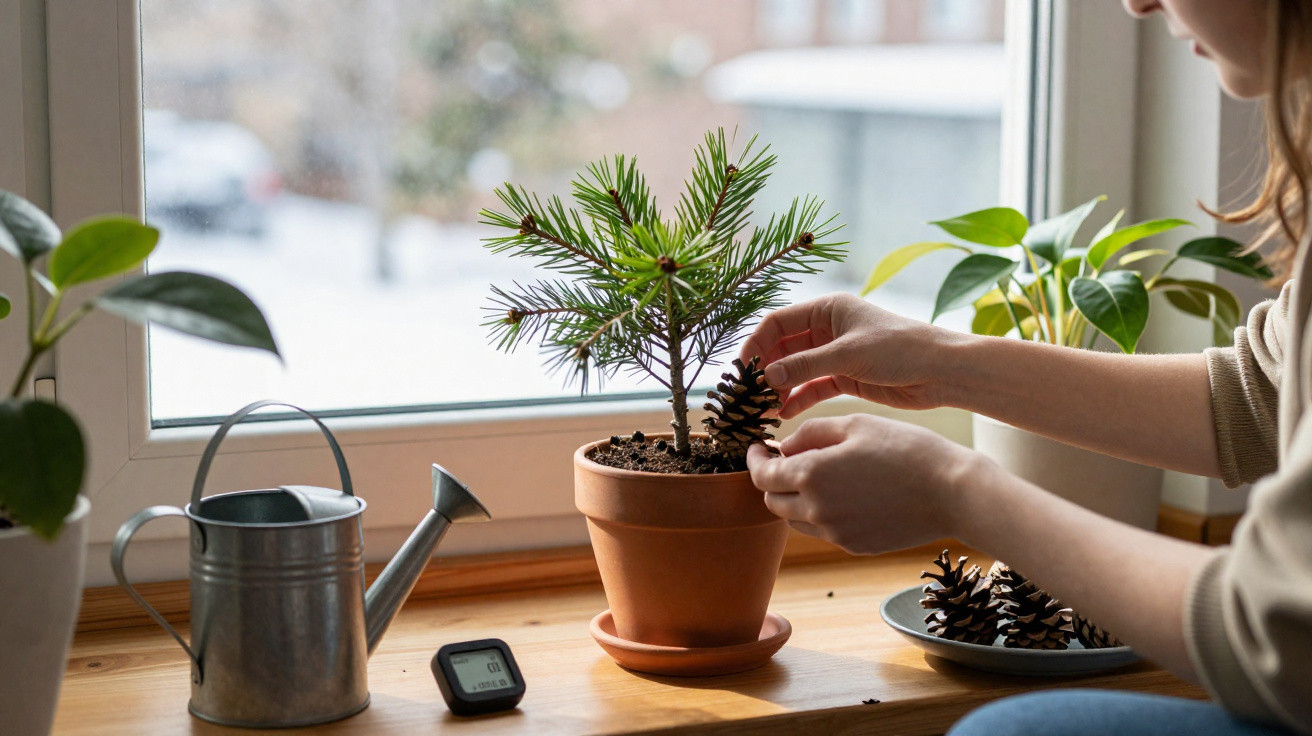
This is where the pine cone comes in. What many people regard as a decorative item can act like a small moisture manager in a flowerpot. Simply placed on the soil, a dry, open cone creates a buffer zone between the potting compost and the room air.
The important point is that the cone must not be buried. It should rest loosely on the surface. Its woody structure absorbs excess moisture at the top of the soil and releases it again later. This means the upper layer dries out more slowly without leaving the bottom of the pot sitting in water.
“A pine cone works like a natural sponge and a mini air filter directly on the compost.”
As a result, mouldy patches, greenish deposits and the hard white crust of lime and fertiliser salts that so often appears on flowerpots in winter form far less frequently. The cone also adds the look of a small piece of woodland to the living room – a pleasant side benefit.
Woodland biology: how the pine cone “measures” moisture
Pine cones are remarkable natural structures. Their scales respond to humidity and moisture in their immediate surroundings. In the woods, this mechanism ensures that they release seeds only in dry weather. At home, you can read this effect easily.
- Scales closed or clearly pressed together: The air and soil surface are still fairly moist. Keep away from the watering can.
- Scales wide open, with the cone looking fanned out: The surroundings are dry. It is time to inspect the pot more thoroughly.
A cone does not replace checking deeper into the soil with your finger, but it is a surprisingly dependable first sign. It reacts far more sensitively than a quick touch of the dry-looking crust on top.
“Anyone who glances at the cone every day will soon develop a very good feel for their plants’ water balance.”
Step by step: preparing a pine cone for houseplants
To avoid bringing spiders, beetles or fungal spores indoors along with the cone, it needs a little preparation. This takes only a few minutes.
Preparing pine cones
- On a walk, collect only dry cones that have already opened – they are lighter and contain less resin.
- Remove coarse dirt using a brush or an old toothbrush.
- Heat the cones in an oven at around 90°C for 20 to 30 minutes, or leave them to dry for several days on a warm radiator.
- Allow them to cool fully before placing them near your plants.
Heat treatment kills any insects, larvae and fungi that may be present. At the same time, the cone’s natural structure remains entirely intact – which is precisely what is needed.
Positioning them correctly in the flowerpot
The cone belongs on the soil rather than deeper inside it. The centre of the pot, or the area close to the plant stem, is ideal.
- One cone is enough for small pots.
- Spread two to three cones loosely across large planters.
- Always leave a little space between the cone and the stem so air can circulate.
Several cones work like a thin mulch layer. They prevent the surface from drying too quickly without sealing the soil airtight.
What a pine cone can – and cannot – do
A pine cone is not a fertiliser in the traditional sense. It does not suddenly supply plants with nutrients such as nitrogen or potassium. Its main job in winter is different: helping to manage the delicate balance between moisture and air in the pot more effectively.
| Function | What the pine cone does |
|---|---|
| Moisture management | Absorbs excess surface moisture and releases it gradually |
| Mould protection | Makes mould and algae less likely to develop on the soil |
| Monitoring | Acts as a natural moisture indicator through the position of its scales |
| Fertilising | Releases only very small amounts of nutrients, and only very slowly as it decomposes |
Over time, the cone breaks down slightly and releases tiny quantities of organic matter. This is more of a bonus and is not a replacement for a proper fertiliser. Most houseplants need hardly any additional nutrients in winter anyway, because their growth is greatly slowed.
Winter care mistakes you should stop making urgently
Anyone using pine cones should also adjust their winter routine. Many issues arise from habits that suit the summer growing season.
- Extend watering intervals: In winter, watering every two to three weeks is often enough, depending on the pot size and plant.
- Check the location: Do not place pots directly above radiators; keep some distance from the heat source instead.
- Provide more light: Move plants closer to the window and open heavy curtains during the day.
- Protect leaves from cold: Do not allow leaves to press directly against cold window panes.
“Less water, more light and a little ‘woodland’ in the pot can bring many plants safely through the cold season.”
Which plants benefit most from the pine cone trick
This approach is particularly suitable for plants that react badly to waterlogging but appreciate slightly consistent humidity:
- Monstera and other arum family plants
- Ficus species, including rubber plants and weeping figs
- Succulents, which should be watered very sparingly in winter
- Living-room palms
- Orchids, where mould on the bark is a common problem
For species that love very moist conditions, such as bog plants or certain ferns, the cone serves more as an indicator than a drying aid. For these plants, checking the position of the scales before reaching for the watering can is especially worthwhile.
Everyday practical examples
In many homes, plants such as Monstera and rubber plants sit beside the sofa, often not far from a radiator. In the evening, someone walks past and runs a hand over the top layer of soil – it feels dry. Out of habit, the plant is watered. Two or three such watering sessions are enough to leave the lower roots standing in water for days.
With a pine cone on the soil, the picture changes: its scales are still half closed even though the surface looks dry. This signals that the soil should be checked further down first. If you then push a finger 2 to 3 centimetres into the compost, you will find that it is still noticeably moist below. The watering can stays in the cupboard, and the roots remain healthy.
Risks, limitations and useful combinations
A poorly prepared pine cone may bring insects indoors. Anyone who does not heat it or dry it thoroughly risks introducing small crawling creatures into the living room. Resinous cones from freshly felled trees are also less suitable, as they can be sticky and leave unattractive marks.
Combining the method with other simple measures makes sense: a saucer containing expanded clay and a little water raises local humidity without flooding the roots. Fresh compost once a year, gentle repotting and moderate pruning of dead parts further support the plant. Within this overall approach, the cone acts as a quiet guardian on the soil surface.
Anyone willing to try it will quickly realise that professional gardening skills are not needed to help houseplants through winter safely. A walk in the woods and a few minutes in the oven are all it takes to place a small piece of nature in the pot, where it works reliably in the background.
Comments
No comments yet. Be the first to comment!
Leave a Comment