
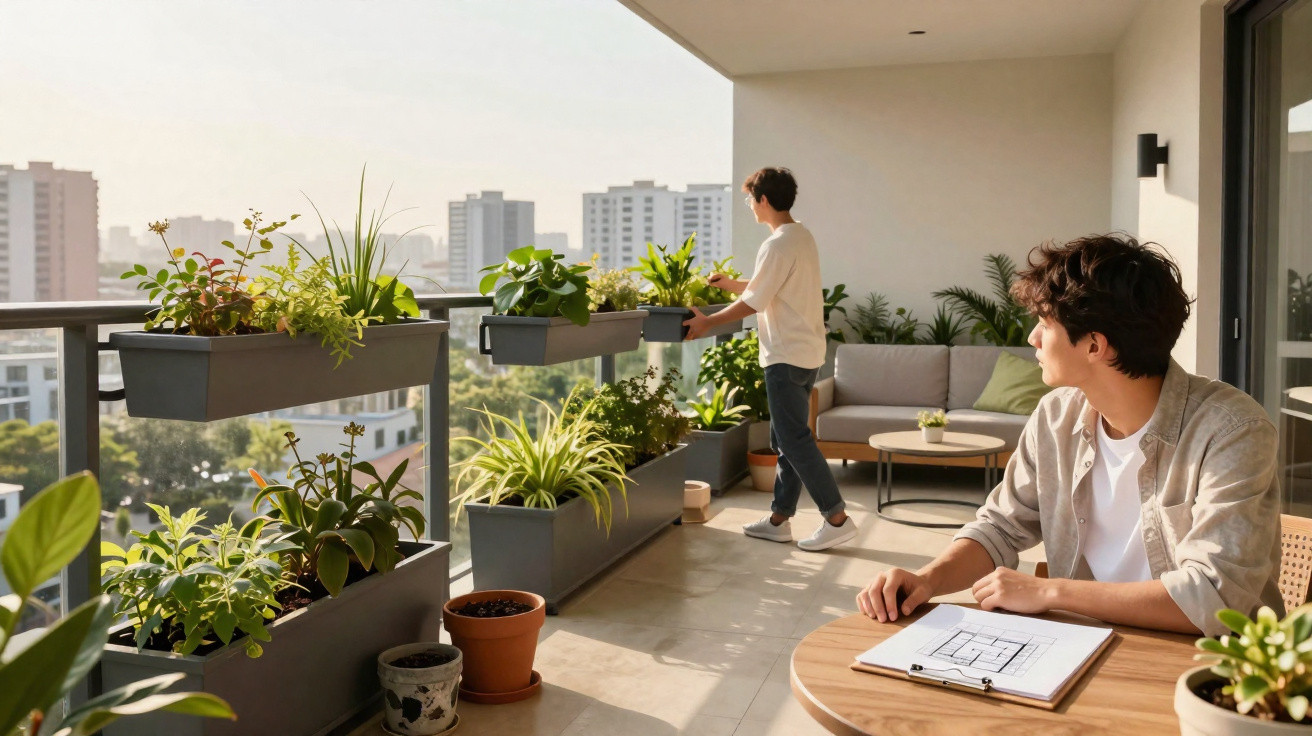
A new approach to balcony design is turning limited space into a genuine living area.
For years, balconies and terraces were treated as storage spots, with a few uninspiring pots dotted around. That trend is now shifting: outdoor spaces are being planned as an extra room, with defined styling, carefully considered planting and furniture that no longer looks randomly chosen. At the heart of it is a principle likely to transform many urban balconies by 2026.
From a collection of pots to a considered planting scheme
Anyone still filling their balcony with individual pots is giving up valuable space. The new design approach favours structure over piecemeal arrangements: plants become a deliberately staged part of the décor.
Raised beds and elevated planters free up the floor
The most noticeable change is that plant containers are no longer scattered across the ground. Rectangular planters on metal or wooden stands take centre stage instead. They lift greenery to eye level, or at least considerably higher than was previously usual.
“By lifting plants off the floor, even a tiny balcony feels airier, larger and far more orderly.”
The benefits are clear:
- More unobstructed space: There is more room for chairs, a small table, a sun lounger or stools.
- Easier care: There is no need to bend down to floor-level pots, while watering becomes quicker and more precise.
- A more cohesive overall look: A clear line replaces a chaotic collection.
Especially in cities, where outdoor space often measures only a few square metres, this step can feel almost like doubling the area – not in reality, but visually.
Minimalist and defined, without feeling clinical
Visually, the look is dominated by restrained shapes paired with striking contrasts. Black metal with slim bars meets warm wood and rich green foliage. The combination recalls Scandinavian interiors and contemporary loft styling, simply transferred outdoors.
Popular choices include:
- slim, elongated planters rather than round pots
- crisp, rectangular shapes
- understated container colours such as anthracite, sand, stone and olive
Plants therefore take on a different role. They are no longer a decorative extra, but a central part of the design – much like a statement sofa in a living room.
A flowing layout rather than trip hazards
Packing every available centimetre with pots creates a cramped impression. The new direction starts with the overall composition: plants are grouped, arranged in a line or deliberately placed in blocks. This creates a clear structure that naturally guides the eye.
“Fewer individual containers and more continuous lines create visual calm and freedom of movement underfoot.”
The practical benefit becomes obvious every day. It is easier to turn around, move chairs and welcome guests without constantly knocking into something. A small barbecue, side table or outdoor lamp is also more likely to find a suitable place.
Playing with height and volume: why nobody will plant flat in 2026
A guiding idea for the coming balcony season is to move away from a uniform height. Rather than positioning everything on the same level, designs are being created in tiers.
Plant displays across several levels
A few tall grasses in a raised planter, lower herbs and ground-cover plants beneath them, perhaps finished with a trailing plant, are enough to create a lively scene. The eye automatically moves from one layer to the next, making the space appear deeper.
This delivers noticeable results, particularly on compact balconies:
- Wall and balustrade height are put to use.
- Most of the floor remains available for practical use.
- The area feels like a setting rather than a storage space.
Even a narrow city balcony can gain character in this way – and look considerably more interesting in photographs, which matters to many social-media users.
Greenery as a room divider instead of heavy partitions
Plants at varying heights can create separate zones within just a few square metres, without putting up a visual barrier. For example, three raised planters containing medium-height plants can mark the boundary between a dining spot and a lounge corner, while still allowing sightlines through.
“Balcony greenery becomes the invisible architect: it separates without shutting things off, and connects without becoming dull.”
This creates small “islands” – an area for morning coffee, a corner for working and a place for an evening drink. The footprint stays the same, but its uses feel more varied.
The outdoor area as a fully fledged room
These new design ideas align with a broader trend: indoors and outdoors are blending more closely. Balconies are no longer seen as cluttered spaces with railings, but as an extension of the living room or kitchen.
This is evident in several areas:
- Furniture choices: Outdoor sofas, rugs, side tables and even small shelving units are replacing the standard plastic chair.
- Textiles: Cushions, throws, rugs and outdoor curtains add a homely feel.
- Lighting: Warm-white fairy lights, solar lanterns and table lamps create an evening atmosphere similar to that of a living room.
Planting follows the same ambition: it should not simply be placed “somewhere”, but should look like a designed backdrop. Instead of continually buying more pots, many city dwellers are purposefully developing a scheme that matches the style of their home.
How to put the new balcony idea into practice
The trend may sound design-led, but it can also work on a modest budget. A few steps are enough to adapt an existing balcony.
Take stock before buying quickly
Before ordering new planters, it is worth taking a critical look at the space:
- How much floor area should genuinely remain clear?
- Where is a pot currently getting in the way of sitting or walking?
- Which plants look out of place or no longer suit the style?
Pots that block the way can often be replaced with one wider raised bed. Several small containers with similar plants can be brought together in one elongated planter.
Choosing suitable plants
The following are particularly well suited to elongated, raised containers:
- grasses for height and movement
- herbs such as rosemary, thyme or mint for fragrance and practicality
- trailing varieties such as ivy or cascading geraniums for the edges
- compact shrubs in miniature form, including small ornamental woody plants in containers
Those with limited time should choose hardy, low-maintenance varieties and combine only a few types in each container. This creates a calmer effect and makes watering and feeding easier.
What balcony owners should consider by 2026
The new design approach brings opportunities, but it also involves a few considerations. Raised planters add weight to the balcony balustrade, so the structure must be suitable. However, many systems are lightweight and designed specifically for rented balconies.
An adapted watering approach is also helpful. Elongated planters dry out more quickly on warm days. Anyone without green fingers can consider built-in water reservoirs or automatic irrigation. For very exposed, windy locations, wind-resistant varieties are sensible, so the airy look does not disappear after the first autumn storm.
It will also be interesting to see how this develops alongside technical solutions: smart plugs for fairy lights, small solar panels on planters and soil-moisture sensors all suit these new, clearly structured set-ups. The balcony is then not only more attractive, but also used more functionally.
Anyone who rethinks their space today will not need to start completely again in 2026. One or two raised planters, deliberately positioned plants across different levels and a cleared floor can often be enough to make an ordinary balcony suddenly feel like a small, designed outdoor lounge.



Comments
No comments yet. Be the first to comment!
Leave a Comment