
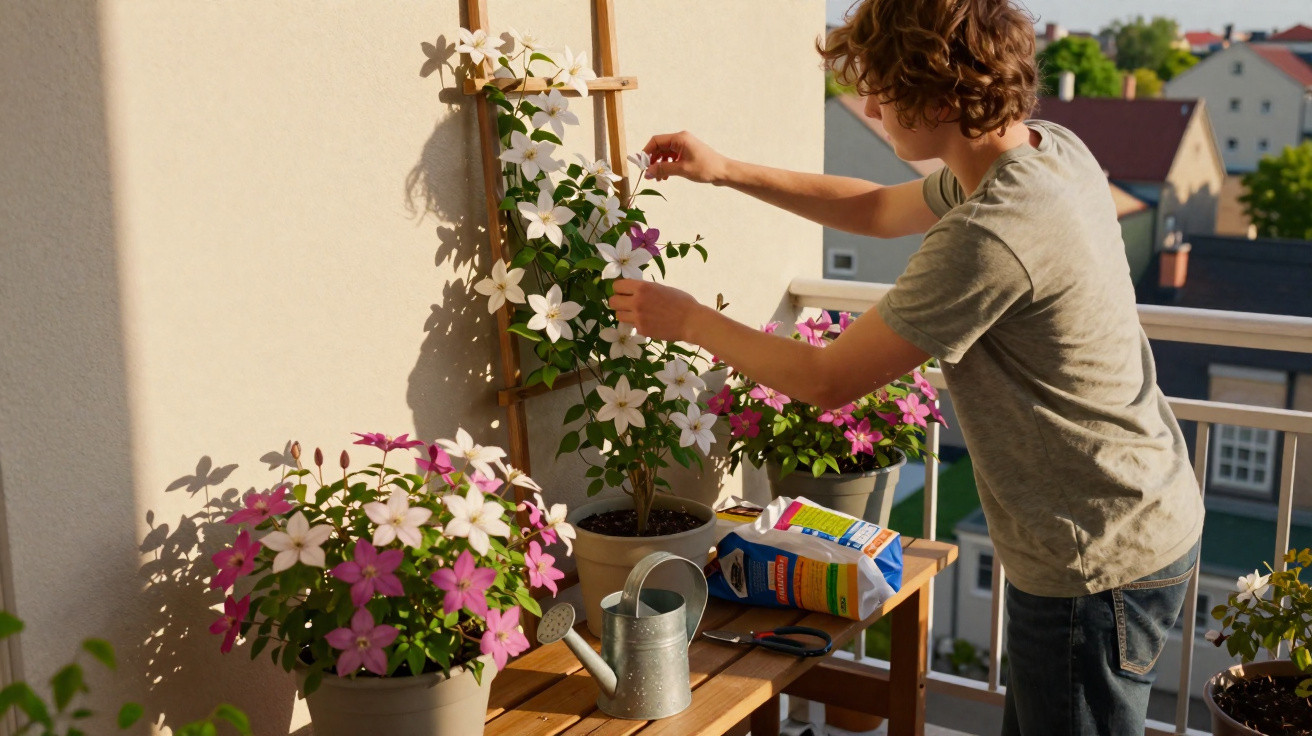
This is exactly where a special climbing plant shows what it can do.
Anyone with only a few square metres outdoors may often look enviously at lush gardens. Yet a compact climbing plant can turn even a drab stretch of wall into a dense wall of flowers – without taking up floor space or requiring complicated gardening tricks.
Why mini climbers are a game changer for small gardens
In tight courtyards and narrow balconies, every centimetre of floor space matters. Containers, pots and furniture all compete for room, while conventional shrubs and wide perennials can quickly obstruct the entire usable area. Vertical gardening solves precisely this issue.
With a compact climbing plant, the floral display moves upwards – the ground stays clear, and the space feels larger and more welcoming.
Low-growing Clematis varieties, often sold as dwarf or mini Clematis, have proved particularly effective for this purpose. They grow to only around one to a maximum of two metres high, yet develop densely enough to cover a trellis, cane or railing completely. This creates the impression of an unbroken carpet of flowers, even though there is just one pot on the ground.
Unlike many traditional climbers, these compact Clematis produce flowers right from the base of the plant. There are no bare, woody stems at the bottom – a major benefit in tiny gardens, where every empty corner is immediately noticeable.
Colours and varieties: from snow white to vivid pink
The choice of low-growing Clematis varieties has expanded considerably in recent years. Breeders are specifically bringing out types for small gardens, terraces and window ledges.
Especially popular are varieties that produce large flowers despite their compact habit:
- White with soft pink: Varieties such as ‘Ithemba’ have white petals with a pink central stripe, making them ideal for brightening dark corners.
- Pastel shades with changing colour: Typical examples begin in a delicate blue and fade to almost white as the flowers age. This gives the plant a constantly shifting appearance.
- Intense pink: Strong pink varieties such as ‘Queens Nurse’ make striking accents against grey concrete walls or brown wooden slats.
For a more playful effect, choose very low wild-species hybrids with small, bell-shaped flowers. One example is a yellow-flowering form that reaches only about 45 centimetres in height and has a bushy, trailing habit. It is perfect for hanging baskets or balcony planters, where its shoots can tumble loosely over the edge.
Pot, planter or hanging basket: where should Clematis go?
Mini Clematis are remarkably adaptable when it comes to positioning. The key factor is less the available surface area than the container's volume and sensible drainage.
The right container size and suitable compost
When growing the plant in a pot, avoid choosing one that is too small. A container holding at least around 10–12 litres provides sufficient room for roots and a reserve of water. Several large drainage holes at the base are essential to prevent waterlogging.
Good-quality, free-draining compost is essential for Clematis – it is better to mix potting compost with a little sand or expanded clay than to pack heavy garden soil into the pot.
The following arrangement works particularly well in a large container:
- Place a layer of expanded clay or coarse gravel at the bottom for drainage.
- Add fleece or a little newspaper above it so the compost and drainage layer do not mix.
- Fill the top section with a loose blend of potting compost and a little compost or slow-release fertiliser.
To keep the root area cool, low ground-covering plants can be planted in front of the Clematis, for example:
- trailing petunias
- nasturtiums
- alyssum or cushion-forming flowers similar to lobelia
They also conceal the rim of the pot, making the whole planting look much fuller.
Window ledge, balcony or terrace: clever places to use them
Mini Clematis suit almost any small outdoor setting:
- Balcony with a railing: Position the pot directly beside the railing and add a small support. The shoots can be loosely threaded through it.
- Narrow terrace: A tall, slim container in a corner creates a flowering privacy screen without sacrificing valuable floor space.
- Window ledge: Low-growing or trailing varieties work well in balcony planters and can be combined with other summer flowers.
- Hanging baskets: Very compact Clematis with short shoots look like a hanging flowering shrub in these containers.
How the plants climb properly: supports and fixing methods
Clematis can use their leaf stalks to wrap themselves around thin wires or canes. However, these natural hold points are often insufficient for sturdy railings or wooden posts.
Practical small-scale climbing supports include:
- slim bamboo canes placed in the pot
- a small metal or wooden trellis
- curved climbing arches inserted directly into the container
- wire cables or rods fixed to a house wall
Secure the first shoots loosely with plant ties or strips of raffia until they can support themselves. Do not pull them tight, as this can constrict the stems. Once established, the plant will usually take over the structure on its own.
Watering, feeding and pruning: care on a small scale
Water correctly rather than over-loving the plant
Compost in pots dries out more rapidly than soil in a flowerbed. Even so, excessive watering causes more harm than occasional dryness. As a rule, allow the top layer of compost to dry slightly before watering again. Any water still standing in the saucer after a few minutes should be poured away.
During prolonged heat above around 27°C, foliage may turn yellow in places. This is often a protective response, with the plant slowing its metabolism slightly. Water only moderately at this point; never soak it excessively “out of sympathy”.
Feeding for more flowers
For abundant flowering, Clematis need nutrients with an emphasis on potassium. A standard tomato fertiliser is ideal. The following approach is useful:
- As soon as the first buds appear, apply a potassium-rich liquid fertiliser once a week.
- Continue feeding until shortly before the first flowers begin to open.
- Then pause fertilising so the plant can direct all of its energy into producing flowers.
The mild “stress” caused by this feeding break often results in even more lavish flowering.
Pruning – no science required
Many amateur gardeners are wary of pruning Clematis. With compact varieties, however, this concern largely disappears. In most cases, it is enough to do the following in early spring:
- cut out dead, brown shoots
- shorten overly long or awkward stems by about one third
- thin out tangled sections slightly so that air can reach the plant
If in doubt, prune a little less rather than more. Dwarf Clematis often recover well and repeatedly send out fresh growth from the base.
Position, risks and clever combinations
Many Clematis prefer a sunny to partly shaded spot with “cool feet and a warm head” – in other words, a shaded root zone and sun on the foliage. On south-facing balconies exposed to fierce midday sun, a light screen or a neighbouring plant that shades the pot can help.
All plants in containers carry a certain risk: they dry out faster in summer and are more exposed to frost in winter. A few measures reduce this risk:
- Move the pot close to the house wall in winter.
- Wrap the container in hessian or bubble wrap.
- Stand the pot on a wooden board or polystyrene so cold cannot penetrate directly from below.
A Clematis looks especially appealing when combined with other plants to create a mini “mixed border in a pot”. Suitable companions include:
- fragrant herbs such as thyme or oregano as underplanting
- small grasses for structure and movement in the wind
- spring-flowering bulbs that are overtopped by the Clematis in summer
This creates a layered, lively “mini garden” even on a balcony measuring two square metres. The climbing plant forms the vertical focal point, while its companion plants add depth and variety.
Anyone who previously thought that an impressive wall of flowers required a large garden will soon be proved wrong by these compact Clematis. With one well-prepared pot, a simple climbing support and a little care, almost any dreary corner can become a colourful, living backdrop – all without fighting for space on the ground.
Comments
No comments yet. Be the first to comment!
Leave a Comment