
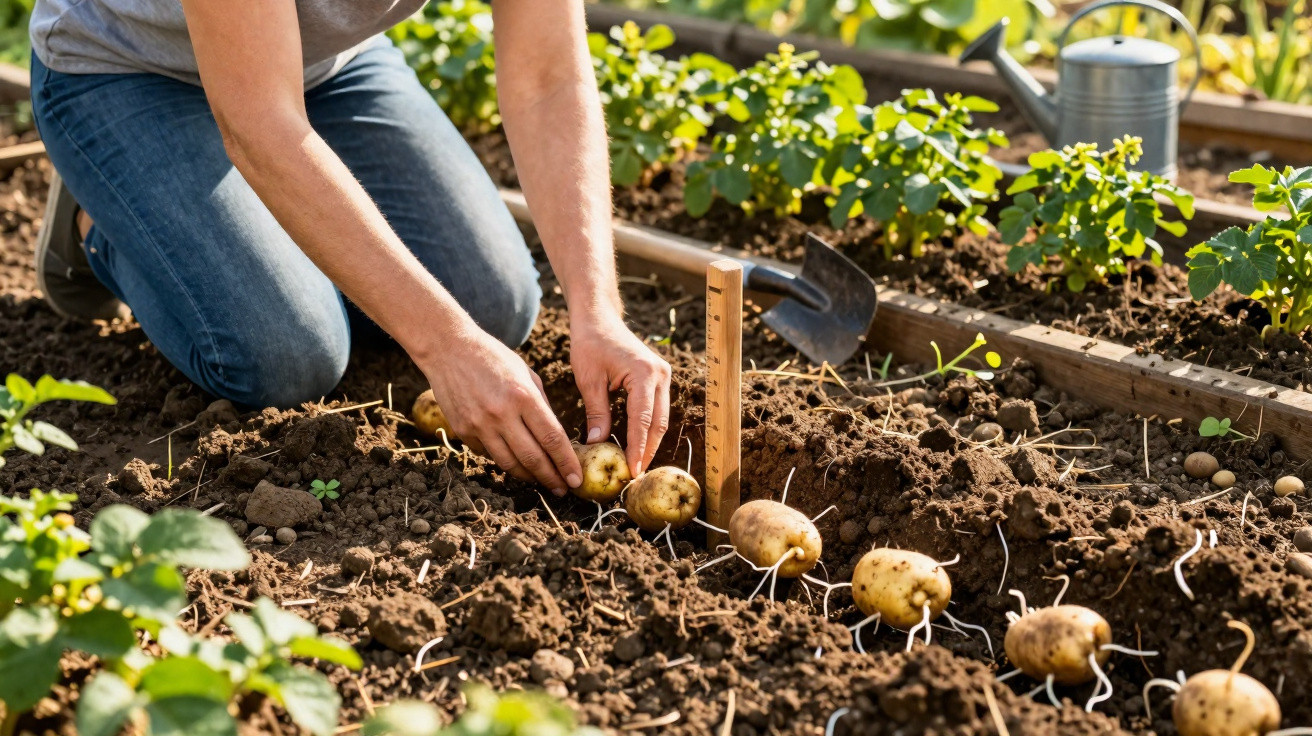
When planting potatoes in spring, most people focus on the variety, position and perhaps fertiliser. The crucial issue of how deeply the tubers should go into the ground is often overlooked. Yet this seemingly minor measurement determines how quickly plants establish, how healthy they remain and, ultimately, the yield in the harvest box. A few centimetres too much or too little can mean the difference between a handful of undersized tubers and a genuinely abundant crop.
The ideal planting depth: the key measurement for strong plants
Growing potatoes means burying a small store of energy. This single tuber must produce roots, stems and new potatoes. It needs protection from light and late frosts, while the emerging shoots must not have to struggle through darkness for too long.
“As a rule of thumb, plant potatoes 10 to 15 centimetres deep, measured from the top of the tuber to the soil surface.”
At this depth, protection and speed of establishment are well balanced:
- soil temperatures are more stable than at the surface
- frost is less likely to reach the tuber
- shoots can still reach daylight quickly
- the area is well aerated, reducing rot and disease
Before planting, loosen the soil to a depth of around 15 to 20 centimetres. This creates a light bed in which the tuber can root easily. One detail often underestimated is that the potato’s “eyes” should face upwards. That gives the shoots the shortest route to the surface.
Planting substantially deeper can result in slow or uneven emergence, particularly during cool springs. The plant uses some of its reserves simply to cover the longer distance upwards. Tubers set too shallowly, on the other hand, are at risk from sunlight, drying out and green skins.
Why a few centimetres make such a difference
Planting depth determines the small-scale environment in which a potato begins to grow. Oxygen supply suffers in an area that is too loose or too wet. In an overly dry layer, the plant produces only a few small tubers because it is under continual stress.
For most gardens, the ideal zone between 10 and 15 centimetres deep provides:
- enough moisture without waterlogging
- sufficient air in the soil for healthy roots
- protection from sudden drops in temperature
- consistent conditions for even plant growth
Anyone familiar with their soil can fine-tune the depth within this range. This is exactly where experienced gardeners gain the crucial extra yield.
Adjusting planting depth for soil and climate
Heavy clay soil: avoid planting too deeply
Water can quickly collect in heavy, clay-rich soils. In these plots, the middle of the range is generally sufficient, meaning a planting depth of about 12 centimetres. First loosen the soil thoroughly, break up clods and, if necessary, work in some coarse sand or well-rotted compost to improve drainage.
Planting too deeply in these conditions encourages rot. The tubers then sit in a cool, wet layer where fungi can establish easily.
Light sandy soil: lean towards the upper limit
Water drains more rapidly through sandy ground, and nutrients are more easily washed away. In these conditions, it makes sense to plant closer to 15 centimetres deep. The tubers will then be slightly better protected in a moister zone. A generous addition of compost also improves the soil’s ability to retain moisture.
Immediately after planting, 10 to 15 centimetres remains the reference range. Later, you can use the technique known as earthing up to build a greater volume of soil over the tubers.
Late frosts and drought: how climate affects the decision
In regions where late frosts are common, it helps to place the tubers a little deeper and then earth them up promptly once shoots emerge. This creates an extra protective bank of soil over the shoots against cold conditions.
In dry areas, a closely timed planting date alone achieves little. A moderate planting depth is more useful, together with:
- thorough watering after planting
- a mulch layer after emergence, such as straw or grass clippings
- regular but not excessive watering while tubers are setting and growing
The key is to combine the correct depth with loose, well-prepared soil and surface protection, rather than attempting to manage everything through planting depth alone.
Spacing, rows and earthing up: depth alone is not enough
Even the best planting depth offers little benefit if plants later crowd one another. The following spacing has proved effective for a plentiful harvest:
| Parameter | Recommendation |
|---|---|
| Distance between tubers within the row | 30–40 cm |
| Distance between rows | 60–75 cm |
| Initial planting depth | 10–15 cm |
With these distances, each plant receives enough light, air and nutrients. The tubers can spread without competing with neighbouring plants.
Earthing up: the hidden advantage for more tubers
When young potato plants reach 15 to 20 centimetres in height, the next way to increase yield begins: earthing up. Soil is drawn from between the rows towards the plants to form a small ridge.
“Earthed-up potatoes often produce more attractive tubers because they grow in a larger volume of soil.”
Earthing up offers several benefits:
- newly forming tubers remain safely in the dark
- the ridge prevents greening and therefore toxic substances in the skin
- plants receive more loose soil in which additional tubers can form
- weeds in the row area are suppressed
As a rule, earth up two or three times during the season, whenever the plants have grown several more centimetres. The original planting depth gradually becomes a much higher soil ridge, without requiring the tubers to be planted too deeply at the outset.
Common planting-depth mistakes – and how to avoid them
Many issues in a potato bed can be traced back to a few familiar errors:
- Planted too deeply: slow establishment, weak shoots, and often a later or smaller harvest.
- Set too shallowly: green tubers, sun scorch on shoots and greater watering needs.
- Working wet soil: the ground becomes compacted, followed later by rot and disease.
- Ignoring soil type: using the same depth in heavy clay as in sand creates opposite problems.
If you are unsure, plant one or two rows at slightly different depths and observe which plants develop more successfully. This practical test adapts textbook guidance to your own garden.
Practical tips for starting the potato-growing season
Before planting, inspect the soil carefully. It should be crumbly rather than sticky, lightly moist but not wet: that is the ideal seedbed. If soil clings to the spade, wait until it has dried a little. Working it while too wet causes compaction that restricts roots.
Chitted seed potatoes have already developed short, sturdy sprouts indoors. These must not break off, as this costs them some of their initial energy. Place such tubers carefully in the prepared furrows, positioning them with the sprouts pointing upwards.
For gardening with children, create a small trial plot: plant one row at 8 centimetres, one at 12 centimetres and one at 18 centimetres deep. The differences in growth are striking and help demonstrate how sensitively potatoes respond to these few centimetres.
Why the right depth also matters for flavour and storage life
Potatoes grown well in a consistently supplied soil zone develop stronger, more intact skins. Such tubers can be stored considerably longer in cool, dark rooms without quickly shrivelling or rotting. Less stressful growth also often has a positive effect on texture and flavour.
By matching planting depth to the soil, climate and your own ability to earth up, you create stable conditions from the first root to the harvest-ready tuber. A few deliberately chosen centimetres can result in full harvest boxes and a season in which working in the potato bed is genuinely enjoyable.
Comments
No comments yet. Be the first to comment!
Leave a Comment