
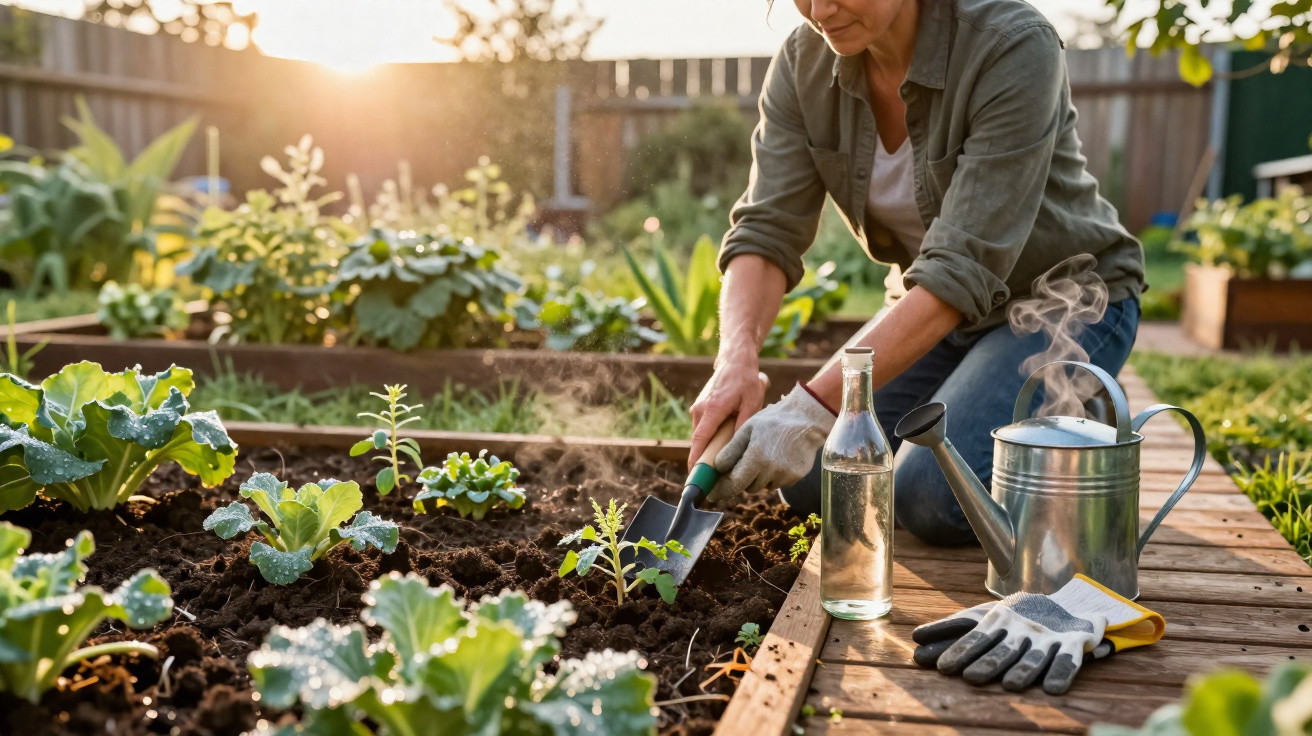
Between birdsong and the first cup of coffee, many amateur gardeners reach for a liquid secret weapon from the kitchen: vinegar. Especially early in the morning, roughly between 6 am and 11 am, a splash of vinegar in the garden is said to transform entire beds. Although this may sound like simple home-remedy magic, there are practical reasons behind it – as well as clear risks.
Why the early morning is so effective in the garden
Anyone heading into the garden at sunrise benefits from conditions that simply no longer exist later in the day. The air is cooler, the soil is still damp and many weeds are soft and full of moisture.
- Damp leaves: Morning dew keeps foliage wet, making it more absorbent.
- Softer roots: Moist soil means roots give way more easily.
- Less heat: Cooler air is gentler on nearby plants you want to keep.
- Short roots: Particularly in spring, many weeds have barely established their roots.
This is why many people reach for a hoe, paving-joint scraper or simple knife between 6 am and 11 am. At this time, weeds can be pulled from the ground much more easily and deeply, often together with their roots. Keeping to this routine noticeably reduces the number of new shoots.
Vinegar in the garden: what is really behind it
Reaching for a bottle of clear table vinegar seems obvious. It is inexpensive, found in almost every kitchen and widely regarded as “natural”. Many online forums promote it as a harmless alternative to chemical weedkillers.
In reality, ordinary table vinegar contains a fairly powerful substance: acetic acid. Typical concentrations range from five to ten per cent, with a pH value of around two to three. That is considerably more acidic than most soils can tolerate.
Vinegar does not work in a “gently natural” way; it acts as a contact treatment, scorching primarily young leaves and delicate stems.
The effect can look especially dramatic from March to June, when weeds are still small and only lightly rooted. After a targeted treatment, leaves turn yellow, plants collapse and the area looks tidy. It gives the impression that the problem has been solved.
However, there is a catch: vinegar often affects only the visible parts of the plant. Roots survive and may sprout again after a while. Those who keep applying more vinegar to prevent this gradually create a different problem – in the soil.
When a home remedy becomes an environmental problem
Acetic acid is biodegradable, but it is far from beneficial for soil organisms. Treating the same patch repeatedly with vinegar shifts the soil’s pH into the acidic range. Earthworms, soil fungi, bacteria and other helpful organisms that build humus and make nutrients available become stressed or disappear.
Soil specialists report paths and driveways that appear almost “dead” after long periods of vinegar use: there is barely any life or structure in the soil, while compacted, crusted layers form instead. Plant roots find it harder to establish themselves there, and waterlogging and erosion increase.
It becomes particularly problematic when people use kitchen mixtures recommended in some guides:
- Vinegar with table salt
- Vinegar with boiling water
- Vinegar with harsh cleaning products such as chlorine bleach
Salt can leave an area unable to support plant growth for a long time. What may seem desirable on a patio also affects the soil: useful plants, microorganisms and soil fauna suffer too. Additives containing chlorine increase the environmental burden further.
Legal position: when vinegar becomes a “plant protection product”
As soon as a product is deliberately used to kill plants, different legal rules apply. It is no longer treated as an ordinary household product, but falls within rules for plant protection or plant treatment products – including approval requirements, conditions of use and potential fines.
This is precisely where ordinary table vinegar falls short. A standard kitchen bottle has no approval as a weedkiller. Anyone intentionally using it for this purpose enters a legal grey area that can become unpleasant in the event of a dispute – potentially leading to substantial fines.
“Natural” does not automatically mean “permitted” in legal terms – especially where plants are intended to be damaged deliberately.
Many local authorities now point out that only approved products may be used even on private driveways, patios or garage entrances. The reason is direct run-off into drains or groundwater when rain washes active substances away.
Early morning, strong results: how to manage weeds without vinegar
The advantages of the 6 am to 11 am window are, in any case, far better used mechanically than chemically. Anyone who makes regular rounds of the garden during this period can keep most beds permanently clear – without a bottle from the kitchen.
Proven methods for the morning combination of dew and hoeing
- Hoe or cultivator: In beds with loose soil, a shallow pass is enough to dislodge young weeds completely.
- Paving-joint scraper or sharp knife: Between paving stones and patio slabs, the upper part of the root system can be levered out effectively.
- Gloves and hand-pulling: Individual plants with deep roots are best pulled out by hand, including the roots.
Because the soil is moist, roots release more readily, less force is needed and your back will thank you for it. Anyone taking a short early-morning walk around the garden about twice a week in spring prevents larger clumps from becoming established in the first place.
Heat rather than acid: where hot water makes sense
On purely mineral surfaces, such as gravel paths or paved areas, hot water can be an alternative. Boiling or very hot water destroys proteins in plant cells, and the parts above ground usually wilt within a short time. Deep-rooted species may occasionally return, but they are weakened.
A watering can filled with freshly heated water is often enough for a small driveway. Anyone using this method regularly should still apply it sparingly to avoid placing unnecessary strain on soil organisms.
Prevention instead of control: stopping weeds from taking over
The most effective way to reduce work begins long before the first morning round. Many weeds treat bare, open patches in a bed as an invitation. Closing these gaps removes their opportunity to spread.
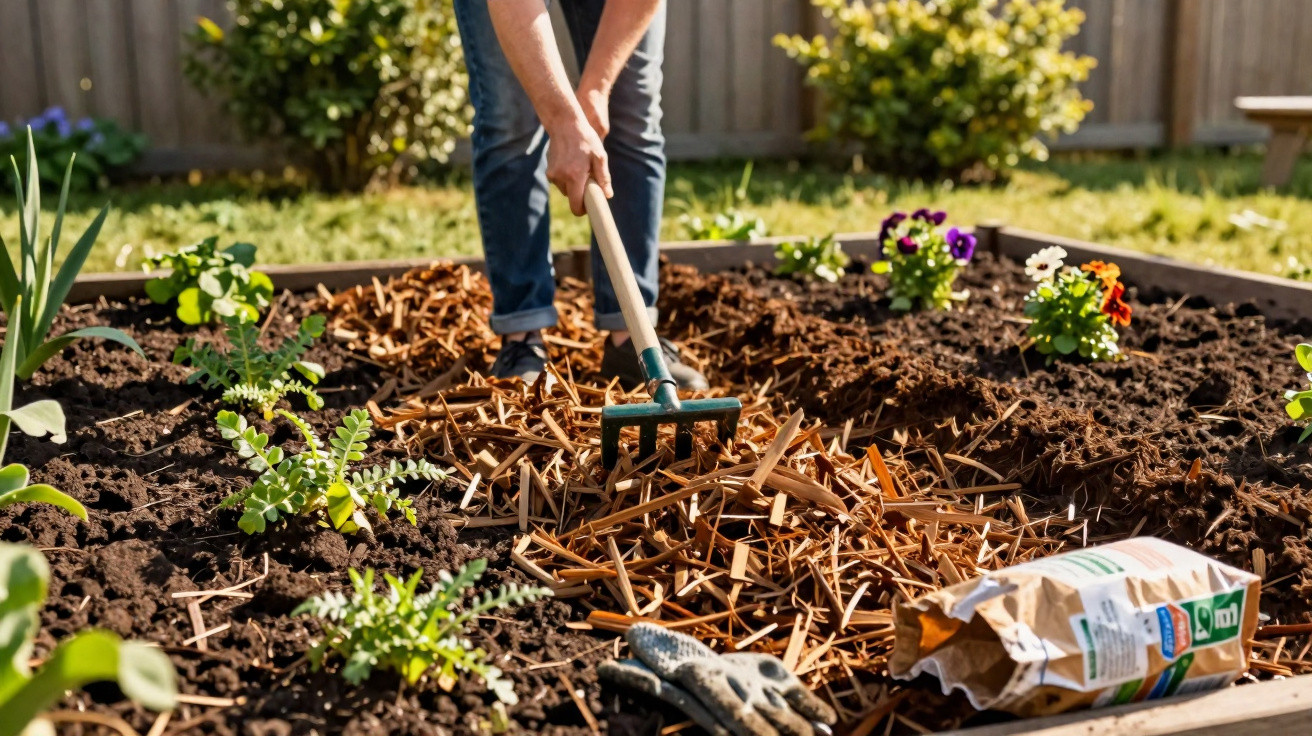
- A thick mulch layer: Bark mulch, woodchip, grass cuttings or layers of leaves cover the soil and allow less light through.
- Ground-cover plants: Mat-forming perennials such as cranesbill or bugle create dense cover.
- Closer planting: Tightly spaced perennials or vegetables shade the soil heavily.
- Clearly defined paths: Lawn edging stones, bed borders or wooden boards prevent runners from spreading into these areas.
Combining these measures with a brief morning inspection soon makes one thing clear: the “fight against weeds” becomes a manageable routine rather than an hours-long weekend chore.
When vinegar in the garden still has a use – and when it is best avoided
Table vinegar does not need to be condemned entirely in the garden. It does have valid uses, just not as a weedkiller. Many people successfully use it to clean terracotta pots, descale watering cans or remove light limescale marks from water features, provided that the water is not then allowed to run directly into beds.
As a spray for plants, however, it is best kept out of the amateur garden. The risks to soil life, the environment and possible legal disputes are disproportionate to the benefit – especially when straightforward, traditional methods work so well early in the morning.
For many gardeners, a small change in perspective is worthwhile: rather than viewing weeds as the enemy in every case, it helps to look more closely. Some species provide food for insects, loosen the soil or indicate nutrient deficiencies. Choosing carefully what can stay and what must go creates a lively, healthy garden – without risky kitchen experiments.

Comments
No comments yet. Be the first to comment!
Leave a Comment