
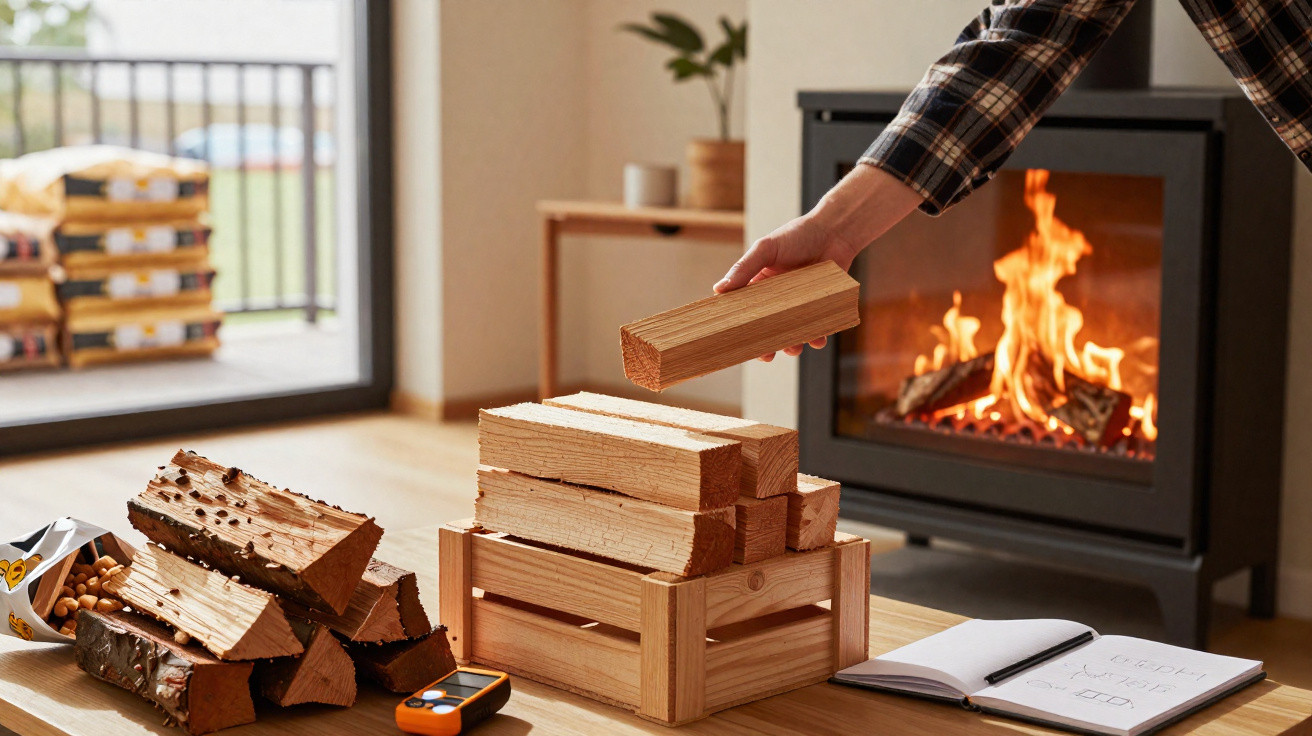
Orders are soaring in DIY stores and online shops: compressed wood briquettes, also known as pressed wood logs, promise substantially more heat from the same stove. But what is behind the trend, how great is the difference compared with ordinary logs, and is switching worthwhile for households in Germany, Austria and Switzerland?
What these new pressed wood logs are made from
Pressed wood logs are not made from whole timber, but from leftover materials: sawdust, planer shavings and small pieces of wood from sawmills and joinery workshops. The material is dried and compacted under high pressure, without chemical additives.
The result is uniformly dense logs that store considerably more energy per kilogram than conventional firewood.
As a result, they burn more slowly, more intensely and more consistently. Many users report that a single one of these logs produces the effect of several ordinary firewood logs.
Why compressed wood briquettes produce so much more heat
Extremely low moisture content
Moisture content is the crucial factor. Ordinary, properly stored firewood usually contains between 20 and 30 per cent moisture, while poorly dried wood can contain as much as 50 per cent.
Pressed wood logs are often below 10 per cent. This means:
- less energy is lost through evaporating water;
- more energy is available as heat;
- flames burn more steadily and cleanly.
For this reason, one pressed wood log can often deliver the heating output of three to four conventional logs, depending on the timber type, stove and draught behaviour.
High density and high energy content
Intensive compression concentrates a large amount of material into a small volume. One cubic metre of these briquettes contains considerably more kilograms of wood substance than one cubic metre of stacked logs with gaps between them.
The result is a fuel that burns for longer, retains embers more effectively and reaches higher temperatures. Modern wood-burning stoves in particular benefit, as they can transfer the heat efficiently into the room.
Consistent warmth rather than waves of heat
Anyone using ordinary firewood knows the familiar fluctuations: flames initially blaze strongly, then the heat drops away until more wood is added. The uniform composition of pressed wood logs counteracts this. They provide a relatively even flow of heat over a longer period.
Anyone who wants to keep heating through the evening rather than add wood every half hour gains a clear convenience benefit from pressed wood logs.
Everyday advantages of compressed wood briquettes
Less mess and less work
Many people switch not only for the heating performance, but because daily use becomes easier:
- significantly less ash in the stove;
- virtually no bark and no loose shavings in the living space;
- neatly stacked packs instead of unstable piles of logs;
- no need to pre-dry wood in the garden for years.
Because the fuel burns largely cleanly, it produces less soot and fewer deposits. This reduces the risk of chimney fires and places less strain on the chimney.
A space-saving option for the cellar or balcony
Storage requirements are another factor that particularly appeals to city residents. In practice, the comparison is repeatedly clear:
| Fuel | Required storage space | Heating output (rough comparison) |
|---|---|---|
| Firewood (air-dried) | approx. 4 m³ | Base value |
| Pressed wood logs | approx. 1 m³ | Similar total energy |
Anyone with only a small cellar, garage or sheltered balcony can therefore store considerably more heating energy in a limited area.
How to use pressed wood logs correctly
Starting a fire in the fireplace or stove
Using them is straightforward, although a few rules are worthwhile:
- Place two to three firelighters in the combustion chamber.
- Put some kindling or a smaller piece of briquette on top.
- Light the firelighters and initially open the air supply widely.
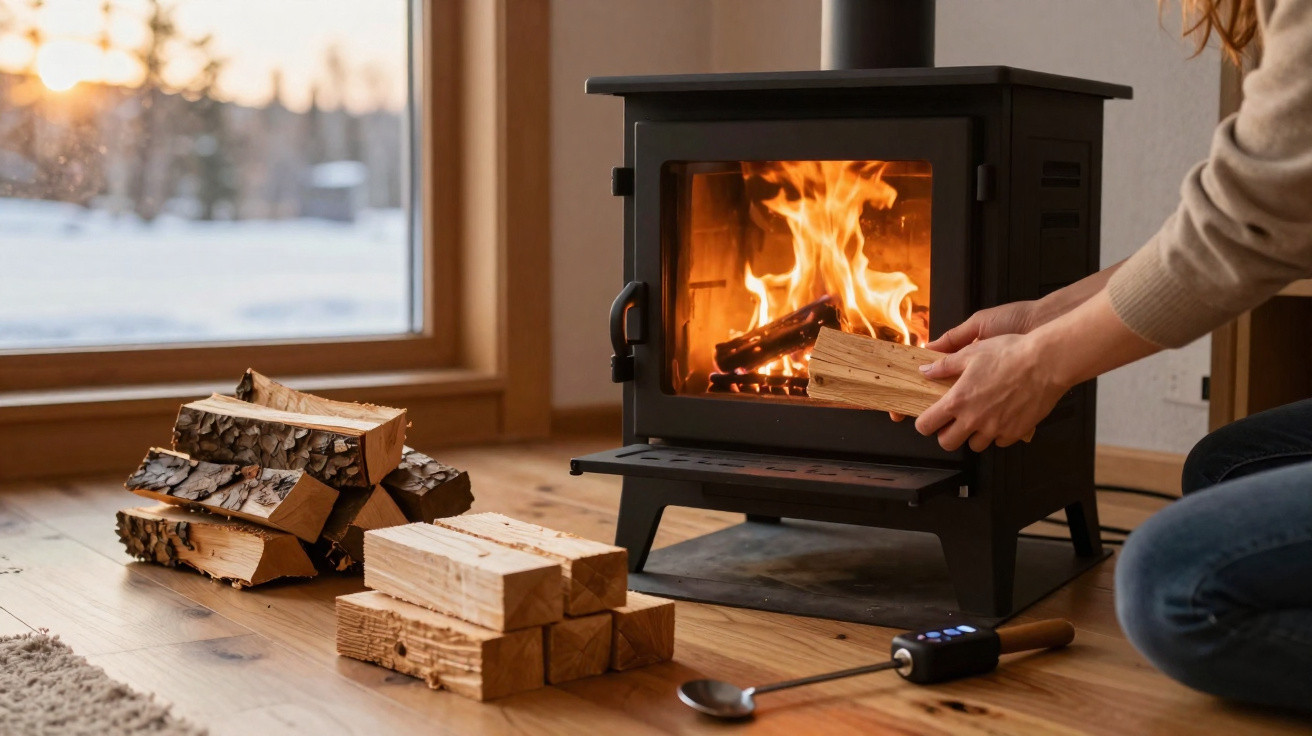
- Once the fire is burning steadily, add one to two pressed wood logs.
Important: do not fill the entire stove. These logs generate substantial heat, and overloading can cause overheating.
Take care with the temperature
Many wood-burning stoves have a thermometer on the flue pipe. Anyone changing to pressed wood logs should take this instrument seriously. If the temperature rises unusually sharply, reduce the air supply or temporarily avoid adding more fuel.
Before using them for the first time, it is worth checking the operating manual: not every older tiled stove is designed for the high energy density of modern pressed wood logs.
Comparison with traditional firewood
Calorific value and burn time
Per kilogram, pressed wood logs often provide a higher calorific value than mixed firewood because their moisture content is minimal. In practical terms, this means less carrying, less refuelling and more time enjoying actual warmth.
The calorific value of mixed firewood varies widely. Softwood burns away quickly, hardwood lasts longer, damp wood produces soot, and properly dried wood can be difficult to obtain. Pressed wood logs reduce these uncertainties.
Storage and pests
Insects, fungi and mould are another contentious issue with traditional stacks of wood. Pressed wood logs are dried industrially and are usually sold in plastic wrapping or cardboard. This means neither ant colonies nor woodworm are brought into the home.
Environmental considerations
The briquettes make use of residues from the timber industry that might otherwise be discarded or used less efficiently for energy. They therefore save whole timber and can help reduce pressure on forests.
As they burn more dryly and cleanly, they tend to produce less fine particulate matter and fewer pollutants than damp or lower-quality firewood. This can be particularly relevant in densely populated areas with strict air-quality plans.
Who benefits most from switching
Pressed wood logs are not equally suitable for every household. They make particular sense for people who:
- do not have extensive storage space for split firewood;
- do not own woodland or have inexpensive access to whole timber;
- use their fireplace as an important heat source rather than solely for appearance;
- value a clean living space and minimal mess.
Those who can obtain dry firewood free of charge and enjoy sawing, splitting and stacking may possibly find traditional logs cheaper. For urban households with limited time and space, the calculation is often different.
What buyers should check during their first trial
There are noticeable quality differences between manufacturers. Checking the details on the packaging is helpful:
- timber type (pure hardwood, softwood or a blend);
- stated moisture content;
- shape (cylinder, block, with or without a hole);
- origin of the raw materials.
Buying one or two packs to try is sensible before ordering entire pallets. This makes it possible to assess how the fuel performs in your own stove, how long a log actually glows and how pleasant the warmth feels.
Anyone changing from a previous stack of firewood to pressed wood logs should deliberately observe the first few evenings of heating: how quickly does the room warm up? How does the chimney draught respond? Does the stove door remain sealed? These experiences help identify the ideal quantity for each heating cycle and make full use of the potential of the new logs.

Comments
No comments yet. Be the first to comment!
Leave a Comment