
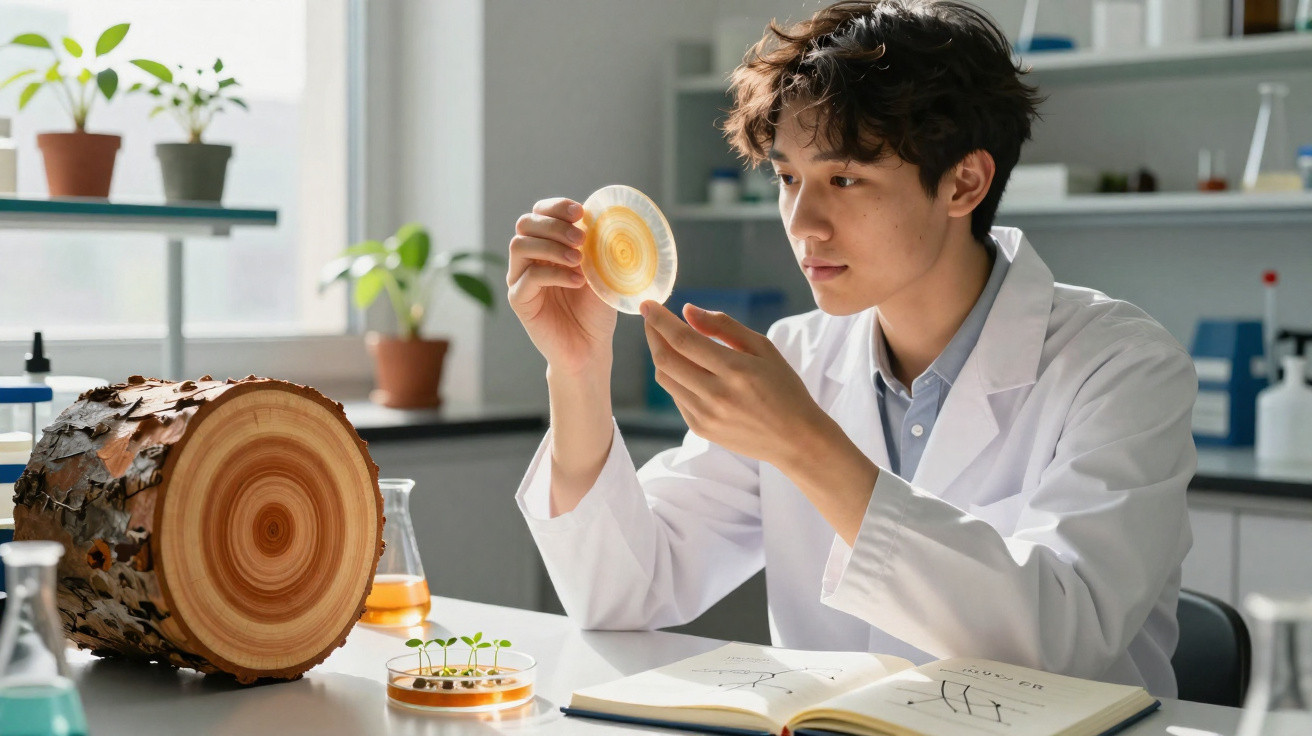
Wood supports homes and stores more carbon than nearly any other living thing on land. Its production begins in a narrow strip of living cells located immediately beneath the bark.
Scientists believed they had a fairly complete understanding of how this strip regulates itself. New research by a team in England suggests that an extra level had been overlooked.
Cells beneath the bark
This strip, known as the cambium, is a sheath of stem cells surrounding the stem that replenishes itself as the plant develops.
On its inner side, it produces xylem – the woody tissue – while the outer side creates the channels that transport sugars through the plant.
Previous studies established the layer as a genuine stem cell region, directed by a small set of organising cells. Whether an individual cell continues dividing or becomes wood depends on the signals it receives.
Dr Peter Etchells, a plant biologist at Durham University in north-east England, has spent years studying how the cambium determines when wood should form. Yet one enduring question remained unresolved.
A surprising PXY and ER partnership
Plant cells interpret their environment through receptor proteins: sensors in the outer membrane that bind to particular molecules passing by.
The standard model held that each receptor identifies its own signal before transmitting the message into the cell. They were assumed to operate separately.
The researchers focused on two receptors. PXY maintains division in cambium cells, while ER appeared in areas where wood was being produced.
A broad survey of plant receptors had suggested that PXY and ER could make contact, prompting the team to test the possibility directly.
They found that the two join to form a single structure at the cell surface. Before this research, these receptor families had not been shown to work together in this way.
“Plants are real masters of detecting and responding to signals,” said Etchells.
Catching proteins together
Demonstrating that two proteins meet within a live cell requires inventive methods.
The researchers attached markers to PXY and ER that shine only when the proteins are sufficiently close to touch. Inside cells, the markers glowed together.
In another experiment, they extracted one protein from the mixture of cellular material and examined what accompanied it. When PXY was isolated, ER was pulled out with it, firmly attached.
The result was also seen with ERL2, a close counterpart of ER, whereas a third closely related receptor did not join the pair. This selectivity indicated that the interaction was genuine rather than a chemical coincidence.
However, these tests could not show how their partnership alters the signals each receptor sends into the cell. That question is still unanswered.
When the signal goes into overdrive
Establishing that the proteins connect was one step; proving that their partnership directs wood production required a further test.
PXY responds to a signalling molecule named TDIF. The team therefore modified thale cress (Arabidopsis thaliana), a small plant commonly used in laboratories, so that its wood-forming region was flooded with additional TDIF.
The surplus signal disrupted the cambium. Cells began dividing in all directions.
The normally orderly cell files became short and misshapen, and scarcely any normal wood was formed.
The scientists then removed ER from these same plants. The disorder subsided.
The cambium returned to a tidy ring, while the length of the aligned cell files more than doubled. The researchers concluded that this was consistent with the two proteins functioning together rather than independently.
Wood in the wrong places
Their partnership does not only promote cell division; it also stops cambium cells becoming wood prematurely. The cells need to stay adaptable, because early hardening would exhaust the stem cell reserve.
When the researchers disabled both receptor families simultaneously, this safeguard broke down.
Rigid, hollow vessels – the structures that usually move water through mature wood – emerged throughout regions where cambium cells should still have been dividing.
Taken together, the findings revise the understanding of how wood is produced. ER had been associated with the cambium for years, although its role there was unknown.
This study proposes that ER acts through PXY: the receptors form one complex that promotes cell division and ensures wood develops in the right location.
Why the discovery matters
Wood is one of the world’s major stores of carbon, retaining more than almost anything else living on land, according to one study. It is also the source material for timber and paper.
Any process that controls the amount of wood a plant produces has implications beyond the laboratory.
If scientists can establish how this receptor complex controls growth, they may be able to adjust it – encouraging plants to produce more wood, potentially resulting in more resilient crops and greater carbon capture.
The team is now investigating how the two receptors modify each other’s internal signals and whether the same partnership occurs in trees.
“So we already knew that signalling in plants was complex, but it has been fantastic to uncover another layer of complexity,” said Etchells.
If receptors can form pairs in this case, related partnerships may also be directing growth in other parts of plants and are yet to be identified.





Comments
No comments yet. Be the first to comment!
Leave a Comment