
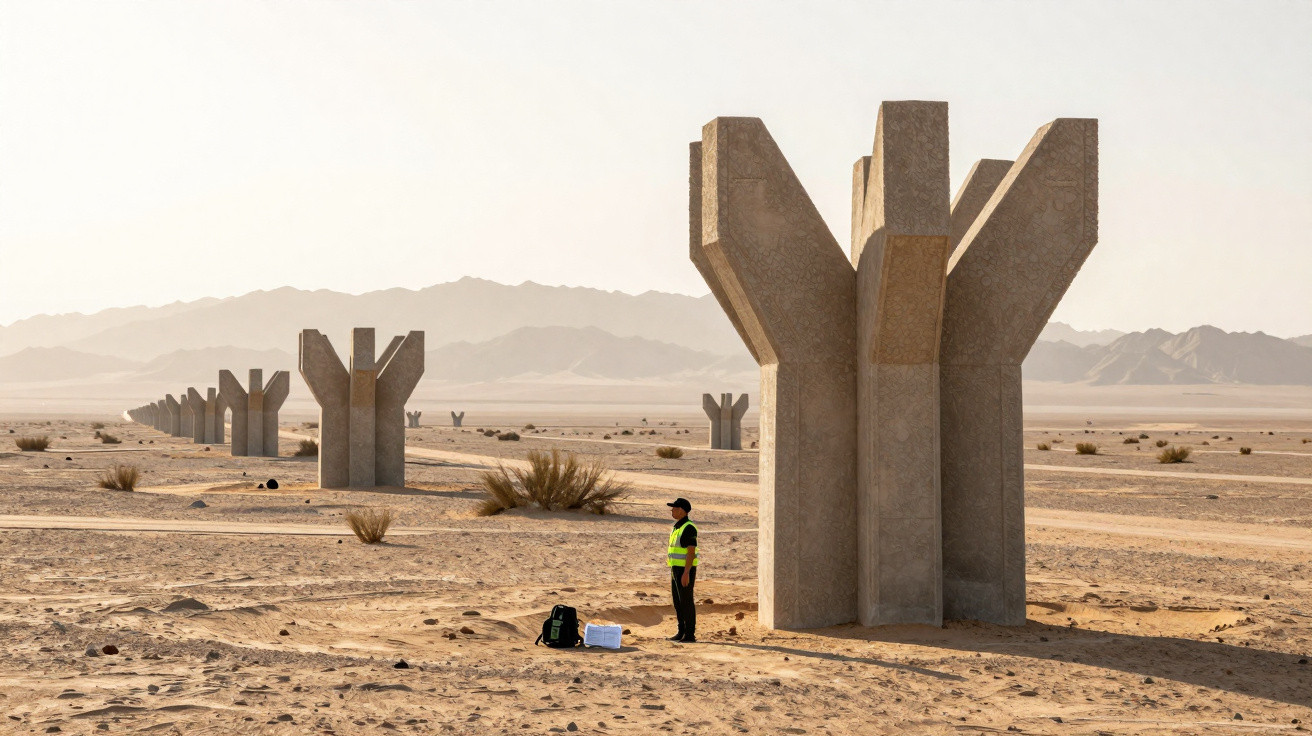
The tetrapods installed by Chile on its border with Peru are large reinforced-concrete structures originally deployed in maritime works to contain waves. Units weighing around 16 tonnes have now been placed in the Arica and Parinacota region to stop vehicles using unauthorised routes.
What are the tetrapods installed at the border?
Tetrapods are four-armed concrete blocks engineered to interlock and withstand impacts. At ports and along coastlines, they are generally arranged as barriers against the force of the sea, limiting wave damage to breakwaters and coastal protection zones.
At the Chile–Peru border, that same principle of weight and stability has been adapted to dry land. Since each unit is exceptionally heavy and bulky, removing it without specialised machinery is difficult.
Why did Chile put these structures on the border with Peru?
According to reports published in the Peruvian press, the tetrapods were installed to prevent vehicles involved in smuggling, drug trafficking and the irregular transport of people from travelling through unauthorised crossings. The action forms part of the so-called Border Shield Plan.
- Blocking informal tracks used by vehicles.
- Making smuggling routes in the border area harder to use.
- Strengthening controls in vulnerable desert areas.
- Reducing movement through locations outside official checkpoints.
How large are these concrete units?
The structures measure roughly 2.9 metres high and 3.4 metres wide, and each weighs close to 16 tonnes. These dimensions help explain why they attracted attention on the Peruvian side and came to be regarded as a substantial physical barrier.
The units were positioned in Chile’s Arica and Parinacota region, in areas near Chacalluta and between border markers referred to by the press. Installation is taking place in desert territory, where irregular routes can be created away from formal roads.
How do tetrapods operate as a land barrier?
Unlike an ordinary fence, a tetrapod does not rely solely on its height. Its effectiveness comes from its weight, irregular shape and the challenge of moving it. Even when gaps exist between individual units, the overall arrangement prevents vehicles from passing easily.
- Reinforced concrete withstands impacts and wear.
- Its weight makes manual or improvised removal difficult.
- The four-armed design creates obstructions from several angles.
- Units can be placed in rows to close off particular routes.
- The barrier can be used alongside surveillance, patrols and other controls.
Why has the installation caused such a reaction?
The response stems from the unusual sight of structures normally associated with coastal engineering, made from tonnes of concrete, appearing in the middle of a land border. The measure was also presented as part of the Chilean government’s wider border-security strategy.
The tetrapods are not simply concrete blocks in the desert. They represent an effort to turn vulnerable sections of the border into places that are harder for vehicles to cross, while also prompting debate about security, territorial control and human impacts in the region between Chile and Peru.






Comments
No comments yet. Be the first to comment!
Leave a Comment