
The Roman Empire reshaped humanity for centuries during its rule and left a legacy that has influenced civilisation ever since.
Yet even the ancient Romans built on the achievements of those who came before them.
That heritage includes earlier civilisations such as Egypt and Greece, along with innumerable prehistoric communities whose inventions have mostly vanished from history-or, in some instances, have been wrongly credited to later peoples.
A new study reports that an advanced plaster-production method long attributed to the Romans was already being used by Neolithic people some 8,000 years earlier.
How could this be the case?
Roman dolomite-based plaster and its origins
Ancient Rome is famous for its engineering expertise, demonstrated by landmark structures such as its aqueducts and the Pantheon. Beyond their capabilities in design and construction, Roman builders probably also benefited from resilient concrete and other high-quality materials.
Some Roman structures used dolomite-based plaster: a rapidly drying paste that is stronger and more resistant to water than the conventional calcitic plasters commonly made in antiquity.
"However, using dolomitic lime is challenging and requires a high level of expertise at all steps of preparation, which may explain why it is not commonly found in archaeological sites," the researchers write.
Dolomite is both a mineral composed of calcium magnesium carbonate and a rock made predominantly from that mineral. Like calcitic limestone, it can provide lime, an inorganic material that can be used to produce certain construction materials.
The researchers note that the oldest written reference to dolomitic lime appears to be from Vitruvius, the Roman architect and engineer, in the first century BCE.
Although Vitruvius did not name dolomite directly, his discussion of lime manufacture appears to describe the mineral.
Plaster had been widely used long before Vitruvius wrote about it, yet there is little evidence that anyone employed dolomitic lime prior to his description around 2,000 years ago.
Archaeological findings indicate that calcite and gypsum were the principal materials used to make plaster in prehistoric times.
Neolithic plaster production at Motza
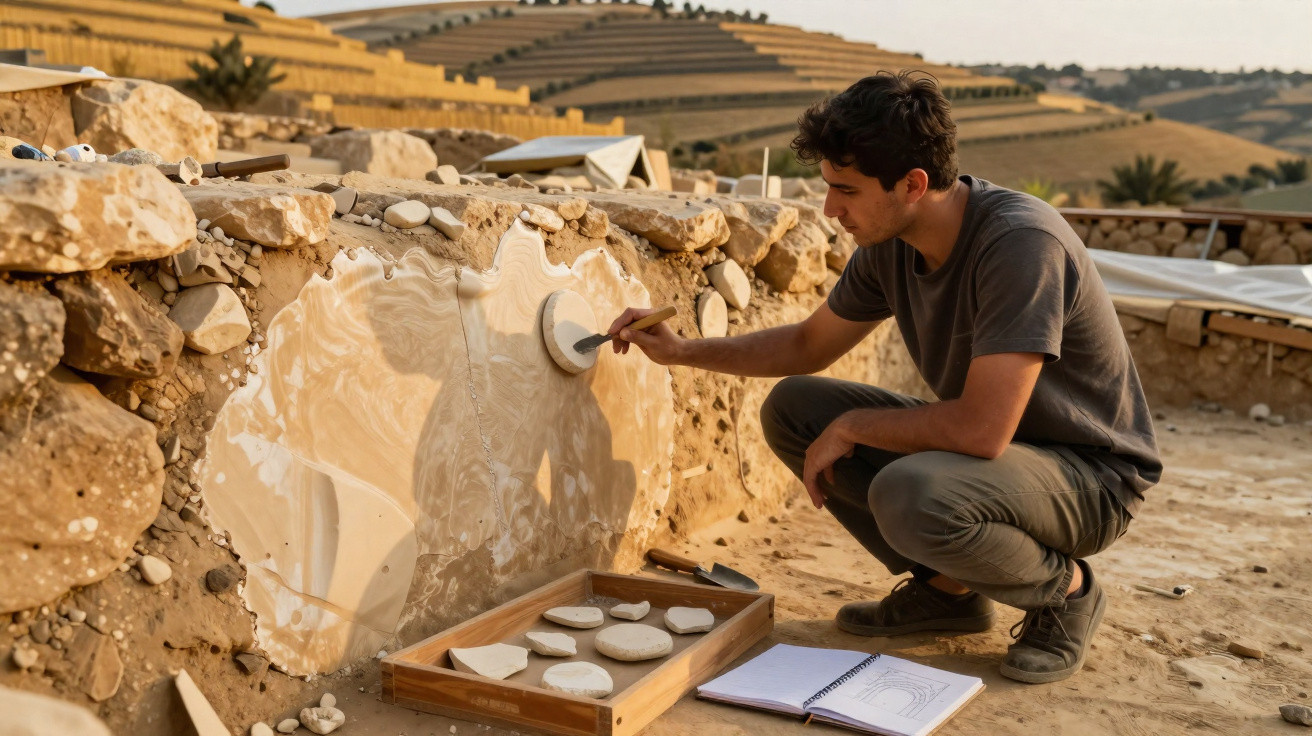
About 10,000 years ago, however, inhabitants of a Neolithic settlement in the Judean Hills seem to have produced dolomite-based plaster. According to the researchers, they left behind subtle evidence that has only now been recognised.
Now situated in Israel and Palestine, the region was already a centre of human activity, with settlements flourishing thousands of years before either the Iron Age or the Roman Empire began.
One settlement later became the modern archaeological site of Motza, approximately 5 kilometres west of Jerusalem. Researchers carried out several excavations there from 2015 to 2021, ahead of construction work for a motorway crossing the area.
Examining layers representing multiple occupations across millennia, the team concentrated on a large Neolithic settlement dating to about 9,000 years ago. They uncovered more than 100 plaster floors from this period, many of which were "particularly well-preserved and coated with red pigment".
The researchers also identified separate kilns in which residents had burnt limestone or dolomite to produce plaster. This points to a level of sophistication not often associated with Neolithic people.
The team explains that calcitic and dolomitic lime need different conditions during plaster manufacture. Nevertheless, these prehistoric inhabitants evidently understood this sufficiently well to create specialised kilns for each material.
Using dolomite for plaster was a remarkable accomplishment for people of that era, but the technique used at Motza remains noteworthy even by contemporary standards, the researchers add.
"They may have successfully made dolomitic plaster where dolomite is fully recrystallized along with the calcite, something that to our knowledge has not been observed anywhere else and was thought to be physically impossible," they write.
A technology lost to history
In addition to exploiting the local abundance of dolomite, the method probably created a better plaster for buildings, offering more strength and water resistance than traditional alternatives.
Because dolomite-based plaster is difficult to produce, and because no earlier evidence had been found, Ancient Rome has long been credited with inventing it.
The technique may conceivably have endured for 8,000 years after Motza before reappearing in Rome. However, the absence of archaeological evidence during the intervening period suggests that the Romans discovered it independently.
"The results suggest a technology lost to history," the researchers write.
The study appeared in the Journal of Archaeological Science.






Comments
No comments yet. Be the first to comment!
Leave a Comment