
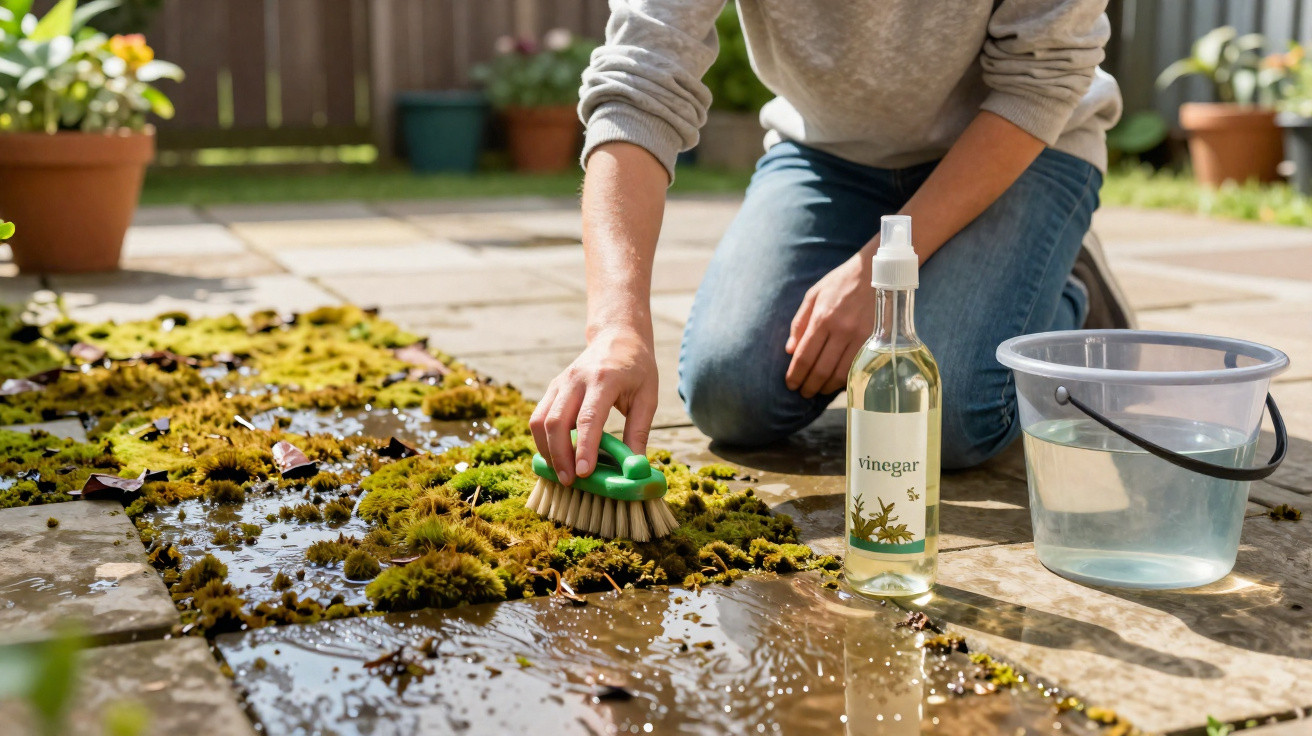
After winter, the terrace looked like an ice rink, but a simple kitchen trick made it safe to walk on again in just one hour.
When people first inspect their terrace in spring, the sight can often come as a shock: a green film, slippery cushions of moss and black marks. Many instinctively reach for costly specialist cleaners or hire a pressure washer. Yet the answer is often already in the cupboard – and costs less than a takeaway coffee.
From green nightmare to clean terrace
Wet winters, mild weather and limited sunshine create ideal conditions for moss, algae and lichens. Concrete or stone slabs can then become genuinely slippery. It looks unpleasant and presents a safety risk.
DIY shops stock shelves full of containers designed to remove green deposits. Many of these products contain biocides. Although effective, they require protective clothing and good ventilation, and they are far from cheap. There is also the inconvenience of arranging a pressure washer, connecting it and cleaning everything afterwards.
A simple household vinegar, costing around €0.35 per bottle, can deliver results similar to expensive specialist cleaners in certain conditions – without any pressure-washing equipment.
This was precisely the experience of one homeowner, who took inspiration from a British colleague. Her suggestion was straightforward: ordinary household vinegar diluted with water, plus a little physical effort.
How to clean a terrace with ordinary household vinegar
Step 1: Remove loose dirt
Before applying the vinegar solution to the terrace, start with a sturdy broom. Sweep away leaves, twigs, loose soil and thick patches of moss first. The cleaner the surface, the more effectively the solution can reach the deposits.
- Sweep thoroughly using a stiff outdoor broom
- Push away puddles and standing water
- Move plant pots and furniture out of the way
Step 2: Prepare the mixture
The British journalist whose method inspired this tip uses a very simple ratio: one part household vinegar to one part water. The water should be cool or lukewarm, never hot.
For a medium-sized terrace, one standard bucket will usually be enough:
- Around 5 litres of water
- Around 5 litres of clear household vinegar, usually containing 5–10% acid
- Mix both ingredients thoroughly in the bucket
In the original case, the homeowner used only half a bottle of vinegar, priced at around €0.35 per bottle in the supermarket. The cost of each clean is therefore well below one euro.
Step 3: Apply the solution and leave it to work
Pour the mixture generously over the affected areas or spread it with a watering can. Areas with particularly heavy growth can be allowed to “soak”.
The solution should remain on the surface for at least 30 to 60 minutes so that it can penetrate the moss and algae.
Do not rinse it off with water during this time, and preferably choose a dry day so that rain does not dilute its effect. Direct midday sunshine is unnecessary; light shade is sufficient.
Step 4: Gentle scrubbing instead of pressure washing
Once the contact time has passed, use the broom again, this time as a scrubbing brush. Firm but not excessively harsh strokes will often lift the deposit straight from the surface.
Many users say the difference becomes apparent after only a few strokes: the slabs’ original colour starts to reappear and the green film disappears. You can rinse with clean water at the end if preferred, although this is not essential.
Which surfaces household vinegar works on – and which it does not
Vinegar works because it is acidic. This makes it useful against organic deposits, but it can also damage sensitive materials. Checking the surface first helps prevent unwelcome surprises.
| Surface | Suitable for vinegar? | Note |
|---|---|---|
| Concrete slabs | Yes, usually unproblematic | Limit the contact time to 30–60 minutes |
| Outdoor ceramic or porcelain tiles | Suitable in many cases | Test on an inconspicuous area first |
| Granite, marble, polished natural stone | Generally no | Acid can dull or discolour the surface |
| Timber decking | Only with great caution | Wood may fade and metal components can corrode |
| Joints between slabs | Yes, with limitations | It also weakens weeds, but joints may crumble over time |
If you are uncertain, always test the solution on a barely visible spot first. If there are no marks or dull patches once it has dried, you can proceed with the remaining area.
Vinegar against moss: a low-cost alternative to harsh chemicals?
A direct comparison highlights how substantial the differences can be:
- Cost: Household vinegar often costs less than €0.50 per litre. Specialist green-deposit removers can cost several euros per litre.
- Application: Vinegar generally only needs diluting and spreading, while chemical products require the safety instructions to be read carefully.
- Environmental aspect: Vinegar breaks down relatively quickly, but can harm plants at high concentrations. Products containing biocides place a considerably greater burden on aquatic organisms.
For everyday use, occasional application of household vinegar is enough for many terraces to keep moss and algae under control – especially on smaller areas.
There is another benefit: the same mixture also weakens weeds that have taken root between the slabs. After one or two days, many plants are easier to pull out because their roots have lost strength.
When a specialist product is worthwhile
Anyone with a very large terrace, or who has left green deposits untreated for years, will eventually reach the limits of the bucket method. In such cases, many homeowners turn to containers of green-deposit remover.
Typical products come in 5-litre containers, cost around four euros and cover roughly 50 square metres. They are usually highly effective, but their use is more demanding:
- Wear protective gloves and, ideally, safety glasses
- Keep dogs, cats and children away while the product is drying
- Do not spray in windy conditions to prevent drift
- Follow instructions regarding drainage into sewers or the garden
Anyone using this type of product should remember that many active ingredients are hazardous to water. Targeted use may make sense on heavily used surfaces, but the gentler household remedy is often enough for ordinary home terraces.
How often a terrace should be cleaned
The best way to stop moss taking hold in the first place is regular upkeep. A simple annual plan could look like this:
- Spring: Carry out a thorough deep clean using a vinegar solution or another product.
- Summer: Touch up as needed, particularly in shaded, damp areas.
- Autumn: Remove fallen leaves consistently to prevent permanently damp patches from forming.
- Winter: Leave as little organic material as possible on the surface and avoid standing water.
Keeping an eye on the terrace in this way means light cleaning sessions are usually enough, rather than having to battle thick moss every year.
Risks, limitations and sensible combinations
Although the vinegar trick sounds remarkably simple, it does have limitations. Metal parts on furniture or railings can corrode after repeated exposure to acid. Plants around the edge of the terrace may react badly if the mixture reaches their roots or leaves directly.
A combination approach has proven practical: first work mechanically by loosening moss with a scraper or joint-cleaning tool, then apply a mild vinegar solution and allow it to work. This reduces the amount needed and keeps the environmental impact low.
If there are children or pets in the household, let the terrace dry completely after cleaning before anyone plays barefoot on it or eats there again. The smell of vinegar generally disappears within a few hours.
Why this household remedy is so popular
Household vinegar is found in almost every kitchen cupboard, is inexpensive and has many uses. It removes limescale, neutralises odours and cleans glass – and, under the right conditions, can also help on a terrace. Many people value solutions like this because they do not require specialist equipment and can be put into practice quickly.
For concrete or tiled surfaces affected by green deposits, it is worth trying it on a small area first. If the material and result are suitable, a slippery, greenish surface can quickly become a safer, brighter seating area again – without hired equipment or a major investment.
Comments
No comments yet. Be the first to comment!
Leave a Comment