
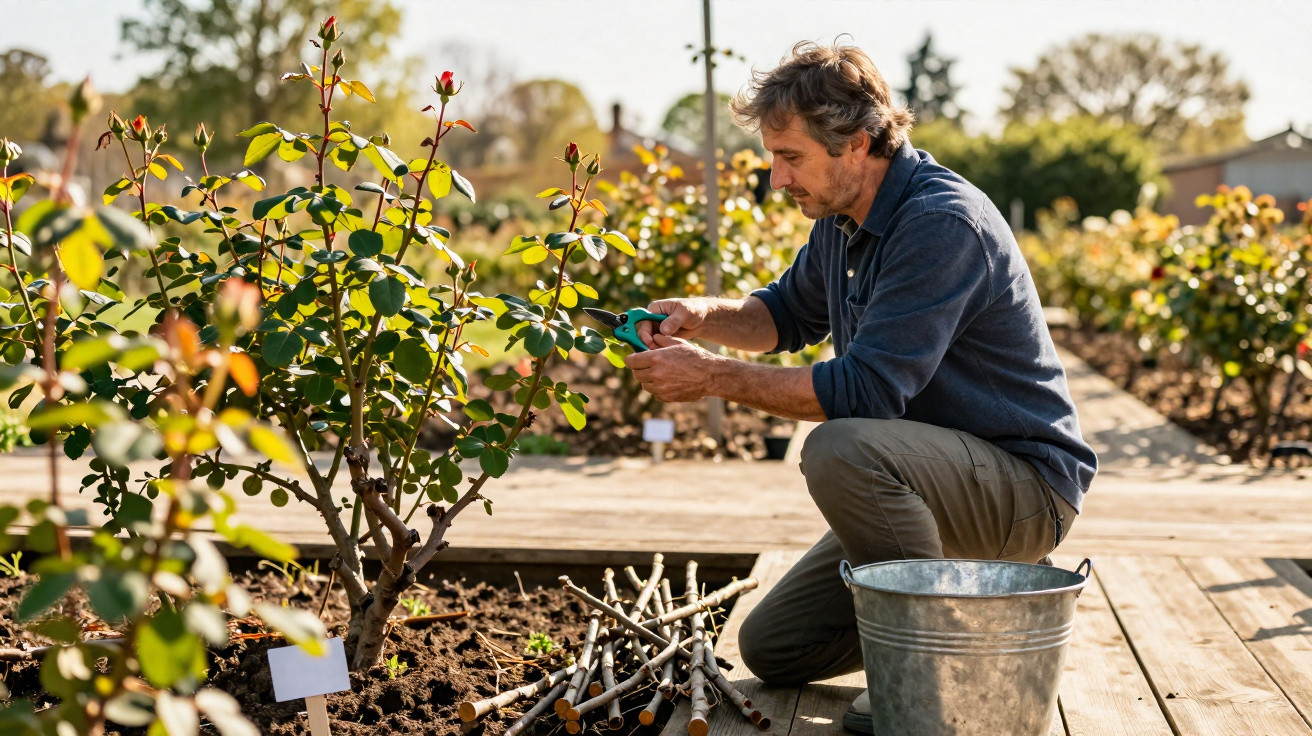
An experienced nursery gardener demonstrates a surprisingly straightforward technique that starts with viewing the rose bush differently. Rather than hurriedly cutting everything back, the aim is to understand the plant’s structure and remove only what is genuinely holding it back. Gardeners who take this approach often see noticeably more flowers, stronger shoots and a far more balanced growth habit in the very first year.
Why conventional rose pruning so often disappoints
Many people prune roses by instinct in spring: cut the whole plant back firmly and evenly, remove a few shoots, and consider the task done. Although this seems convenient, it frequently produces precisely the opposite of the desired result.
- Pruning too hard weakens the plant because it loses a great deal of woody growth and stored reserves.
- Pruning too cautiously leaves behind a tangle of thin, weak shoots.
- The centre of the bush stays crowded, damp and shaded – ideal conditions for fungal diseases.
The result is fewer buds, more leaf diseases, and a bush that flowers here and there without ever creating an attractive overall shape.
“Anyone who simply cuts roses back ‘with a ruler’ deprives them of their vigour and natural form.”
This is exactly where the professional nursery method begins. It treats every rose as an individual plant with its own character, and pruning is adapted accordingly.
The nursery method: observe first, prune second
The key distinction is that a professional does not reach for the tools immediately. Instead, they spend one or two minutes ‘reading’ the bush.
They check:
- Which shoots are old, grey, cracked or clearly dead?
- Where are branches crossing and rubbing against one another?
- Is the middle of the bush completely overgrown, or is it open and well ventilated?
- Which shoots appear strong, properly matured and equipped with healthy buds?
This assessment provides the basis for a clear sequence of actions.
How to prune like a professional
The gardener follows four simple steps that are easy for anyone to remember:
- Remove dead wood: Cut away anything blackened, dried out or broken without hesitation.
- Take out weak shoots: Thin, soft branches carrying hardly any buds should be removed.
- Cut out crossing and rubbing branches: Create more space, particularly within the centre of the bush.
- Shorten strong shoots selectively: Always cut just above an outward-facing bud.
“The skill lies not in cutting a lot, but in cutting the right things.”
This produces an open framework of several sturdy main shoots growing outwards and opening up the bush. Light and air can reach the leaves and buds more effectively, while moisture dries more quickly. This significantly reduces the risk of fungal disease.
Choosing the right time for spring rose pruning
The best time for this pruning depends greatly on the region and the weather. The calendar offers only a rough guide; looking at the plants themselves matters more.
- The buds are beginning to swell and show slightly green tips.
- Severe overnight frosts are no longer forecast.
- The ground is no longer deeply frozen.
In many areas, this point falls between late winter and early spring. Those who are slightly late and can already see small new shoots need not panic. In that case, a gentler cut is enough, taking care to preserve the young growth wherever possible.
Roses are tougher than many people believe. They tolerate minor mistakes, provided they are not cut back brutally and without a system.
Practical pruning steps for a rose bush
Approaching the bush with a precise plan makes the work calmer and more confident. Before making the first cut, it is worth pausing briefly: walk around the rose and inspect it from every angle.
- Work from the bottom upwards so that the structure remains clear.
- Remove inward-growing, horizontal ‘trip hazards’ that would obstruct later shoots.
- Occasionally remove older, very thick stems close to ground level so that younger wood can replace them.
- For bush roses, retain three to five strong, evenly spaced main shoots.
- Shorten each of these shoots to an appropriate length – never trim them all to exactly the same height.
The cut itself should be clean and sloping. Sharp, clean tools prevent ragged wounds, where rot and disease can take hold easily.
What pruning height suits each rose?
How far a rose should be cut back depends largely on its vigour:
| Rose type | Recommended pruning length | Note |
|---|---|---|
| Very vigorous bush | approx. 20–30 cm above ground level | Cut back slightly harder to encourage branching. |
| Medium-vigour variety | around 30–40 cm | Prune moderately, taking the variety’s character into account. |
| Weak or young plant | 40 cm or more | Use a lighter prune so enough leaf mass remains. |
Cutting every rose to precisely the same height takes away its individuality and strength. In nurseries, rose pruning is often compared with a conversation: first listen to the plant, then ‘reply’ with the secateurs.
Common mistakes when pruning roses in spring
Many difficulties stem from a handful of mistakes that are repeated time and again.
- Pruning without a plan: Taking a centimetre off here and a branch there creates an unsettled shape while the bush remains too dense.
- Keeping old wood out of fear: Thick, ageing stems may still produce leaves, but they hold back young, vigorous shoots.
- Cutting far too close to the bud: If the stem is cut directly above the bud, the bud often dries out.
- Using blunt tools: Crushed rather than clean cuts provide ideal entry points for pathogens.
“Leave a small piece of wood above every bud – about one centimetre is enough.”
Following these basic principles prevents many of the classic rose ‘disasters’ in the home garden.
What roses urgently need after pruning
Secateurs alone are not enough. After pruning, the plant must produce new shoots and build leaves, and that requires energy.
Useful measures immediately after pruning include:
- Water thoroughly once in dry weather.
- Work in mature compost or a specialist rose fertiliser.
- Cover the root area with a layer of mulch.
Mulch protects the soil from drying out, moderates temperature fluctuations and suppresses weeds. Using organic materials such as composted bark, chipped branches or leaves also improves soil structure over the long term.
It is worth keeping a watchful eye on the plant in the weeks following pruning. New growth soon reveals whether the bush has coped well with the intervention. Strong, upright shoots arranged loosely indicate successful pruning.
How your view of garden roses changes
Anyone who works according to the nursery principle just once will usually notice a change in the first year: the rose appears more orderly, flowers more evenly across the bush and looks healthier overall.
Over time, an entirely different relationship with the plant develops. You begin to recognise which varieties benefit from harder pruning and which should be handled more gently. At the same time, the pressure to prune ‘perfectly’ decreases – the structure matters, not the millimetre.
Practical advice for different rose types
The underlying principles remain the same, although a few details vary:
- Floribunda roses: Cut back fairly firmly so they remain compact and richly branched.
- Shrub roses: Thin them out rather than cutting them back severely, so their typical, somewhat looser form is retained.
- Climbing roses: Keep the longer framework shoots, shorten only the side shoots, and gradually replace old wood.
Anyone who knows the variety name can also consult the breeder’s recommendations, but should not be unsettled by them. Observing the actual plant in its location is always more important than a general instruction.
Why this rose pruning method means less work in the long term
At first glance, this observant approach may seem more time-consuming. In practice, the reverse is true: a healthy bush with a clear structure needs less follow-up work, fewer emergency cuts in summer and is considerably less susceptible to disease.
Open, well-lit roses dry more rapidly after rain. Fungal issues such as black spot or powdery mildew occur less often and can usually be managed with gentle measures. Applying fertiliser moderately rather than excessively also keeps growth in balance: strong, but not overly lush and soft.
In this way, annual rose pruning changes from an irritating chore into a short, focused task with visible results – often as early as the first flush of flowers in late spring.


Comments
No comments yet. Be the first to comment!
Leave a Comment