
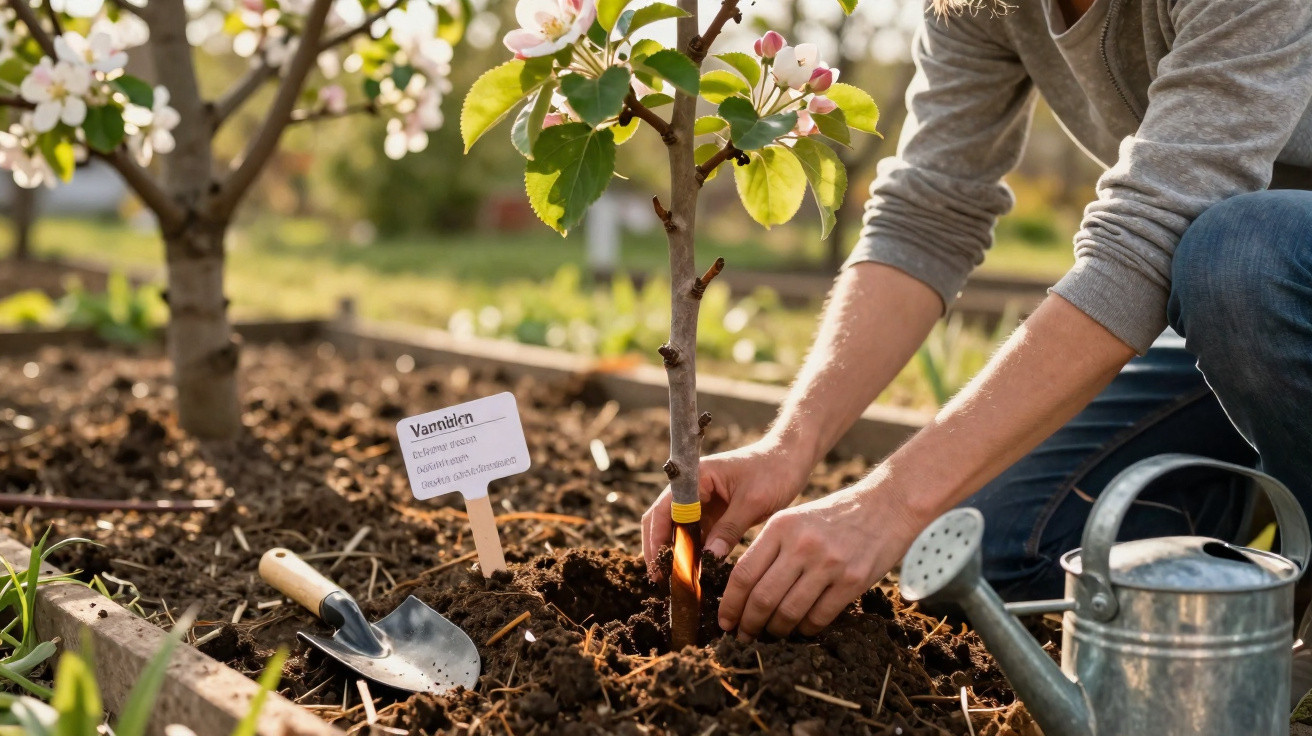
Anyone planting an apple, cherry or apricot tree in spring imagines fragrant blossom and baskets filled with home-grown fruit. Yet in reality, the tree often remains stunted and produces little or no blossom. A “poor variety” is rarely to blame; almost always, the same planting mistake is responsible: the trunk has been placed at the wrong depth in the soil.
The inconspicuous area on the trunk that determines blossom or disappointment
Fruit trees bought from a nursery are nearly always grafted. In other words, the desired variety grows above, while a hardy rootstock forms the lower section. The join between these two parts is the most sensitive point on the entire tree – and it is precisely this area that is frequently buried during planting.
“Covering the graft union with soil deprives a fruit tree of air, vigour and the basis for early, abundant blossom.”
To understand exactly which parts may go into the ground when planting and which must remain above it, inspect the lower trunk closely.
Root collar and graft union: how to identify the crucial boundary
Two areas lie close together at the base of the trunk:
- Root collar: the point where the roots meet the actual trunk; it is usually slightly swollen and often discoloured near ground level.
- Graft union: a pronounced bulge, bend or scar-like thickening a few centimetres above the root collar.
From the root collar upwards begins the part of the tree that must not remain permanently below ground. This is where many gardeners go wrong: they pile soil generously around the trunk, often covering the graft union bulge as well. Although this may appear stabilising and “protective”, it is extremely dangerous for the tree.
Why planting fruit trees too deeply can effectively suffocate them
Constant moisture around the trunk invites fungal disease
Trunk bark is not designed to sit continually in damp soil. Unlike roots, it is highly sensitive to persistent moisture. As a result, the bark starts to rot, initially unseen beneath the surface.
The tree may still look normal from the outside for a while, but the following is happening internally:
- Moisture builds up around the trunk.
- Fungi enter the softened bark.
- The transport tissues carrying water and nutrients are gradually destroyed.
The trunk decays from the bottom before the gardener notices any damage. The canopy is no longer supplied adequately, shoots stay thin and hardly any flower buds form.
When the scion variety develops its own roots – and the tree loses its advantages
Covering the graft union with soil often causes another problem: the upper, “choice” variety begins to form roots of its own. At first, this may sound like extra stability, but it comes at a considerable cost.
“As soon as the scion variety produces its own roots, the tree loses the beneficial qualities of the hardy rootstock – it becomes more susceptible and bears fruit much later.”
The carefully chosen rootstock normally provides:
- better adaptation to the soil,
Comments
No comments yet. Be the first to comment!
Leave a Comment