
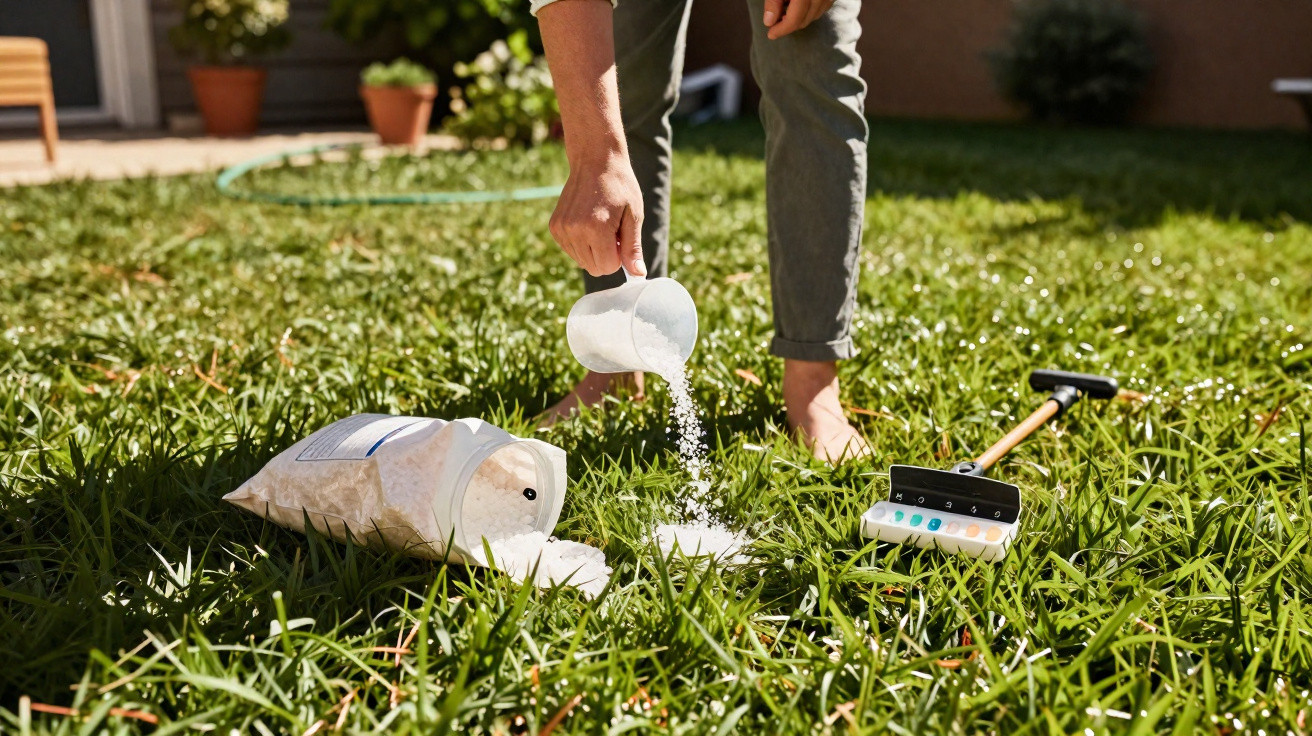
Many lawns look tired after winter – but an inexpensive bath additive from the chemist’s shelf is said to revive the grass before summer.
A tip currently doing the rounds in gardening forums and on social media sounds almost too straightforward: rather than buying costly specialist fertiliser, gardeners are advised to use a product normally intended for the bath that costs little more than £1. It is not a miracle cure, but a familiar household remedy that amateur gardeners have been watching for years.
Why a bath additive has become an Epsom salt lawn trick
The product in question is standard Epsom salt, chemically known as magnesium sulphate. Most people know it from chemists, where it is sold for relaxing baths. In the garden, however, it serves an entirely different purpose.
Magnesium is essential to the formation of chlorophyll. If grass lacks enough magnesium, it cannot make such effective use of sunlight, its green colour becomes dull and growth remains sluggish. These deficiency signs are particularly apparent after a long, wet winter: yellowish patches, pale blades and thin areas across the lawn.
“Magnesium acts like a switch-on button for a tired lawn: it supports chlorophyll production and helps grass make better use of the nutrients already available.”
In the soil, magnesium sulphate helps roots absorb nitrogen and phosphorus more efficiently. Vegetable growers have therefore applied Epsom salt to tomatoes, roses and fruit trees for years to support healthy foliage and flowering. The trend is now increasingly spreading to lawn care.
When Epsom salt genuinely helps a lawn – and when it does not
As appealing as the £1 trick may sound, Epsom salt only works where there is an actual deficiency. Specialists identify typical situations for its use as:
- sandy soils that retain nutrients poorly;
- established lawns that have been heavily irrigated or watered over many years;
- areas where grass turns yellow between the leaf veins despite receiving sufficient water and fertiliser.
In these circumstances, magnesium has often been washed down through the soil with water. A targeted application of Epsom salt can then visibly improve the lawn’s colour and density.
The situation is different for many ordinary domestic lawns. Anyone who regularly uses a balanced slow-release fertiliser will usually already be meeting the lawn’s magnesium requirements. Adding Epsom salt on top mainly increases two things: costs and the risk that surplus nutrients are carried by rainwater towards groundwater.
“Without a genuine deficiency, Epsom salt does little for a lawn, while potentially putting pressure on both the environment and your wallet.”
Professionals therefore recommend arranging a soil test where possible, particularly for larger areas. Local authorities and some horticultural businesses offer these tests at relatively low cost. Those who prefer not to do this should at least look for the typical symptoms of deficiency before reaching for the bath product.
How amateur gardeners can use Epsom salt correctly before summer
If the turf shows clear signs of weakness and a magnesium deficiency seems likely, applying it in spring can make sense. The dosage, timing and application method are all important.
The right amount for a domestic lawn
The instructions on the packet provide useful guidance. Manufacturers of garden products often recommend quantities of up to 600 grams of Epsom salt per 10 square metres of lawn, normally once a year. Using more will not produce better results; it simply raises the risk of nutrient leaching and salt stress for plants.
Anyone using a product from the bath or chemist’s aisle should check the ingredients carefully:
- Use only pure magnesium sulphate.
- Avoid fragrances, colourings and oils.
- Do not use blended products containing other bath additives.
Spreading the bath additive across the lawn
For an even result, many gardeners apply the granules with a spreader. This reduces the risk of overdosing some areas while leaving others untreated.
Key points when applying it include:
- Wait until the lawn is slightly damp or there is dew on the blades, so that the granules adhere more effectively.
- Water thoroughly after spreading, or rely on forecast rain, so the salt dissolves and moves into the topsoil.
- Do not apply it during intense heat or in strong midday sunshine, to avoid stressing the grass.
For a more cautious approach, dissolve the Epsom salt completely in water first. One common method is to add one cup, around 200 grams, to a large watering can of water, stir thoroughly and distribute the contents evenly over the area. This lowers the risk of excessively high concentrations in individual spots.
Lawn care: Epsom salt is only one part of the solution
Despite the current hype, this bath additive is no substitute for sound lawn care. The most important measures for creating a dense, green lawn remain unchanged:
| Care step | Effect on the lawn |
|---|---|
| Mow slightly higher (4–5 cm) | Protects the soil from drying out and strengthens roots |
| Scarify or aerate regularly | Removes thatch and improves air and nutrient exchange |
| Water moderately but deeply | Encourages deeper roots rather than shallow, thirsty grass |
| Use a slow-release fertiliser with a balanced nutrient mix | Supplies grass over the long term with nitrogen, phosphorus, potassium and trace elements |
| Overseed thin areas | Fills gaps and suppresses weeds and moss |
Epsom salt is best viewed as a supplement: useful where magnesium supply is a weak point, but unnecessary when the basics are already right.
The risks and limits of the £1 trick
As with any fertiliser, too much can be harmful. Over-fertilising with magnesium sulphate can increase salt levels in the soil. Some grasses respond with scorched leaf tips or stalled growth.
Groundwater protection is another consideration. If more is spread than plants can absorb, rain carries the excess down through the soil. This happens particularly quickly in light, sandy ground. Routinely treating a lawn with Epsom salt without checking whether it is needed therefore adds unnecessarily to nutrient pollution in the environment.
In addition, yellow lawn patches are not always caused by a nutrient shortage. Possible causes include:
- dog patches caused by urine;
- fungal diseases following damp weather;
- compacted soil due to frequent foot traffic;
- waterlogging in poorly drained areas.
In all of these cases, magnesium sulphate is unlikely to bring much improvement. Soil loosening, adjusted watering or targeted disease control are more suitable measures.
Practical examples from everyday gardening
Many amateur gardeners now test the bath additive on small sections before treating the entire lawn. For example, it can be useful to mark and treat one noticeably weakened patch while leaving an adjacent, similarly affected area unchanged. After four to six weeks, it is easier to judge whether colour and growth have genuinely improved in the treated section.
Anyone already using lawn fertiliser containing magnesium should read the label. If it lists a sufficient proportion, there is often no benefit in additionally buying the bath product. It may be more worthwhile in beds containing tomatoes, peppers or roses, where lighter foliage and slow growth can also indicate a magnesium deficiency.
How Epsom salt can be combined with other lawn care
The substance can be combined effectively with other measures, especially from early spring into early summer. A typical sequence is as follows:
- Mow the lawn and scarify lightly if needed.
- Apply Epsom salt at an appropriate rate, or dissolve it in water and distribute it.
- Water the area thoroughly so that the active ingredient reaches the soil.
- Apply an organic-mineral slow-release fertiliser one to two weeks later.
This order prevents nutrients from simply remaining on the surface. The roots can then absorb them gradually as the lawn develops new, denser green growth.
Anyone seeking to improve soil health over the longer term can also use sand, compost or soil conditioners. These loosen compacted areas, increase humus content and improve water retention. In such a stable setting, an occasional magnesium application is considerably more useful than it would be on depleted, untreated ground.


Comments
No comments yet. Be the first to comment!
Leave a Comment