
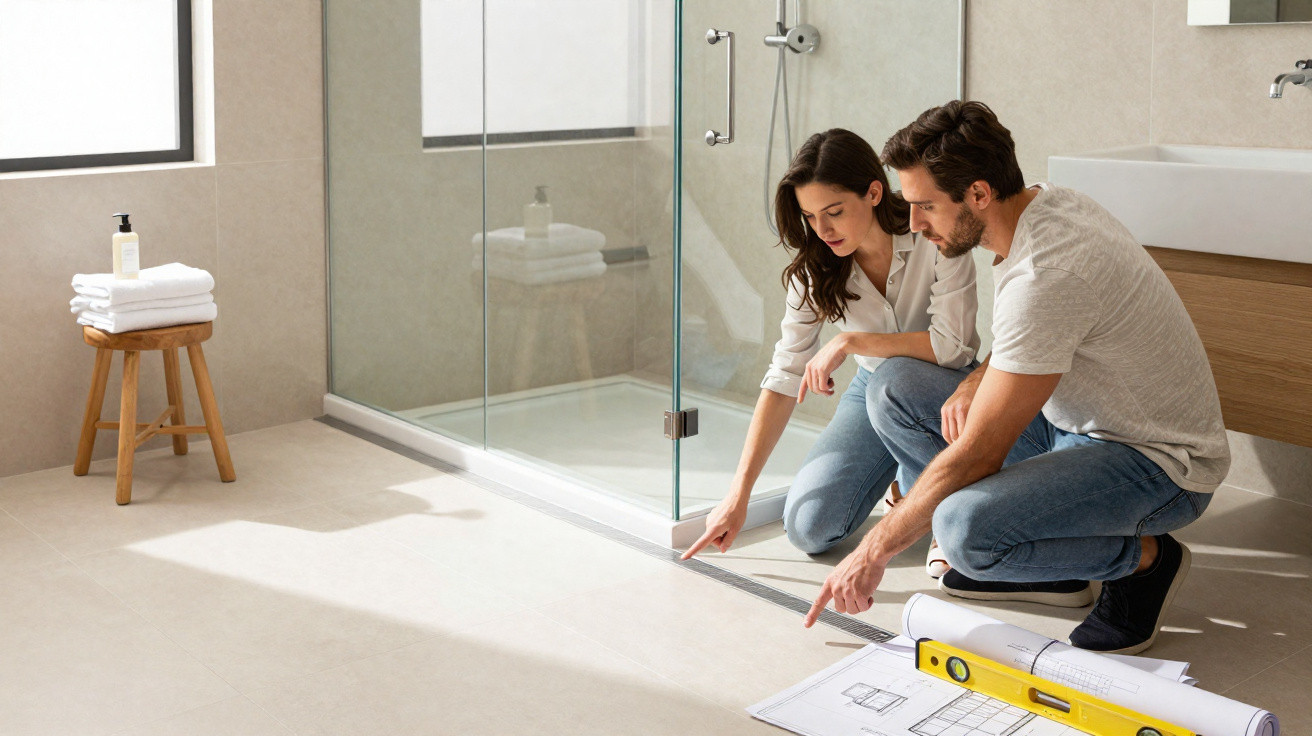
The tempered glass shower enclosure is increasingly being replaced by bathrooms with an open shower, also called a walk-in shower or wet room. This approach removes difficult-to-clean tracks, seals and profiles, resulting in a more seamless, airy and visually spacious showering area.
Why does a tempered glass shower enclosure collect mould so easily?
The issue is not confined to the glass itself. Build-up usually develops on sealing strips, lower tracks, rollers and corners where water remains after showering. These areas collect soap, body oils, limescale and moisture.
In bathrooms with limited ventilation, drying takes longer, allowing mould to return in protected gaps. Even when cleaned regularly, the enclosure edges can become dark because silicone and rubber seals age, lose their effectiveness and retain residue.
Which trend is replacing the traditional shower enclosure?
The alternative is the open shower, featuring a continuous floor, a linear drain and a carefully designed wet area. Rather than enclosing the shower behind glass doors, the design relies on the correct floor gradient, waterproof finishes and, in some cases, only a half-height wall or a discreet fixed screen.
- Walk-in shower: an open showering space without a sliding door.
- Wet room: a waterproofed bathroom designed to accommodate water across a larger zone.
- Linear drain: helps guide water away while creating a cleaner-looking finish.
- Level-access floor: improves movement around the room and accessibility.
Why does an open shower feel more spacious and hygienic?
Without doors, tracks or frames, the view extends across the bathroom without interruption. This effect is particularly beneficial in small bathrooms, as the shower area no longer looks like a separate cubicle and instead becomes part of the same visual plane as the floor and walls.
Cleaning is easier because there are fewer crevices in which grime can gather. A cloth can reach the floor more easily, a squeegee can move freely without catching on tracks, and surfaces dry faster when the room is well ventilated after showering.
What must be planned before removing the tempered glass shower enclosure?
An open shower does not work well as an improvised alteration. Before taking out the tempered glass shower enclosure, assess the floor fall, shower position, drain capacity, waterproofing, and the distance between the wet area and the toilet, cabinet and electrical socket.
- A floor gradient leading towards the drain to prevent standing water.
- A drain with sufficient capacity for the shower’s water flow.
- Slip-resistant flooring in the wet area.
- Proper waterproofing on the floor and on walls close to the shower.
- Natural ventilation or an extractor fan to reduce trapped moisture.
An attractive open shower only works when water has a clear route
An open shower can make a bathroom feel lighter, but it relies on proper design. If the floor lacks a suitable fall, water spreads; if the drain is too small, showering creates puddles; and if ventilation is poor, mould simply moves elsewhere.
The most effective version of this trend combines a continuous surface, a well-positioned drain, easy-clean finishes and a calculated splash zone. The bathroom then feels more spacious, dries more effectively and leaves behind the very areas where the old enclosure was most likely to collect mould: tracks, seals and hard-to-reach corners.





Comments
No comments yet. Be the first to comment!
Leave a Comment