
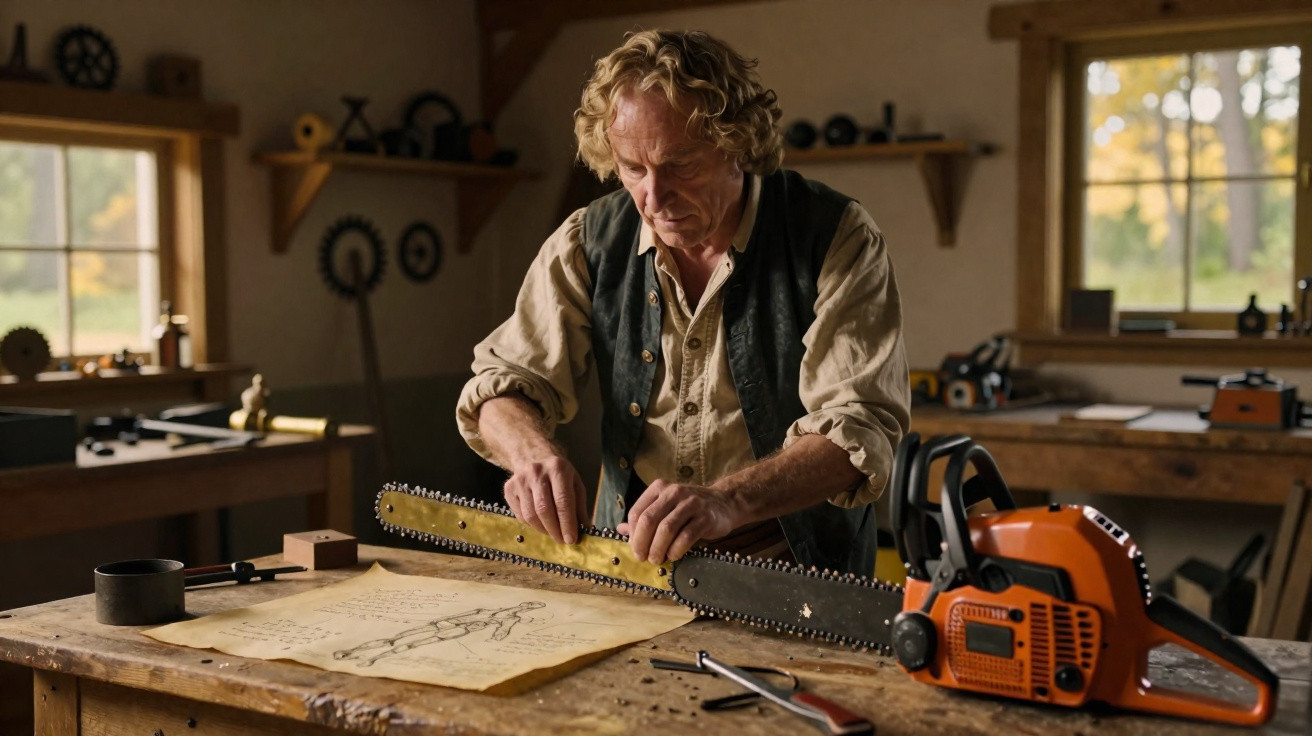
Who invented the chainsaw? Although it is now closely linked with cutting down trees, the earliest form of this device emerged in the eighteenth century as a surgical instrument designed to assist with exceptionally difficult births.
Why was the first chainsaw created?
The origins of the chainsaw date back to the 1780s, when Scottish doctors John Aitken and James Jeffray devised a hand-operated device for cutting bone and cartilage during surgical procedures.
Medical resources were highly limited at the time. The tool was intended to speed up certain operations, particularly complicated childbirths, while reducing the physical effort required during the procedure.
How did the first chainsaw model work?
Unlike the modern tool, the original device had no motor. It used a small toothed chain that was turned manually using a crank handle.
Compact in size, it was designed solely for hospital use. Despite its simple appearance, the mechanism marked an important medical advance for that era.
When was the chainsaw used to cut wood?
Technological progress in the early twentieth century made it possible to adapt the original concept for industrial purposes. Powered first by combustion engines and later by electric motors, the tool became considerably more powerful.
This development took the chainsaw out of operating theatres and made it essential for work including forestry, construction, agriculture and the maintenance of green spaces.
What are the main differences between the old and current versions?
While both versions share the same mechanical principle, they serve entirely different purposes. Technological development changed virtually every aspect of the device.
The most notable changes can be outlined as follows:
- Purpose: from a surgical instrument to a tool for cutting wood.
- Operation: manual in the eighteenth century and motorised today.
- Size: small for medical use and substantially larger for heavy-duty work.
- Use: hospitals in the past; forests, farms and construction sites today.
- Power: limited in the original version and high in modern models.
Why does this history arouse so much curiosity?
Learning that the chainsaw began as a medical instrument often surprises people. That is because its modern image is completely associated with cutting down trees.
The history of the tool illustrates how the same idea can take on new purposes over time. Advances in engineering turned a piece of hospital equipment into one of the best-known tools in industry and forestry.
The invention shows how technology evolves over time
The creation by John Aitken and James Jeffray shows that many inventions can change function completely as new needs emerge and technical advances are made.
Today, the chainsaw is a symbol of efficiency in woodwork, yet its history reveals an unexpected origin that brings together medicine, engineering and innovation in one technological journey.






Comments
No comments yet. Be the first to comment!
Leave a Comment