
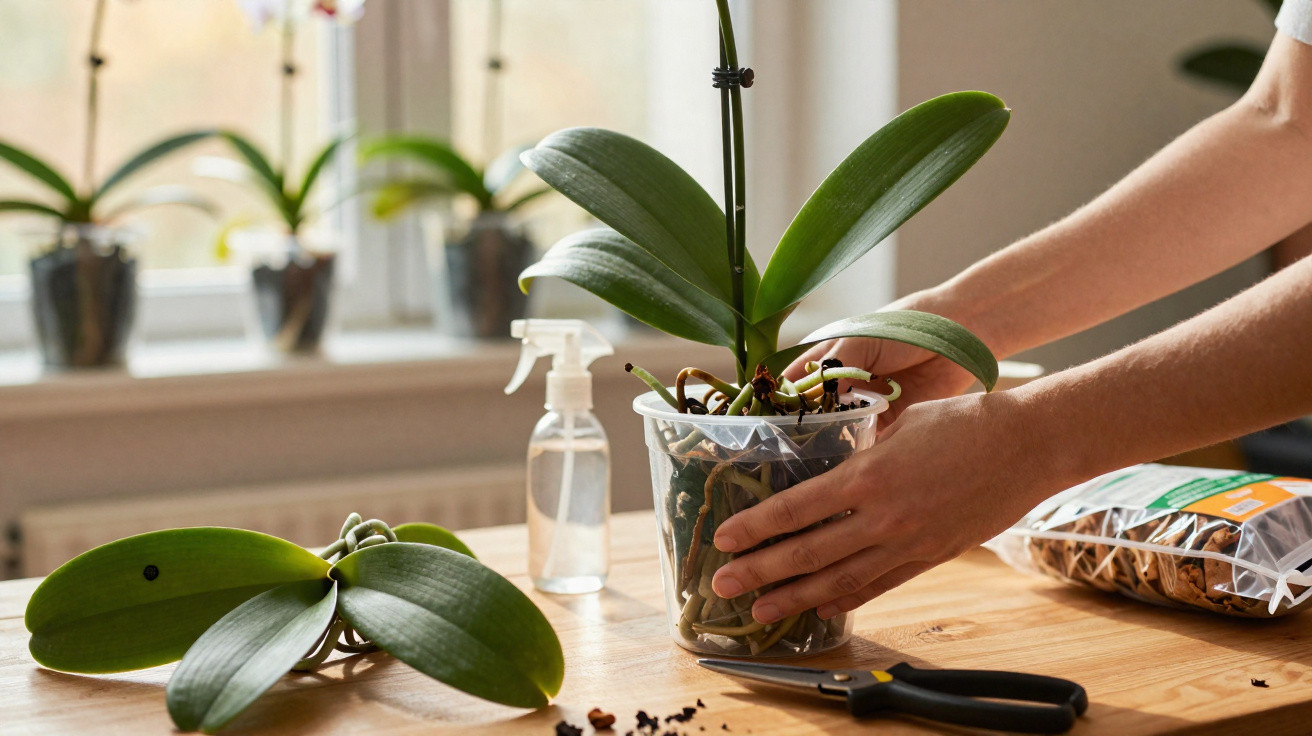
Many amateur gardeners panic at this point and reach for the nearest watering can. Yet that often makes the situation dramatically worse. In most cases, limp, sunken leaves mean the plant can no longer take up water – either because it is genuinely too dry or because its roots have rotted after a watering spree. A methodical approach can still stabilise the plant in most cases.
Soft, wrinkled leaves: what your orchid is trying to tell you
The popular Phalaenopsis orchid makes its stress very clear through its leaves. If they become soft, rubbery and appear as though they have been drained, there is almost always a water-related issue behind it. Crucially, both too little and too much water can cause this.
“Limp leaves mean that the plant can no longer absorb water – not necessarily that it is not being given any.”
Persistent wetness causes the roots to rot, effectively destroying their water-carrying channels. The plant may therefore be sitting in damp growing medium while still dying of thirst. At the other extreme, roots can dry out completely, becoming brittle and unable to pass water onwards. Both situations produce the same outcome: the leaves collapse.
Quick check: identify the cause in minutes
Before cutting anything back or repotting, first make a diagnosis. This first-aid check has three parts: the roots, the growing medium and the surroundings.
1. Look inside the pot: assess the roots
If your orchid is growing in a transparent pot, you have an advantage: you can immediately see the condition of its roots.
- Healthy roots: firm; green when wet; silvery white when dry; with no rotten smell
- Root rot: brown to black, soft, hollow, and smelling stale or musty
- Drought stress: grey, shrivelled, brittle roots that crumble easily when touched
If the plant is already loose around its base, carefully remove it from the pot for inspection. A healthy root crown remains firm even when gently moved.
2. Growing medium and pot: is the orchid sitting in a “swamp”?
Orchids do not grow in ordinary potting compost, but in an airy mix of bark, sometimes with a little moss and coarse material. As this medium ages and becomes too fine, water remains in the pot for too long, oxygen is lacking and rot can develop.
Check the following:
- Does the growing medium smell musty or rotten?
- Has the bark mix decomposed heavily and become more like soil?
- Is the pot very heavy and permanently wet?
If several of these signs apply, repotting is usually unavoidable.
3. Position and humidity: check the room climate
Phalaenopsis orchids prefer bright conditions but not intense midday sun. A steady temperature of between 18 and 22 °C, with humidity of around 50 to 70 per cent, is ideal. Dry indoor heating in winter or a position directly above a radiator puts further strain on the leaves.
The watering water matters too. Very hard, highly calcareous water gradually damages fine roots. Rainwater or low-limescale tap water that has been left to stand is more suitable.
Simply thirsty? Helping with straightforward dehydration
Where most roots in the pot appear healthy and the plant has simply received too little water, a controlled “soak” is often enough.
- Place the pot in a bowl of lukewarm, soft water.
- Leave it for 10 to 30 minutes, until the roots turn a rich green.
- Allow the pot to drain thoroughly – remove every trace of leftover water from the outer pot.
- Do not water again until the growing medium is almost completely dry.
As a general guide, watering about every 7 to 10 days works well, adjusted for the room climate and pot size. Check the medium with a finger rather than watering mechanically according to the calendar.
When roots are rotting: the decisive rescue plan
If the roots are clearly damaged, only consistent action will help. Half-hearted corrections rarely restore the plant.
Orchid surgery: remove all rotten material
Proceed as follows after discovering root rot:
- Carefully lift the plant from its pot and remove all of the old growing medium.
- Use a disinfected, sharp tool to cut away every rotten, soft or hollow root.
- Leave only roots that are firm and succulent.
- Dust the cut surfaces with a little cinnamon powder – it has a mild fungicidal effect.
- Leave the plant to dry in the air for several hours.
Then place the orchid in fresh, coarse orchid growing medium in a pot that is not too large. Be extremely cautious with water during the first few weeks after this “operation”. Light moistening is sufficient; constant wetness is not.
“The fewer healthy roots remain, the more important air, warmth and restraint when watering become.”
Hardly any roots left? How the bag method works
When the plant is almost bare-rooted, its leaves feel leathery and normal watering has no effect, intensive care is the remaining option. A proven technique among orchid enthusiasts uses a transparent plastic bag.
Step by step:
- Remove every rotten root and clean the base of the plant thoroughly.
- Lightly moisten a piece of sphagnum moss; it should be damp, not dripping wet.
- Place the orchid with its base resting on the moss – do not bury it.
- Put everything into a clear, sealable plastic bag.
- Seal the bag and blow a little air into it to create a mini greenhouse.
- Place it in a bright but non-sunny spot at around 20 to 22 °C.
In this humid air, with humidity close to 100 per cent, the orchid absorbs water directly through its leaves and leaf base. New root buds often appear after 3 to 4 weeks. Open the bag gradually afterwards so the plant can adjust to normal indoor conditions, then pot it in fresh growing medium.
Permanently healthy leaves: preventing a relapse
Anyone who has rescued a half-dried-out orchid will not want to repeat the process. A simple care routine greatly reduces the risk.
A watering routine that genuinely works
- Water only once the bark growing medium is almost dry.
- Always let water drain away completely; never allow standing water in the outer pot.
- Water less frequently in winter than in summer because evaporation is lower.
- Avoid heavy misting of the leaves to prevent fungal infection.
For a more humid microclimate, use a saucer filled with pebbles and water. The pot should rest on the stones rather than in the water; rising moisture surrounds the plant without drowning it.
Position, temperature and monitoring: small routines, major benefits
A bright east- or west-facing window without harsh midday sun is ideal. Draughts and direct proximity to radiators are harmful. A brief weekly health check is generally enough:
- Does the pot feel noticeably lighter than it did after watering?
- Are visible roots in the pot still green, or have they become pale and wrinkled?
- Do the leaves appear firm, or are they starting to droop slightly?
Those who regularly watch for these signs spot problems early and avoid having to resort to emergency surgery.
Why orchids react so sensitively to watering mistakes
Phalaenopsis originally come from tropical regions, where they grow as epiphytes on trees. Their roots hang freely in the air, receive rain and then dry quickly again. The bark growing medium in a pot imitates this life “in the tree” – and explains why ordinary potting compost or wet clay are entirely unsuitable.
Their thick, fleshy leaves can store water, but they depend on functioning roots. Once these are damaged, the leaves draw down their reserves and eventually collapse.
Practical tips for the flat, office and hobby room
People keeping several orchids know of another challenge: every room has a different climate. Bathrooms often provide ideal humidity, bedrooms tend to be cooler, while living rooms can become exceptionally dry in winter. Adjust watering intervals to the position, not to the date on the calendar.
If you are unsure, keep a small watering log for several weeks, recording the date, quantity, and condition of the leaves and roots. Patterns soon become clear and old mistakes can be avoided. With this combination of observation, targeted diagnosis and clear rescue measures, even orchids with limp leaves have a realistic chance of a second life on the windowsill.

Comments
No comments yet. Be the first to comment!
Leave a Comment