
Many amateur gardeners reach for costly machinery or harsh chemical treatments. Yet a weak, moss-covered lawn can be restored to a thick, vigorous green surface with surprisingly little effort: just two simple tools and a clear plan for the gardening year.
Why moss suddenly spreads across the lawn after winter
Moss is not a conventional “weed” that simply appears from nowhere. Instead, it signals that the lawn has become weak and is leaving gaps. Moss takes full advantage of precisely these bare patches.
Common reasons for moss in a lawn include:
- Compacted soil – grass roots do not receive enough air.
- Waterlogging – water remains on the ground for too long after rain or watering.
- Acidic soil – the pH level is too low, so grass grows poorly.
- Too little light – shady positions beneath trees or alongside walls.
- Mowing too short – this stresses the lawn and causes it to thin out.
The effects are especially obvious from late winter into early spring: the turf is yellowish and sparse, with numerous bare spots and a dense layer of moss growing between them.
Moss does not mark the end of your lawn; it reveals its weak points. Deal with them and you can reclaim the area.
Timing matters: when moss treatment really works
Many people start work on the first warm day in March, then feel disappointed by the results. Specialists stress that lawn care should be guided less by the calendar than by temperature.
Begin tackling moss as soon as the lawn is visibly growing again – when the blades look fresher and light green, and the mower is needed once more. If March remains cold and changeable for longer, it is better to postpone the work slightly. Grass needs warmth to recover quickly after intensive treatment and to fill the newly exposed areas.
The two tools needed for a moss-free lawn
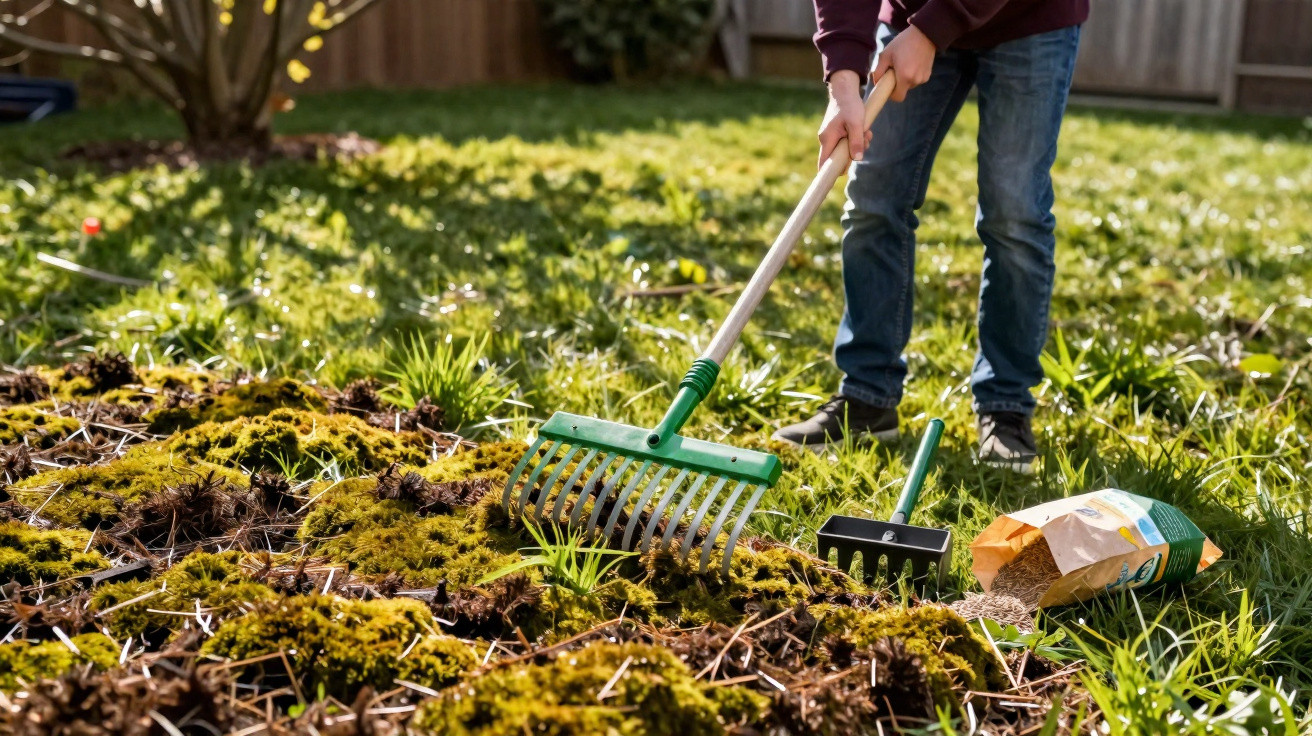
Rather than using a powered scarifier, motorised cultivator and specialist machinery, you essentially need only two traditional garden tools that will fit in almost any shed:
- Lawn rake or lawn scarifier – a specialised rake with sharp tines that pulls moss and thatch from the turf.
- Lawn aerator – such as a garden fork or a spiked roller, used to puncture and loosen the soil.
This pair of tools is enough to remove cushions of moss, open up the soil and let the grass roots breathe again.
Anyone who rakes and aerates regularly will usually need neither noisy machines nor aggressive moss chemicals.
Step by step: the spring moss treatment
1. Mow correctly – but do not cut it “to the ground”
Before any intensive treatment, use the mower first. Initially cut the lawn slightly higher than you would in summer, to around 4–5 centimetres. This avoids weakening the grass further and makes moss patches easier to spot.
2. Remove moss and thatch with the lawn rake
Next comes the most demanding, but also the crucial, stage: work over the lawn strip by strip with the lawn rake. Its tines lightly cut into the turf, pulling out moss, dead grass blades and old lawn thatch.
Key points to remember:
- Work in two directions: once lengthways and once across.
- Do not dig in too deeply – the grass roots should remain intact.
- Remove all loosened material completely rather than leaving it on the lawn.
The result may look alarming: the lawn will appear patchy and battered. That is exactly the aim, as the remaining grass blades now have light, air and room again.
3. Optional: use an iron-based anti-moss product
Where moss coverage is particularly severe, you can apply a product containing iron and fertiliser before or after raking. Such treatments turn moss dark within a few days while also encouraging lawn growth. Follow the instructions on the packaging and spread or spray the product evenly.
Legally, these combined products are classed as fertilisers rather than conventional pesticides, and they are approved for home gardens. Pure chemical moss killers without fertiliser are heavily restricted or prohibited for private use in many places.
4. Loosen the ground with an aerator
Once the moss has been removed, it is time for the second tool. Use a garden fork or specialist lawn aerator to make holes in the soil at regular intervals. On heavy clay soils, a rolling aerator with metal spikes can be worthwhile.
The benefits are clear:
- Rainwater drains more effectively, reducing waterlogging.
- More oxygen reaches the roots.
- Grass roots grow deeper and become more stable.
5. Overseed and fertilise bare patches
Sow a suitable lawn repair seed mix wherever larger gaps have appeared. Lightly roll or tread it in so the seeds make contact with the soil. A gentle fertiliser formulated for lawns will help the grass regrow quickly and close the open areas.
Grass that is dense, deeply rooted and well nourished gives moss no long-term chance.
Year-round lawn care plan for lasting strength and health
A single spring treatment is not enough if the soil is fundamentally too heavy, too acidic or heavily shaded. A straightforward routine across the year brings much better results.
| Period | Tasks |
|---|---|
| Late winter / early spring | Mow high, remove moss with a lawn rake, aerate the soil, overseed if necessary, apply a light feed |
| Late spring / summer | Mow regularly but not too short, water deeply during dry spells, rather than giving the lawn a brief daily sprinkle |
| Autumn | Clear fallen leaves, aerate lightly once more, apply an autumn fertiliser with a higher potassium content |
| All year | Avoid waterlogging and, where necessary, lime the soil if the pH level is too low |
Common mistakes that practically invite moss
The same problems recur in many gardens. Knowing them can prevent a great deal of frustration:
- Mowing too short – the “golf-lawn look” puts grass under considerable stress.
- Watering incorrectly – water less often but thoroughly, rather than briefly every day.
- Ignoring leaves in autumn – thick layers suffocate the lawn, and moss thrives in those conditions.
- Skipping a soil test – lime can help with very acidic soil; otherwise, moss will win every year.
Accept moss-friendly spots and use them creatively
Lawn grass naturally struggles beneath old trees, on north-facing sides or in exceptionally damp corners. Even the most dedicated gardener will repeatedly have to deal with moss there. Sometimes it is worth rethinking the space:
- plant shade-tolerant perennials and ground-cover plants;
- create a small shaded path or seating area;
- deliberately allow moss to become a design feature in a wildlife-friendly garden.
This lets you focus the lawn rake and aerator on areas where grass truly makes sense – and where you will see the greatest success.
Once you incorporate thorough raking, targeted aeration and tailored care into your annual routine, you will quickly notice that moss no longer feels like a permanent enemy but a seasonal signal. It shows where the lawn needs support. In exactly those places, the two simple tools can turn a slippery moss-covered surface back into a hard-wearing, vigorous lawn.





Comments
No comments yet. Be the first to comment!
Leave a Comment