
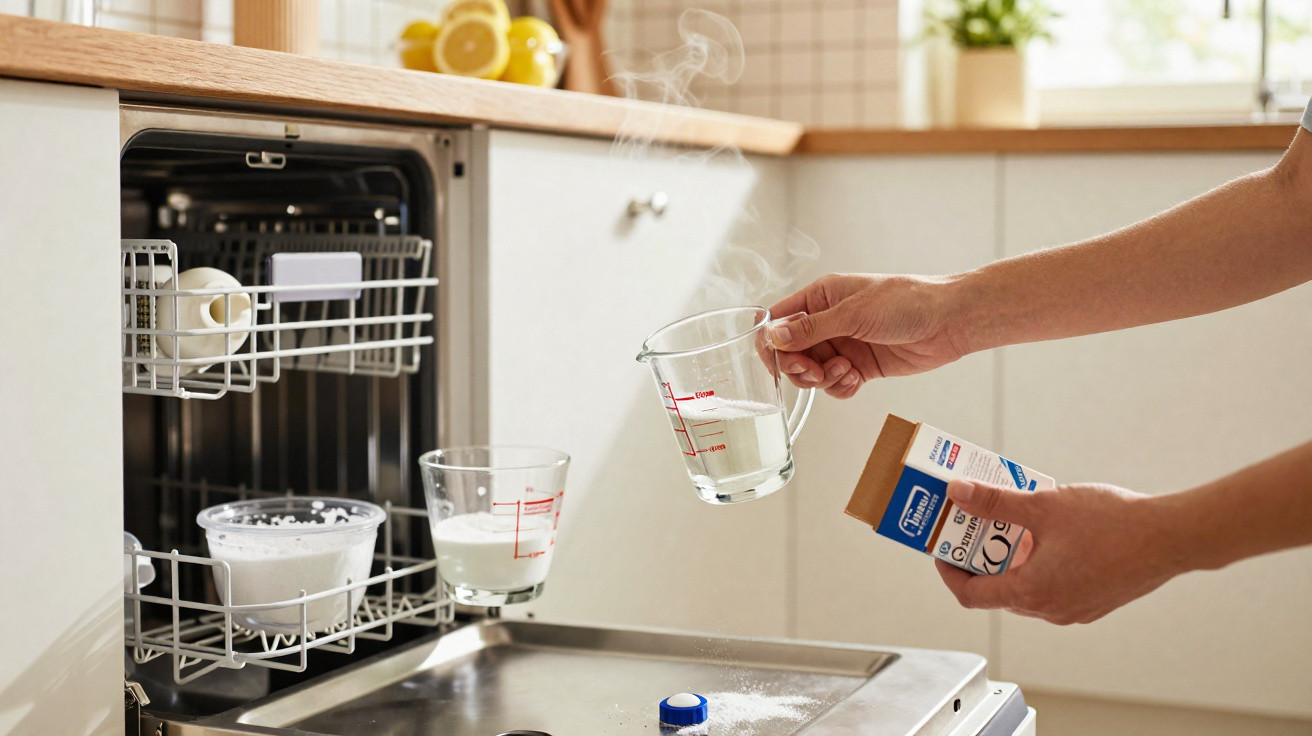
Using household products in the dishwasher has become increasingly common in many kitchens, particularly among people aiming to cut costs or avoid harsher chemicals. Among the various popular mixtures, vinegar and bicarbonate of soda in the dishwasher often attract attention because they are said to provide a deep clean, eliminate odours and unblock the appliance. However, the results do not always live up to expectations and, in some cases, may cause unwanted effects.
What really happens when you mix vinegar and bicarbonate of soda in the dishwasher?
Putting vinegar and bicarbonate of soda into the machine at the same time triggers an immediate chemical reaction, producing foam and releasing carbon dioxide. Although this fizzing can look like intensive cleaning, its actual cleaning effect inside the dishwasher is limited.
Vinegar is a weak acid, while bicarbonate of soda is a weak base. When they come into direct contact, they neutralise one another. This reduces much of vinegar’s grease-cutting ability and bicarbonate of soda’s mildly abrasive action. Excess foam may also reach filters and hoses, potentially contributing to minor blockages and unusual noises over time.
Do vinegar and bicarbonate of soda actually clean the dishwasher?
Some home tests suggest that placing vinegar in the detergent dispenser and sprinkling bicarbonate of soda across the base can leave the dishwasher smelling more neutral immediately after a wash. Greasy glasses and cutlery with light marks may sometimes appear cleaner, but this does not ensure deeper or safer sanitisation.
When used alternately, rather than mixed directly, and in moderate quantities, vinegar and bicarbonate of soda may help with lingering odours and limescale marks. To better understand when each product is most useful in the appliance, consider their most common uses:
- White vinegar may help remove mineral deposits and some water marks from the interior walls and racks.
- Bicarbonate of soda helps neutralise odours and can assist with removing light dirt from filters and removable parts.
- When combined at the same time, their cleaning effect is reduced because the acid and base chemically neutralise each other.
- Too much foam inside the appliance can interfere with water circulation and motor performance.
How can you clean a dishwasher safely at home?
For anyone seeking a more household-based option without risking damage to the appliance, vinegar and bicarbonate of soda should be used in separate stages. This allows each product to work more effectively, without an intense fizzing reaction inside the dishwasher.
- Cleaning filters and removable parts: Remove the lower rack, take apart the filter according to the manual and wash it under running water with washing-up liquid. Bicarbonate of soda can be used as an aid: gently scrub with a soft sponge to loosen built-up grease.
- Vinegar cycle: Once the manual cleaning is complete, place a cup of white vinegar upright on the upper rack and run a short cycle or a dedicated cleaning programme with the dishwasher empty. This can help dissolve grease residue and internal limescale marks.
- Occasional use of bicarbonate of soda: After the vinegar cycle, sprinkle a thin layer of bicarbonate of soda over the base of the machine and run another quick empty cycle to help neutralise odours.
Is it worth replacing detergent with vinegar and bicarbonate of soda?
Completely replacing dishwasher detergent and rinse aid with vinegar and bicarbonate of soda is not considered suitable in comparative tests. Products made specifically for dishwashers are formulated to work at high temperatures, break down grease, control foam and protect internal components-benefits household products cannot guarantee in daily use.
With frequent washing, not using a dedicated detergent may leave plates, glasses and pans with invisible grease residues, while also affecting drying performance. Vinegar and bicarbonate of soda are therefore better used as occasional aids for internal dishwasher maintenance, rather than as full replacements for the products recommended by the manufacturer.






Comments
No comments yet. Be the first to comment!
Leave a Comment