
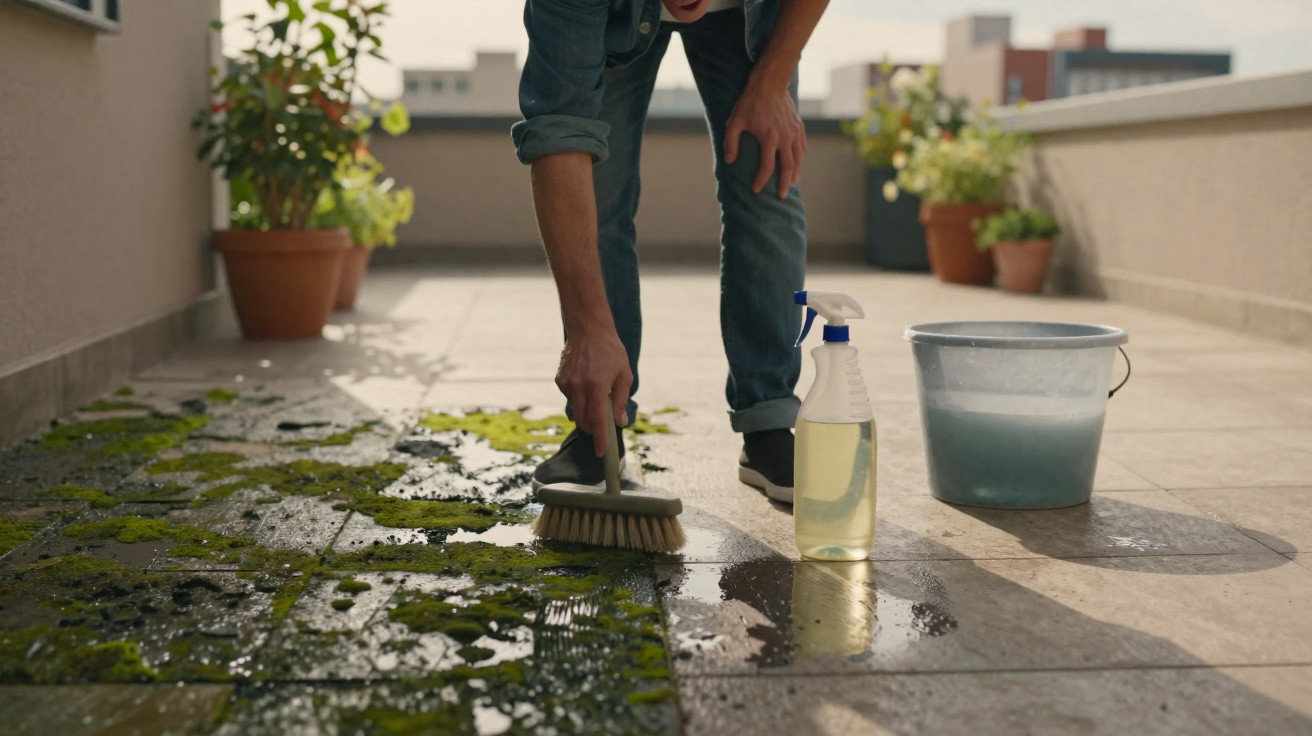
After a wet winter, my patio had become a slippery green surface – but an unassuming product from the kitchen cupboard solved the issue in just one hour.
No pressure washer, no costly harsh chemicals and no spending an entire Saturday on my knees: the answer was a simple bottle of colourless supermarket liquid normally kept in the kitchen. The approach sounds almost too basic to work, yet it cleared moss, algae and dark deposits from my concrete patio for around €0.35.
The starting point: a skating rink instead of a patio
After months of rain, frost and fluctuating temperatures, the outdoor surface was barely recognisable. The concrete slabs appeared to be coated in a green film, cushions of moss filled the joints, and dark, slippery patches shone in places. Putting a chair there felt like risking a trip onto an ice rink.
At the DIY store, containers of green-deposit remover, moss killer and specialist cleaner were piled high. Their prices were well into double figures, accompanied by brightly coloured warning labels. The alternative was hiring or buying a pressure washer – useful, but expensive and far from ideal for many patio surfaces. Soft concrete, old joints and natural stone can all be quickly damaged by excessive pressure.
So I was looking for something that met three requirements:
- inexpensive to buy
- usable without specialist equipment
- achievable without hours of scrubbing
I found the answer in a straightforward everyday product that many people already keep at home: clear household vinegar, commonly sold as “vinegar essence” or a “vinegar-based household cleaner”.
The 35-cent trick: cleaning a patio with household vinegar
A British colleague told me that she has kept her patio clean for years using a mixture of water and vinegar. She did not present it as a miracle cure, but as an affordable household solution that has proved reliable. Her account matched exactly what I was after: simple, quick and requiring no specialist kit.
The basis of the method: mix water and household vinegar at a 1:1 ratio, apply it generously, leave it for one hour, then brush lightly.
In her case, the bottle cost the equivalent of around €0.35. She used roughly half of it and was surprised herself by how bright her slabs looked again after rinsing. That experience prompted me to try it out for myself.
Step by step: how the one-hour clean worked
1. Remove loose dirt
Before applying any cleaner, start with a sturdy broom. Leaves, soil, small twigs and loose moss need to be removed; otherwise, the cleaning solution remains on the top layer and barely reaches the actual stains.
- Sweep the entire area thoroughly with a stiff-bristled broom.
- Pay particular attention to joints and corners, as these areas collect the most debris.
- Remove any loose cushions of moss that come away easily straight away.
2. Prepare the mixture
The cleaner itself requires only two things: tap water and household vinegar.
- Fill a bucket with water.
- Add vinegar at a 1:1 ratio, using equal quantities of water and vinegar.
- Do not use overly hot water; lukewarm water is entirely sufficient.
The mixture should be easy to spread evenly, not boiling hot. Water that is too hot can do more harm than good to delicate surfaces.
3. Apply the solution generously
Next, pour the liquid directly over the patio. It is particularly important to thoroughly soak the green and darkened areas. You can use a watering can if you wish, although a bucket works just as well.
The mixture should remain undisturbed on the surface for at least 30 to 60 minutes, allowing it to loosen moss, algae and deposits.
At first, little appears to change visually during this period. The real effect only becomes apparent when brushing afterwards.
4. Gentle brushing – the surprising part
After around an hour, I picked up the broom again – this time for brushing rather than sweeping.
- Brush the slabs in sections with the broom.
- Apply a little more pressure to stubborn patches, but do not use brute force.
- Loose deposits often lift away with the first pass.
The surprising result was that the green film disappeared from many slabs almost immediately. Considerably lighter surfaces emerged from beneath the coating. Grooves and subtle textures that had previously been completely covered became visible again.
To finish, I rinsed the area with clean water. Anyone without a hose can use buckets again. What matters is that the loosened dirt is not simply left sitting in the joints.
Which patio surfaces are suitable for this method?
Vinegar works because of its acidity. This is exactly why it can be effective against many organic deposits, but not every material tolerates this treatment equally well.
| Surface | Suitability | Note |
|---|---|---|
| Concrete slabs | well suited | Leave for 30–60 minutes, then rinse thoroughly |
| Frost-resistant outdoor tiles | usually suitable | Test on an inconspicuous area first |
| Hard-wearing natural stone, such as basalt | limited | Use only after consulting specialists |
| Marble, polished limestone, some types of granite | unsuitable | Acid can dull the surface or cause stains |
| Timber decking | generally unsuitable | Use timber-care products or specialist cleaners |
If you are unsure, carry out a small test in an area that is not immediately noticeable. If discolouration appears after drying or the surface looks dull, do not continue using this method there.
Cost, effort and comparison with harsh chemicals and pressure washing
At DIY stores, containers of green-deposit remover generally cost several euros per litre. They often cover 30 to 50 square metres, but contain powerful active ingredients classed as biocides. Gloves, eye protection, dry weather and keeping pets away are all essential.
Household vinegar is considerably cheaper. A supermarket bottle often costs less than one euro. For a typical patio, half to one full bottle is often enough, depending on the area’s size and how severe the growth is.
In essence, the work comes down to four stages: sweep, mix, apply and brush briefly – with no specialist equipment or protective suit required.
Pressure washers certainly have their place, but they remove more than dirt alone. They can wash away jointing material, wear down soft concrete more quickly, and reduce the stability of some patio systems. Anyone who does not own one must also hire it or pay a substantial amount to buy one.
Safety, environmental considerations and common mistakes
Although vinegar is a familiar household product, it is still an acid. Avoid direct contact with the eyes or broken skin, particularly when using more concentrated products. Simple rubber gloves are sensible for longer jobs.
A few common mistakes are easy to avoid:
- Making the mixture too concentrated: more acid does not automatically mean better results, but it does create a greater risk for sensitive materials.
- Letting the solution sit in blazing sunshine: the liquid dries too quickly before it can work properly.
- Failing to rinse surfaces afterwards: residues can encourage rust on nearby metal parts or cause irritation to pets.
- Treating sensitive stone without testing first: high-value natural stone usually requires specialist care products.
Practical extra benefits and useful additions
One side effect is that the mixture also weakens small weeds and moss in the joints. After treatment, many plant remnants are easier to scrape out. It will usually not be enough for heavily rooted growth, which then needs targeted pulling or mechanical removal.
For long-term patio care, combine regular sweeping with spot cleaning and keep permanently damp areas to a minimum. Raising plant pots on supports, creating a gentle slope for drainage and removing leaves all help prevent a continuous green layer from forming again.
A brief note on terminology: specialists generally use “green deposit” to mean a mixture of algae, moss and sometimes lichen. These establish themselves wherever conditions are damp, shaded and poorly ventilated. Concrete slabs on a north-facing side or beneath trees are classic examples. The longer such deposits remain, the more firmly they become embedded in the surface pores.
For anyone who does not want a pressure washer and is put off by costly specialist products, using vinegar and water offers a surprisingly effective alternative. It requires no chemistry qualification – just a little time, a broom and the willingness to try something that sounds almost too simple.

Comments
No comments yet. Be the first to comment!
Leave a Comment