
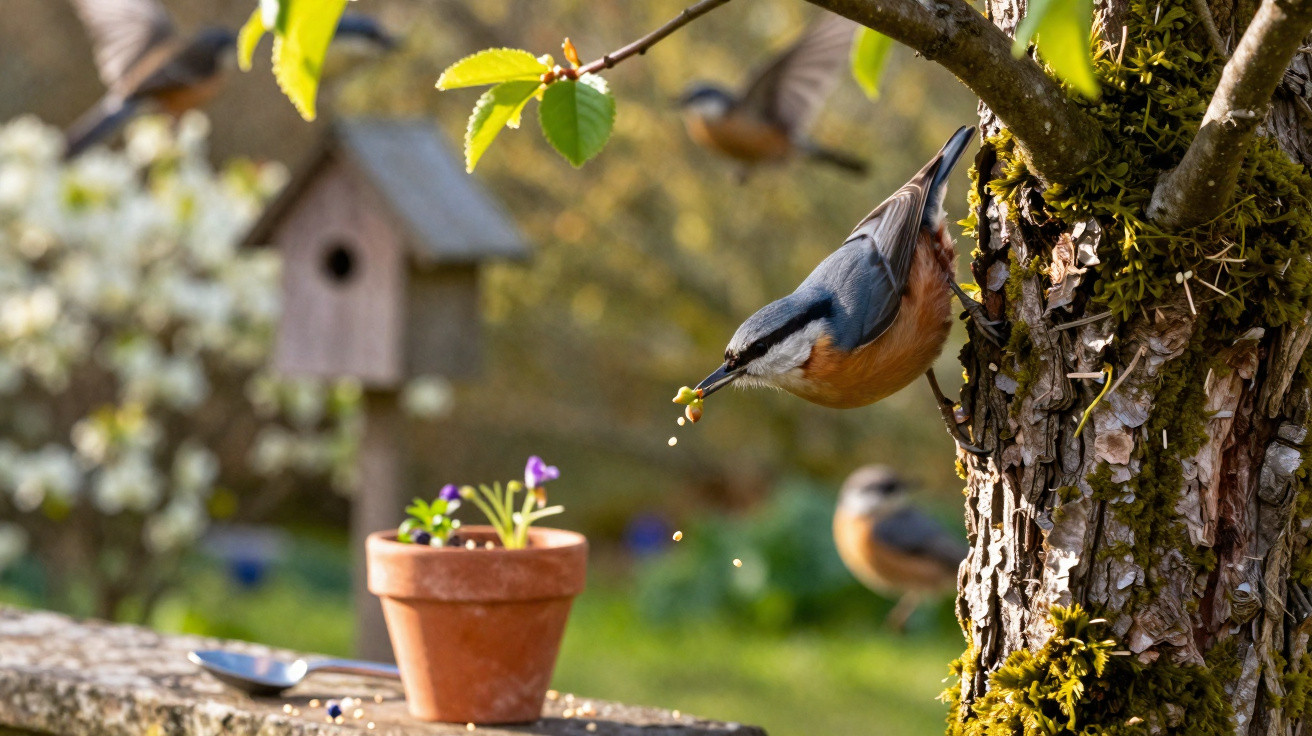
If you listen in your garden early on an April morning, you may suddenly notice unfamiliar calls coming from the treetops. Before long, a compact bird with a “mask” and remarkable climbing skills comes back into view: the nuthatch, more precisely the Eurasian nuthatch. It is regarded as an understated star among garden birds, and its presence says a great deal about the quality of a plot.
The “masked climbing expert”: how to identify the Eurasian nuthatch
At first glance, the Eurasian nuthatch can seem unremarkable. It is roughly sparrow-sized, although it has a more stocky appearance. Look a little closer and its distinctive features become clear:
- blue-grey upperparts
- a warm orange-coloured belly
- a slender, pointed bill
- a conspicuous black stripe through the eye, resembling a small robber’s mask
This dark eye stripe is what makes the little bird especially recognisable. Many garden owners describe it as “the one with the mask that runs down the tree” – and that is a very accurate description.
The Eurasian nuthatch is known for its acrobatic ability: it can climb head-first down tree trunks – something hardly any other garden bird can manage.
Its strong legs and long claws hold firmly to the bark. This lets it move effortlessly upwards, sideways and, of course, head-first down a trunk. It also produces loud, dry calls, often repeated in sequences. Anyone who has consciously heard these short, sharp calls once will immediately recognise them again later.
Why April matters so much for the Eurasian nuthatch
The breeding season begins with spring. From around April, Eurasian nuthatches start marking their territories more clearly and selecting nesting holes. At this time, they appear more often in gardens that meet their requirements.
However, not every plot is suitable. Eurasian nuthatches are selective about where they live. They mainly settle where they can find one thing:
Without mature trees, Eurasian nuthatches have little chance
Mature trees with plenty of structure are the most important factor for Eurasian nuthatches. They are particularly interested in:
- old fruit trees with cracks and cavities
- large oaks, beeches or limes
- trees with natural crevices, decaying areas or woodpecker holes
Unlike blackbirds or finches, Eurasian nuthatches do not build nests in branches. They use existing holes and crevices, favouring those made by woodpeckers or formed through age.
Interestingly, they actively alter these cavities. Using clay or damp soil, they narrow the entrance until only they can fit through it. This protects them from larger competitors and potential predators.
Leaving mature trees standing in the garden automatically creates homes for Eurasian nuthatches – and sends a strong signal in support of biodiversity.
How the Eurasian nuthatch lives – loyal, vocal and always close to trunks
The Eurasian nuthatch is a typical woodland bird that will readily venture close to people when conditions are right. Nearly every aspect of its life revolves around trees.
Faithful to its territory throughout the year
Many garden birds move on or change their location during the year. The Eurasian nuthatch rarely does so. Once it has found an area with suitable trees, it will generally remain there all year round.
Some pairs occupy the same cavities for years. For garden owners, this means that anyone seeing Eurasian nuthatches in spring has a good chance of spotting them again in winter – provided their surroundings do not change radically.
What is on its menu
The Eurasian nuthatch’s diet is closely linked to its habitat. It deliberately searches tree bark for food, with its main diet changing according to the season:
| Season | Main food |
|---|---|
| Spring | Insects, spiders and larvae in tree bark |
| Summer | Beetles, caterpillars and small insects in trees and shrubs |
| Autumn | Nuts, acorns and seeds – often hidden in bark crevices |
| Winter | Energy-rich seeds, sunflower seeds, walnuts and hazelnuts |
In autumn, the Eurasian nuthatch builds up food stores. A typical behaviour is wedging nuts or seeds into crevices before opening them with forceful blows from its bill. Many people will know this scene from a feeding station: a nuthatch takes a seed, flies away, secures it somewhere, hammers at it briefly – then promptly returns.
How to make the garden a perfect Eurasian nuthatch territory
Anyone wishing to see Eurasian nuthatches regularly can adapt their garden to suit the bird’s needs quite easily. Structure matters, rather than perfection.
Essential features for nuthatch-friendly gardens
- Keep mature trees: Do not immediately fell every decaying trunk. It is often enough to make the crown safe and retain the trunk as a habitat tree.
- Provide cavities: Nest boxes with a small entrance hole and a deep nesting chamber can attract Eurasian nuthatches, especially where mature trees are not yet available.
- Tolerate leaf litter and dead wood: These support many insects, providing ideal food, particularly in spring.
- Adapt winter feeding: Sunflower seeds, chopped nuts and high-quality seed mixes are ideal. Only offer unsalted peanuts of good quality.
The more natural a garden appears, the greater the chance that Eurasian nuthatches, woodpeckers and other specialists will choose it as a permanent habitat.
Why the Eurasian nuthatch is so valuable in the garden
This attractive masked bird is more than a pleasant sight. It performs important roles in the garden’s small-scale ecosystem.
It eats caterpillars, larvae and other insects hiding in bark, helping to limit potential pest populations. At the same time, it carries nuts and seeds around, occasionally drops them and therefore indirectly contributes to new plant growth.
Many nature enthusiasts view the Eurasian nuthatch as a kind of “seal of quality”: where it breeds, there is usually a good mix of mature trees, untidy natural corners and richly structured vegetation. Put simply, it is a garden where not everything has been clinically tidied away.
Legal protection and respectful behaviour
Like almost all native songbirds, the Eurasian nuthatch is protected. Breeding sites, cavities and nests must not be destroyed or disturbed. Feeding and habitat improvements should offer support, not create dependence.
Creating a nuthatch-friendly garden does not mean building a “private zoo”; it means providing a refuge for a wild animal that decides for itself whether to stay. This is particularly valuable for children: observing birds without touching or confining them.
An added benefit: Eurasian nuthatch watching as a hobby
Anyone who pays attention to its calls and climbing behaviour can easily distinguish the Eurasian nuthatch from tits, sparrows or finches. Simple binoculars are enough to observe it more closely. A quiet bench overlooking mature trees or a feeding station is ideal.
Many amateur gardeners keep a small notebook or an app-based list for recording their observations: when the Eurasian nuthatch first appears each year, whether it visits the feeding station, or whether it perhaps uses a nesting cavity in an old apple tree. Over time, this becomes a personal nature diary – while also deepening understanding of the subtle processes taking place in one’s own garden.
So, if you spot a small blue-grey “masked bird” darting head-first down a trunk in April, there is every reason to be pleased: the garden evidently offers more than lawn and ornamental shrubs – it has become a genuine habitat.
Comments
No comments yet. Be the first to comment!
Leave a Comment