
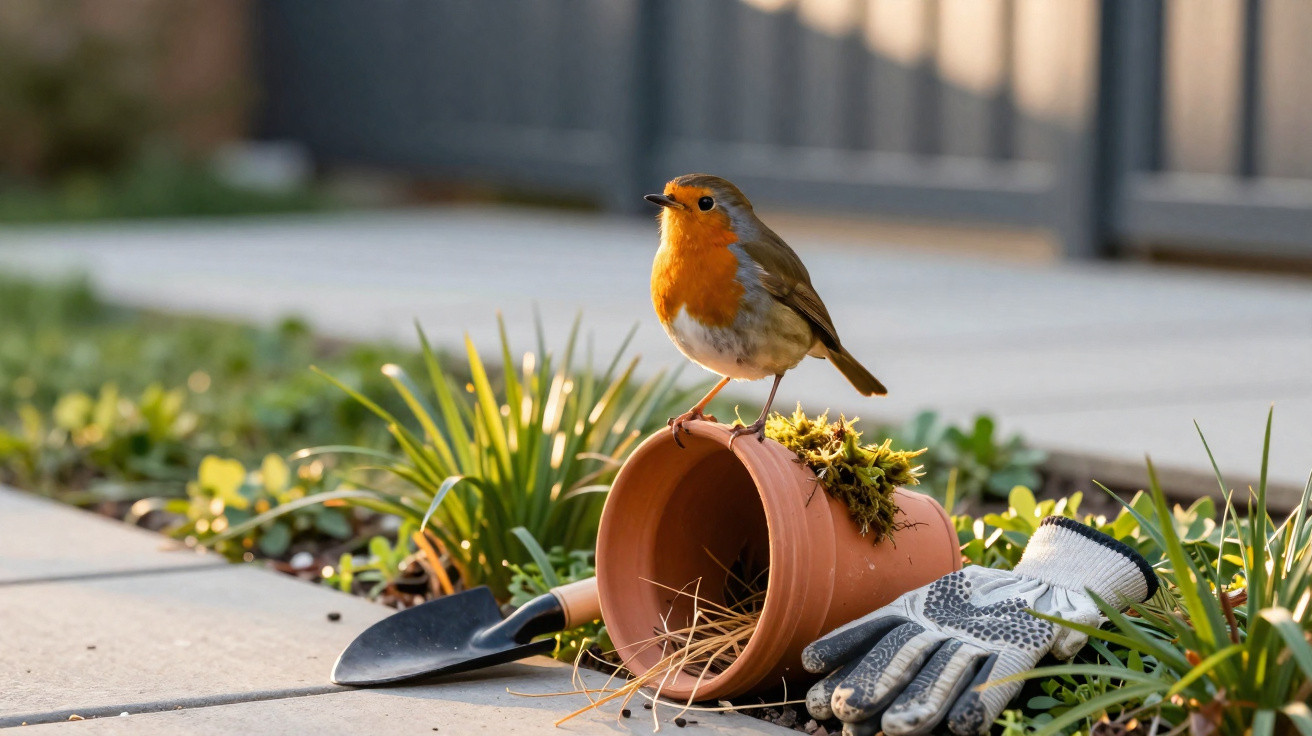
An ordinary terracotta flowerpot can become the perfect nursery for robins in your garden – provided you use it properly.
Many keen gardeners put up costly nest boxes, then wonder why the familiar robin ignores them year after year. This bird knows precisely what it needs, and narrow boxes high in a tree do not fit the bill. A simple terracotta flowerpot, positioned thoughtfully, meets its requirements far better and costs next to nothing.
Why robins avoid conventional nest boxes
Robins may be friendly garden visitors, often hopping almost beneath your feet while you dig a border. Yet they are highly selective when choosing somewhere to breed. Many standard nest boxes with a small entrance hole hold no appeal at all for this species.
The reason is their nesting behaviour: robins are classed as semi-cavity nesters. Unlike tits, they do not seek an enclosed box, but instead need:
- a broad, open yet sheltered entrance
- a low site close to ground level
- dense vegetation providing cover on every side
- a dry, well-ventilated hiding place
Typical wooden nest boxes hung 2 to 3 metres up a trunk simply do not match this profile. To a robin, such a spot feels unnatural and unsafe.
Robins prefer to nest in low, concealed structures – in the undergrowth rather than high up in a tree.
Terracotta rather than wood: why a flowerpot works so well
This is where the traditional terracotta flowerpot comes in. In terms of the conditions inside the nest site, terracotta is close to ideal. Unlike plastic or painted wood, this porous material can absorb moisture and release it again.
The benefits of a terracotta flowerpot as a nesting site
A terracotta flowerpot offers several advantages:
- Natural moisture control: Hardly any condensation forms that could harm the chicks.
- A pleasant internal climate: Terracotta stores a little warmth during the day and releases it gradually.
- An unobtrusive appearance: Its earthy finish blends naturally into hedges, corners and banks.
- Inexpensive and reusable: Old pots can easily be put to use again.
Size matters: a diameter of around 15 to 20 cm has proved effective. Keep the opening wide rather than restricting it to a small slit as in a tit box. This makes the pot resemble a small semi-cavity, exactly the type of site robins look for in the wild.
Preparing a terracotta flowerpot for robins
In many cases, an old flowerpot from the corner of the garden will do perfectly well if you prepare it properly. It only takes a few straightforward steps.
A step-by-step robin terracotta flowerpot
- Choose a suitable pot: Select an unglazed, unpainted pot measuring 15–20 cm across, with no cracks or sharp edges.
- Clean it thoroughly: Rinse it with water only; do not use cleaning products or leave any perfume residues.
- Position the pot: The drainage hole in the base may remain open, as it helps moisture to drain away.
- Prepare the inside: Add a thin layer of dry leaves and a little moss, so the “entrance” already resembles the beginnings of a nest hollow.
The pot should feel as though nature itself placed it there – clean but not sterile, textured but not tidied up.
The crucial factor: position and height in the garden
Whether robins accept your terracotta flowerpot depends less on its material than on where you put it. Many attempts fail because the pot is carefully decorated but positioned entirely wrongly.
The right height and direction
Robins breed in the lower part of the garden. The terracotta flowerpot should therefore:
- be placed or wedged at roughly 1 to 1.5 metres above the ground
- never be fixed noticeably higher
- slope slightly downwards so rainwater can run out
- ideally face south-east, receiving morning sun and afternoon shelter
The downward angle stops damp from collecting in the pot. A south-east aspect provides gentle morning sunshine without allowing the nesting site to overheat in the midday sun.
A hiding place, not a decorative feature
The surrounding area is just as important. Robins need cover:
- a dense hedge or shrubs around the pot
- climbing plants such as ivy on a wall
- banks planted with scrub or wild herbs
Rather than displaying the terracotta flowerpot prominently at eye level in the middle of the patio, make it almost disappear. Tuck it partly beneath branches, push it into a gap in ivy, or place it among old pieces of wood.
For a robin, camouflage matters more than design. Every step that makes the pot less conspicuous improves the chances.
The best time to put out the pot
Robins begin breeding early in the year. Anyone who starts making preparations in late spring will often miss the key period. The ideal window is from late February until around the middle of March.
At this time, the birds are actively searching for suitable nest sites. If the terracotta flowerpot is already in place, it is far more likely to make the shortlist. Later nesting attempts can still happen, but the first impression counts.
What if the pot remains empty in its first year?
Not every arrangement works immediately. Sometimes the surrounding cover is still unsuitable, or the pot is too exposed or too sunny. In that case, patience and a few minor adjustments can help.
Useful changes may include:
- denser planting with additional shrubs or perennials
- a slightly different location within the same hedge
- a second terracotta flowerpot in another part of the garden
The important thing is not to keep rearranging everything. Robins remember calm, stable areas of a garden. A spot that does not seem ideal today may become much more attractive the following year as its vegetation develops.
Protection from disturbance and predators
A well-positioned terracotta flowerpot protects a brood not only from rain, but also from curious eyes and predators. Cats, martens and magpies take advantage of every exposed situation.
A few simple rules make the site safer:
- never position the pot directly above frequently used paths
- do not place a feeding dish close to the nesting site
- do not install lighting that shines onto the area
- keep your distance once breeding activity is apparent, and inform children
The entrance to the pot should be easy for the robin to use but as awkward as possible for larger animals. Closely growing branches, bramble canes or dense scrub act as a natural barrier.
How to tell whether your terracotta flowerpot is being considered
The success of your project is not only apparent once a finished nest is there. Even beforehand, the birds provide clues:
- Robins spend more time near the pot, watching the surroundings.
- They hop inside briefly, then reappear, looking curious.
- Small pieces of plant material or extra leaves begin to appear inside.
As soon as you repeatedly spot material in the pot, do not alter the area any further. Once structures have been accepted, birds can react very sensitively to later interference.
Practical additions for a robin-friendly garden
The terracotta flowerpot is only one part of the picture. To encourage robins to remain in the garden long term, provide a combination of food, cover and peace.
This can include:
- leaf piles or wood stacks that provide shelter for insects
- an area that is not completely cleared during winter
- a strip of open soil where the bird can find worms
- chemical-free areas – avoid pesticides altogether
Avoiding chemical treatments in particular ensures that enough small creatures live in the soil. Robins feed largely on insects, spiders and worms. A garden that is “too tidy” is of little interest to them.
Why the terracotta flowerpot trick suits modern gardens so well
Many gardens are becoming more densely built up, with smaller beds and increasingly dominant lawns. Traditional hedge habitats are gradually disappearing. A reused terracotta flowerpot can partly compensate for this change by creating an artificial nesting place that closely resembles a natural hideaway.
Especially on new-build estates, where mature trees and overgrown corners are absent, such a pot gives robins an opportunity. Planting a few native shrubs as well and not relentlessly clearing away leaves lays the foundation for a stable population in your own neighbourhood.
An unremarkable garden item can therefore become a small contribution to wildlife conservation – and an everyday flowerpot can become a place where the bright orange-red breast brings life in spring.
Comments
No comments yet. Be the first to comment!
Leave a Comment