
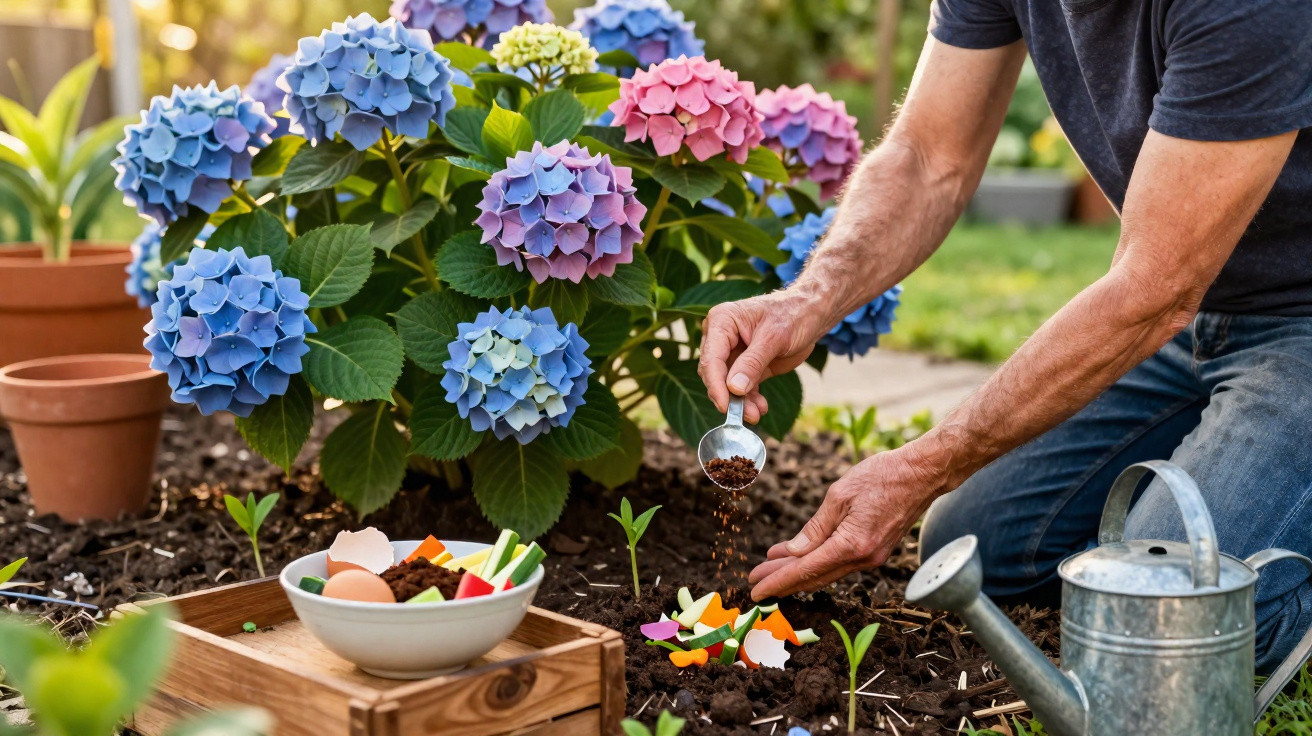
Many hydrangea enthusiasts wonder every year why their shrubs produce hardly any flowers – yet the answer is often sitting right in the kitchen.
While most amateur gardeners are still eyeing the weather cautiously in March, the groundwork for hydrangeas’ floral display is already under way below the soil. At this transitional point, a carefully chosen serving of natural nourishment determines whether the shrubs will be covered in bold flower heads in summer or manage only a few sad clusters once again.
Why March becomes the crucial month for hydrangeas
In March, hydrangeas gradually emerge from their winter rest. Their buds begin to swell, roots become active again and the first delicate shoots push upwards. At this stage, the plant needs energy quickly, but not in an excessive dose.
This is precisely where natural fertiliser has a role to play. Organic matter releases nutrients gradually rather than all at once. This enables hydrangeas to:
- grow sturdy, vigorous shoots capable of supporting flowers well
- direct energy into forming flower buds
- develop a denser, healthier root system
Hydrangeas are among the plants with a high demand for NPK – nitrogen, phosphorus and potassium – as well as trace elements such as iron. Natural fertilisers, including well-rotted compost and aged farmyard manure, provide this combination while also improving soil structure. That is their major advantage over mineral fertiliser straight from a packet.
“Anyone who supplies their hydrangeas with organic nourishment in March lays the foundation for strong shoots and abundant flowers in summer.”
There is another important consideration: hydrangeas thrive especially well in slightly acidic soil. A pH of around 5 to 6 often produces more intense flower colours and supports good nutrient uptake. The right natural fertiliser can help maintain this range.
The overlooked helper: coffee grounds as a natural booster for hydrangeas
Many people thoughtlessly throw them in the bin, although used coffee grounds contain considerable potential. For hydrangeas, they can become a quiet but valuable helper – provided they are used properly.
Dried coffee grounds contain mainly nitrogen, along with some potassium and other minerals. They gently acidify the upper layer of soil. This particularly suits the classic garden hydrangea (Hydrangea macrophylla), which appears in many gardens with pink or blue flowers.
When applied correctly, coffee grounds offer several benefits:
- provide gently released nitrogen for fresh, deep-green foliage
- improve the soil structure around the roots
- encourage earthworms and other soil life
- may slightly deter slugs and ants at the base of the plant
“Coffee grounds are not a miracle cure, but they are a surprisingly effective supplementary fertiliser for anyone who does not want simply to throw away their morning coffee.”
How gardeners should use coffee grounds on hydrangeas
The biggest mistake is tipping fresh, still-wet coffee grounds around the plant in thick layers. They then clump together, can mould easily and may effectively seal the soil surface.
A better approach involves four straightforward steps:
- Remove the coffee grounds from the machine or filter.
- Spread them thinly over a plate or baking tray.
- Leave them to dry for at least 24 hours, until crumbly.
- Scatter them in a very thin layer around the root area, or mix them into the compost.
For one hydrangea, one to two tablespoons every four to six weeks are entirely sufficient. Applying more risks making the soil immediately around the roots too acidic. As a result, roots may be damaged, leaves can turn yellow and the plant may look weakened rather than strengthened.
The ideal March routine for robust, free-flowering hydrangeas
A strong start to the growing season does not begin with fertiliser, but with tidying the base of the shrub. Anyone who spends half an hour on their plants in March can achieve remarkably good results.
Step 1: Clear the root area
First, remove everything that has accumulated around the hydrangea: damp leaves, dead twigs and weeds. This lowers the risk of fungal problems and makes room for air and light.
Then carefully loosen the uppermost layer of soil using your hand or a small rake. Do not dig deeply, as most fine roots lie quite close to the surface and should not be damaged.
Step 2: Work in organic fertiliser
Now comes the main boost: apply a layer of mature compost or well-rotted farmyard manure a few centimetres thick. Alternatively, an organic specialist fertiliser for hydrangeas from a garden centre is suitable.
Keep the following in mind:
- do not heap fertiliser directly against the stems; instead, spread it around the outer tips of the shoots
- water thoroughly afterwards so the nutrients can soak down into the soil
- in very sandy soil, incorporate slightly more organic material; use a more moderate amount in heavy clay soil
“Anyone who places an organic nutrient layer around a hydrangea in March can feed the plant for months without constant top-ups from a bottle.”
Step 3: Use coffee grounds only as a supplement
Coffee grounds are not suitable as the sole fertiliser. They complement the basic feed but cannot replace it. The ideal sequence is to apply the compost or farmyard manure layer first, then scatter a paper-thin layer of dried coffee grounds over it.
Over time, the grounds work their way into the upper soil zone, are incorporated by earthworms and release their nutrients. Those who wish can also add some coffee grounds directly to the compost heap. There, they become part of a balanced garden fertiliser.
Regional timing: southern gardens begin earlier, northern sites should wait
The right timing depends greatly on location. In the milder south or in sheltered urban settings, the March routine can begin at the start of the month. In harsher areas, mountainous locations or shady gardens, it is worth waiting until the risk of severe frost has passed.
A useful guide is this: fertiliser can be applied as soon as new buds are visibly swelling and the ground is no longer permanently frozen. Working too early in soaking-wet, cold soil is more likely to cause harm – soil structure suffers, and the plant cannot yet make proper use of the nutrients.
What amateur gardeners should also know
For many people, fertiliser immediately raises fears of “over-fertilising”. With natural materials, this risk is considerably lower as long as you use them in moderation and do not pile kilograms of coffee grounds or manure around a single plant.
A few rules of thumb are useful in everyday gardening:
- It is better to give moderate amounts twice than one enormous serving.
- Watch the plants: if growth is strong, the leaves remain deep green and the shoots look stable, the feeding regime is usually right.
- Where tap water is very calcareous, organic fertiliser is particularly suitable because it improves soil structure over the long term.
The influence of soil on flower colour is also fascinating. With mophead hydrangeas in particular, colour is closely linked to the pH level and certain minerals in the soil. In slightly acidic conditions with sufficient aluminium, many varieties tend towards blue; in more neutral to slightly alkaline soil, they often turn pink. Using coffee grounds and other organic material changes this balance slowly and gently – an ideal playground for gardeners who enjoy experimenting.
Besides coffee grounds, other household fertilisers can also be mixed in, such as finely crushed eggshells or small quantities of wood ash – always used thoughtfully and only as additions to a solid organic base feed. Over the years, this creates living, fertile soil around the hydrangea that keeps the plant strong and keen to flower almost by itself.
Comments
No comments yet. Be the first to comment!
Leave a Comment