
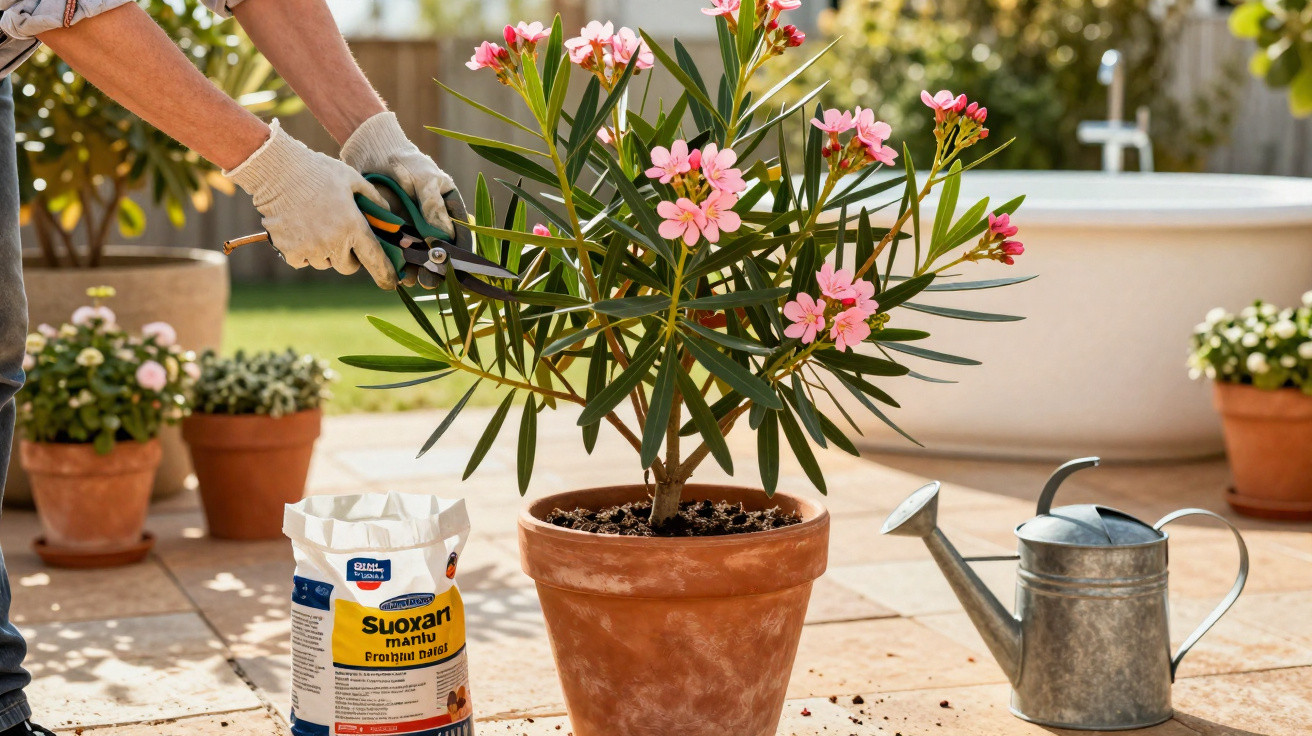
With the right sequence of care, the shrub can regain its strength and flowering potential.
Many amateur gardeners are alarmed when they inspect their oleander in spring: scorched leaves, dried-out branches and a plant that appears only half alive. This Mediterranean long-flowering shrub is particularly vulnerable to frost when grown in containers or in colder areas. The encouraging news is that the shrub is still alive in most cases – it simply needs to be brought out of dormancy methodically.
Check whether the oleander is still alive first
Before moving the plant outdoors or taking off its winter protection, assess its condition. Skipping this stage can mean cutting away too much growth – or wrongly assuming the plant cannot be saved.
Gently scratch the bark with a fingernail or knife. Green, moist tissue underneath shows that the shoot is alive. If the area beneath is entirely brown and dry, that section has died. Repeat this test gradually, working from the tip of each shoot down towards its base.
Pay especially close attention to the lower part of the shrub, where shoots and buds are usually best protected. Small, slightly swollen buds or tiny green specks at the base are clear evidence that the oleander is preparing to grow again.
“Checking precisely which shoots are still green before pruning often saves far more of the plant – and therefore its flowering in the years ahead.”
Bringing oleander gently out of winter quarters
Oleander copes with sun far better than it does with frost. Once several nights have remained above 10°C and no further frost is forecast, it can go outside – though it should not be moved straight into full exposure.
- For the first few days, place it in bright partial shade for only a few hours at a time.
- Gradually extend the amount of time it spends outdoors.
- Move it to its final sunny position only after around a week.
Shrubs planted in the ground should be uncovered with the same care: remove winter protection layer by layer, keep an eye on the forecast and have horticultural fleece ready if late frosts are predicted. During the first few days, weakened leaves should not be exposed to intense direct midday sunshine, as they may suffer sun scorch.
Pruning oleander precisely to encourage new growth
Once the danger of frost has passed, it is time for the most important task: restorative pruning. This determines whether the oleander merely survives or becomes dense and floriferous again in summer.
Start by cutting back all entirely black or straw-brown shoots to the point where the wood looks fresh and green inside again. Depending on the extent of frost damage, the remaining healthy shoots can be shortened by one third to two thirds to encourage the shrub to branch afresh.
Remove without hesitation any shoots that crowd one another, grow inwards or rub together. This allows light to reach the centre of the canopy and gives fresh young shoots room to develop.
“Even severely damaged specimens can be surprising: if cut back drastically to around 40 centimetres above ground level, they often produce vigorous new shoots from the base.”
Repotting, easing the roots and feeding correctly
For container-grown plants, the pot is almost as important as pruning when it comes to a successful restart. If numerous roots can be seen against the pot wall or are already growing through the drainage holes, the plant has outgrown its space.
In that case, move it into a larger container filled with free-draining growing medium. A reliable mixture consists of:
- compost for flowering plants;
- coarse sand or fine grit to improve drainage;
- a portion of well-rotted compost.
Before planting, use clean secateurs to remove any dead, soft or heavily matted root sections. This enables the plant to form healthy new roots again.
Where a container is extremely large and repotting is barely practical, a partial refresh of the growing medium will often be enough: remove the top five centimetres of compost and replace it with fresh, good-quality material.
From March to September, a fertiliser high in potassium supports flower production and stronger shoots. Small, regular applications every one to two weeks, given to slightly moist compost, are ideal. Never apply concentrated fertiliser to bone-dry soil, as this can damage the roots.
Watering correctly: avoiding drought stress and waterlogging
After winter, it is tempting to try to water a weakened oleander back to health. This is precisely what pushes many plants closer to collapse.
For container plants, allow the top layer of compost to dry slightly, then water slowly around the rootball until water drains from the bottom. Empty the saucer afterwards so that the roots are not left standing in water.
In a border, oleander needs roughly two substantial waterings per week in summer: water less often, but thoroughly. Light sandy soil dries out sooner, while clay soil holds moisture for longer, so watering intervals must be adjusted accordingly.
“Well-drained soil, possibly with some mulch around the base, protects the roots equally from rot and sudden dry spells.”
Position, sunshine and common post-winter mistakes
Oleander thrives in warmth and bright conditions. A site with several hours of direct sunshine each day, sheltered from cold winds, produces the most flowers. A south- or south-west-facing wall that stores warmth is particularly suitable.
Many issues after overwintering can be traced back to the same recurring mistakes:
- The container is put outside too early and is caught by a late frost.
- The plant is moved straight from a dark garage into blazing midday sun without an acclimatisation period.
- It is watered constantly “just in case” because of fears that it will dry out.
- Highly concentrated fertiliser is applied to dry compost.
- Saucers or decorative outer pots are left permanently full of water.
Avoiding these pitfalls gives the shrub the chance to change within a few weeks from a sad-looking skeleton into a densely leafed, colourful mass.
How quickly oleander really recovers
Many owners become impatient because little seems to happen immediately after pruning. As a rule, an oleander with reasonable vitality will show fresh growth within three to six weeks. Small leaves first emerge along the cut-back shoots, followed later by new side shoots from the base.
The full display of flowers generally arrives a little later. If the shrub has suffered severely or has been cut back very hard, it may flower less abundantly in the season following a frosty winter. The real reward comes the following summer, when the strongly developed young shoots reach their full potential.
Toxicity, safety and suitable garden companions
As every part of an oleander is poisonous, children and pets should not be able to reach its leaves or fallen plant material. Wear gardening gloves when pruning and wash your hands afterwards. Put prunings in general waste or the organic waste bin, rather than on an open compost heap that animals can access.
In a Mediterranean container display, oleander combines well with lavender, rosemary or sage. These plants all prefer sunshine and a relatively free-draining growing medium. Keeping them together also makes maintenance easier because their water and light needs are similar.
Grouping several containers of warmth-loving plants beside a house wall also creates a small warm refuge. The retained warmth and shelter from wind help oleander recover its form even after a harsh winter – and keep the terrace filled with blooms well into autumn.


Comments
No comments yet. Be the first to comment!
Leave a Comment