
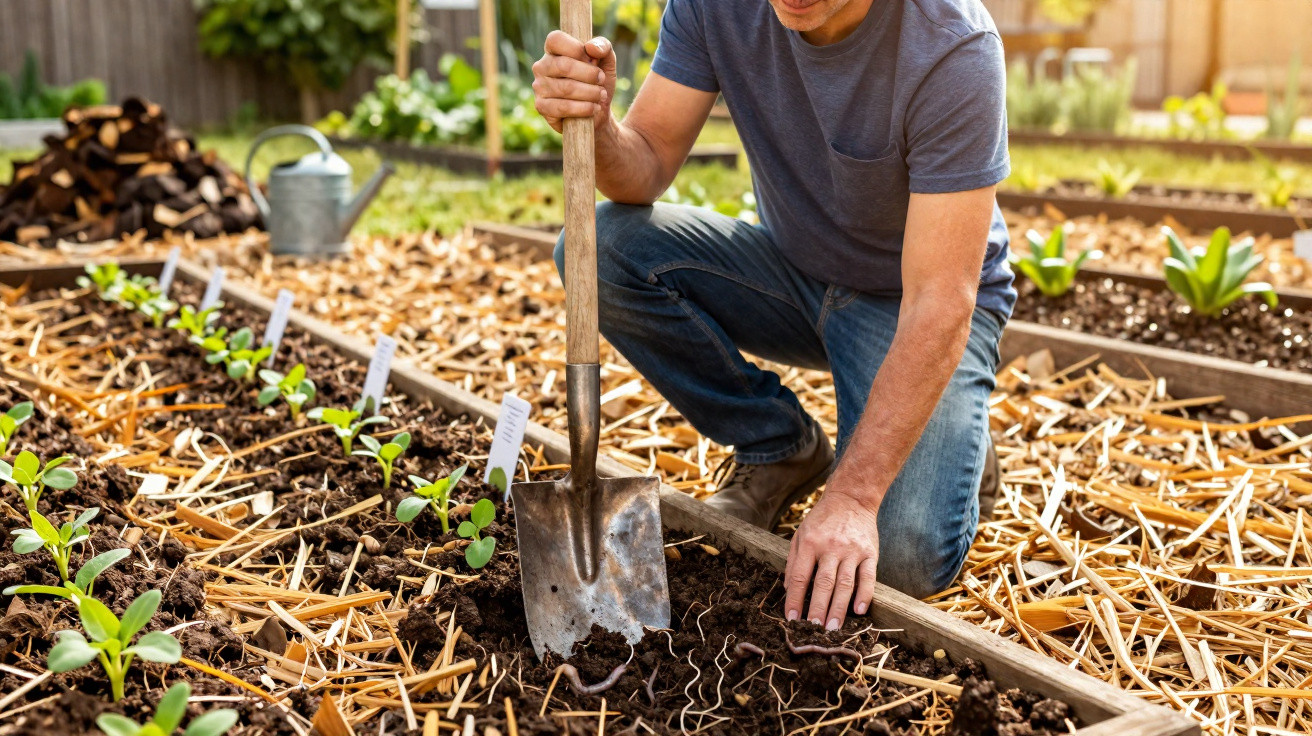
Many amateur gardeners automatically reach for a spade in spring – and end up causing more harm than they would like.
When the first warm days arrive, gardeners are eager to get started: digging over beds, turning the soil and “aerating it properly”. Yet this established spring routine is increasingly being questioned. Soil scientists and experienced vegetable growers show that deep digging can damage the delicate life beneath the ground – precisely when vegetables and herbs need healthy soil most.
Why traditional digging destroys soil life
An invisible drama unfolds below the surface when a spade is used too aggressively. The upper 20 centimetres of soil teem with life: a single gram of healthy soil is estimated to contain between 100 million and one billion bacteria, alongside fungi, nematodes, tiny arthropods and earthworms. Together, they form a closely connected ecosystem.
Every soil layer has its own specialists. Near the top are organisms able to tolerate light, oxygen and fluctuating temperatures. Further down live others that cope with little or no oxygen. Turning the layers over completely with a spade tears these communities apart.
Intensive digging mixes up the soil layers – and kills billions of beneficial micro-organisms within minutes.
Organisms that cannot tolerate oxygen suddenly find themselves on the surface and die. Creatures from the upper layers are pushed downwards, where conditions do not suit them. The result is a virtual clear-out of this microcosm, just before the planting season begins.
There is also a second, frequently overlooked consequence: the soil fungi’s mycelium – fine fungal threads that can be compared with an extended root system – is ripped apart. Many vegetable plants live in close partnership with these fungi. Their fungal networks carry water and nutrients that roots could not reach on their own. If this network is destroyed every spring, plants begin the season in a weakened state.
A different tool is gaining ground
Rather than turning the entire soil over, more and more gardeners are choosing another tool: a digging fork with several curved tines, which loosens the ground without inverting its layers. It is pushed vertically into the soil, then the handle is pulled slightly towards you to lift the earth a little, before working forward step by step.
The benefit is that the soil is aerated, compaction is relieved and its structure remains intact. The layers stay where the organisms living in them can thrive. Micro-organisms, fungal networks and earthworms are disturbed far less.
Easier on the back than a punishing job
This method of soil cultivation is particularly beneficial for older amateur gardeners. Working with leverage puts less strain on the back. Instead of shovelling heavy clods of soil, the tool is tipped using a relatively small movement. This saves effort and considerably reduces the risk of back pain.
- Less lifting, more leverage – better for discs and knees
- Less muscle soreness after long days in the garden
- Longer periods of work without overexertion
Timing is especially important with this technique. Slightly moist soil is ideal. If the ground is bone dry, it becomes as hard as concrete and may even damage the tool. If it is soaking wet and muddy, the structure smears, the soil becomes sticky and it will compact again later.
Mulch instead of bare soil: a quiet change in the vegetable garden
Anyone who stops turning their soil should also avoid leaving it exposed. A layer of organic material on the surface is now considered key to permanently fertile soil. Common materials include straw, shredded autumn leaves, dried-off grass clippings and wood chips.
A permanent layer of mulch imitates a forest floor: never bare, always protected and constantly fed.
This ground cover offers several advantages:
- Less watering: Moisture remains in the soil for longer, reducing water requirements by up to half.
- More stable temperatures: Heat and cold do not penetrate as abruptly, allowing soil organisms to continue working more steadily.
- No hard crust: There is less surface sealing after rain, so water can soak in more effectively.
- Fewer weeds: Many weeds barely germinate beneath a thick mulch layer.
- Continuous feeding: As the material breaks down, it steadily provides food for earthworms and micro-organisms.
Mulched beds are especially useful for anyone who no longer wants to spend hours weeding. With less watering, fewer weeds and less heavy work, the vegetable garden becomes much easier to maintain.
How soil life helps plants grow strong
Soil biology has made enormous progress over recent decades. In the past, plants were thought simply to “drink” dissolved nutrient salts. Today, it is understood that complex exchanges take place in the soil between roots, bacteria and fungi.
Certain bacterial species capture gaseous nitrogen from the air and convert it into forms available to plants. Other microbes release phosphorus from minerals. The mycorrhizal fungi already mentioned multiply the area from which roots can take up nutrients. Earthworms pull organic material into deeper layers and produce crumbly castings that act like a high-quality natural fertiliser.
The less this cycle is disrupted, the more reliably it functions. Vegetables develop stronger roots, grow more evenly and suffer less from drought stress. Many gardeners also report fewer fungal diseases and pests when soil has been treated gently over a number of years.
Practical steps away from the annual spade ritual
No one needs to transform their garden completely overnight. A gradual change is sensible. One possible spring approach is:
- Rather than digging, loosen the soil with a multi-tined digging fork.
- Spread a layer of mature compost around five centimetres deep across the surface.
- Plant or sow only where necessary, then mulch the remaining areas generously.
Anyone starting with heavily compacted soil or dense clay may sometimes need one deeper intervention to break up waterlogging and hard layers. The important thing is not to repeat this intervention every year, but to switch to gentler methods afterwards. With each year of organic additions, the crumb structure improves and the soil becomes looser, more stable underfoot and more fertile at the same time.
Examples of well-planned combinations
Many gardeners achieve good results with a combination of targeted loosening, compost and mulch:
- In early spring, loosen the ground only; do not turn it.
- Apply mature compost and work it in lightly, or simply leave it on the surface.
- Use grass clippings spread between rows as mulch once they have dried off.
- In autumn, add coarse materials such as leaves and wood chips to protect the soil and its living organisms through winter.
Common mistakes and overlooked risks
Those moving away from traditional digging can easily fall into a few traps. A common mistake is placing mulch on soil that is still cold and wet. The ground then dries poorly and stays damp, which attracts slugs and restricts root growth. It is better to wait until the soil has warmed slightly and can be walked on without leaving deep footprints.
A second issue is applying fresh grass clippings directly in thick layers, as they can rot and smell unpleasant. The solution is to let them dry first, apply them more thinly or mix them with straw and leaves. This creates a loose, airy covering.
It is also worth considering the seasons when dealing with heavy soils. Walking over wet clay with tools compresses its structure. It is better to work when the soil is “crumbly”: it should feel slightly moist but no longer stick to shoes or tools.
Why changing approach pays off in the long term
Moving away from annual digging saves not only time but also your back. Over time, yields become more dependable because the soil functions like a living sponge: it stores water, nutrients and air more effectively, then supplies them to plants as needed. Such soils cope far more calmly with heavy rainfall and dry spells.
For many gardeners, the hardest part of this change is adjusting their mindset. The image of a “properly dug-over bed” is deeply ingrained. Those open to another perspective eventually see beauty in loosely mulched surfaces, little piles of earthworm castings and beds that are never entirely bare throughout winter. In the end, that often produces the strongest tomatoes, the crispest lettuces and the least work.
Comments
No comments yet. Be the first to comment!
Leave a Comment