
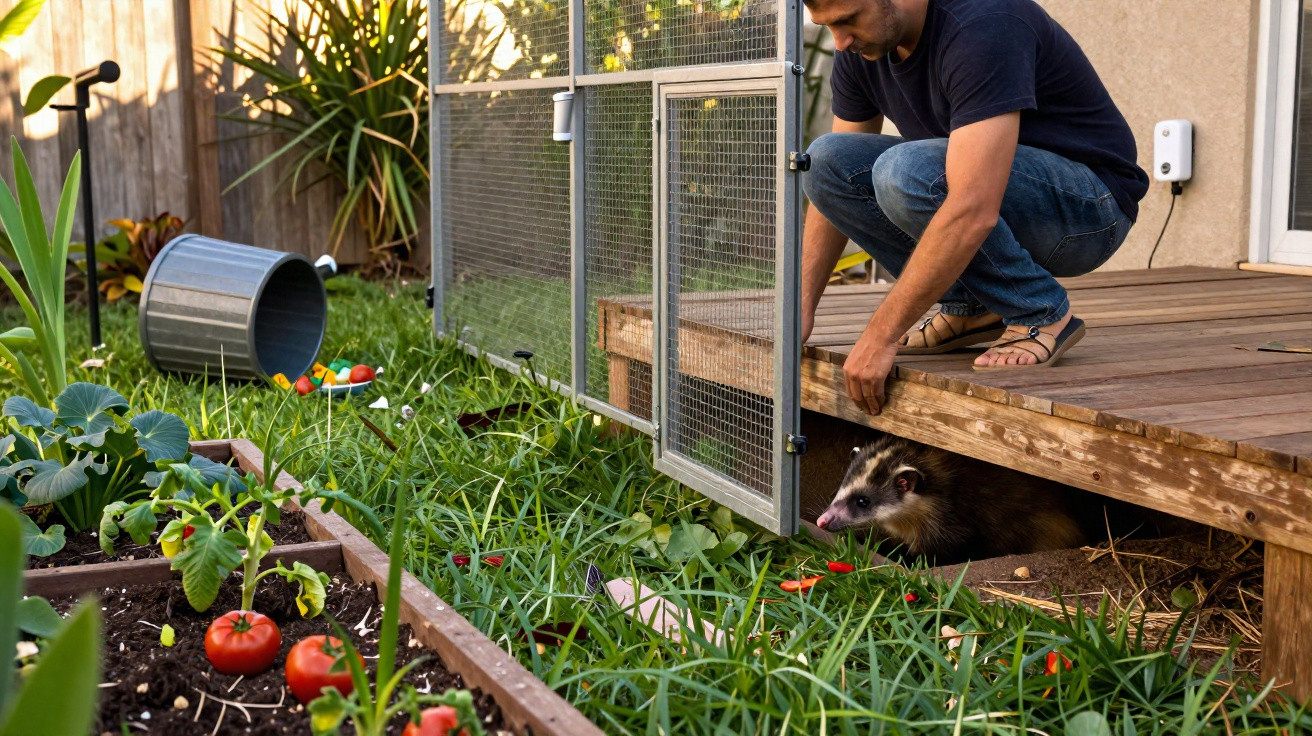
Many homeowners do not realise until rather late that a skunk has settled on their property. By then, the smell is strong, the lawn is dotted with small holes and it may appear to be living beneath the veranda. Reacting rashly at this point can cause even more damage – and earn you a direct hit from the skunk’s “perfume cannon”.
Why skunks choose your garden
Skunks are not random intruders. They follow a fairly simple formula: food plus shelter equals an ideal home. A typical garden often provides precisely that, without the owner even noticing.
Food sources that strongly attract skunks
Skunks are omnivores. In residential areas, they mainly feed on the following:
- Grubs, larvae and other insects in the lawn
- Small mice and other rodents
- Fallen fruit and berries
- Open wheelie bins or poorly sealed rubbish bags
- Compost heaps containing food waste
If the lawn is covered with small, cone-shaped holes in the morning, a skunk was probably digging for grubs overnight. An insect infestation in the soil is like an all-you-can-eat buffet to the animal.
Shelter beneath decking, sheds and wood piles
The other crucial factor is a secure den. Common hiding places include:
- Voids beneath timber decks and patios
- Gaps underneath garden buildings and sheds
- Unsecured crawl spaces
- Dense shrubs and stacks of wood
Female skunks particularly seek suitable places to rear their young in late winter and spring, when the breeding season begins. Anyone offering perfect cover during this period can soon find an entire skunk family on the property.
“Anyone who understands why skunks find a property attractive has already taken the most important step towards driving them away.”
Safely driving skunks away: exclude rather than trap
The most effective approach to skunks is not trapping, but consistent exclusion. The aim is to make your property unappealing enough that the animal leaves of its own accord.
Seal vulnerable entry points thoroughly
Begin with a detailed inspection around the house. Look for every opening through which a skunk could crawl; a gap of only 4 cm high can sometimes be enough.
A protective barrier around the house and at-risk structures has proved effective:
- Bury wire mesh, such as aviary mesh or anti-marten fencing, at least 30–40 cm into the ground
- Bend the base of the mesh outwards to form an L shape, preventing skunks from digging straight down at the edge
- Extend the mesh roughly 20–30 cm above ground level and secure it firmly
- Close gaps around foundations, pipe penetrations and ventilation openings
Important: before permanently sealing an opening, make absolutely sure that no animals remain inside the shelter. If young are trapped, they will die – and the resulting smell can be unimaginable.
One-way doors: a humane option without direct contact
Professionals use so-called one-way doors to ensure every skunk has left its den. Fitted over the entrance, these devices allow the animal to exit but prevent it from returning.
This is the approach many people take:
- Identify entrance holes and dust them with flour to reveal fresh tracks
- Fit a one-way door over the main opening and temporarily seal secondary entrances
- Check for signs of activity over several nights
- Permanently close every opening only once no further tracks are visible
Extra care is needed between May and August, as young animals are usually in the den at this time. If you are uncertain, leave the job to a specialist company.
Natural deterrents that keep skunks away
Those who do not want to call in pest control immediately can use deterrents instead. The objective is to make the surroundings unpleasant without using poison or traps.
Light, water and noise: technology for nocturnal visitors
Skunks are active at dusk and overnight, and they dislike surprises. Useful devices include:
- Motion-activated bright lights
- Motion-controlled sprinklers that deliver a brief spray of water
- Ultrasonic devices, although their effectiveness varies by animal and site
These devices work best along regular travel routes and near suspected shelters. Motion-activated sprinklers in particular often prove useful in everyday garden settings: they startle the animal without harming it.
Smells that skunks avoid
The notorious skunk smell has a reason behind it: these animals depend heavily on their sense of smell. This can be used against them. Methods used in North America can generally be applied here as well, provided they are lawful and humane.
| Deterrent | Application | Duration of effect | Typical location |
|---|---|---|---|
| Predator urine (ready-made product) | Apply as a spray or granules | 2–4 weeks | Property boundary, garden edges |
| Capsaicin spray (hot chilli) | Spray directly onto surfaces and access points | 1–2 weeks | Beds, potential entrances |
| Ammonia cloths | Place soaked cloths in containers | 3–7 days | Beneath patios, in voids |
| Motion-activated sprinklers | Install in the garden | Whole season | Lawn, vegetable beds |
Scents need reapplying regularly, especially after rain. Households with pets or children should choose gentler options and use irritants carefully.
Plants that are less appealing to skunks
Strongly scented herbs can provide additional support in beds and along borders. Frequently used options include:
- Oregano
- Thyme
- Sage
- Lavender
These plants will not deter skunks as effectively as a fence, but they create an overall scent that is less inviting to them. At the same time, certain flowering plants attract beneficial insects that help keep the garden ecosystem stable. A healthy garden is less likely to become a pest haven that draws in skunks.
When to call a professional
Some circumstances are simply risky without specialist knowledge, for example when:
- Skunks are immediately beside the house or close to an entrance
- You are repeatedly sprayed or feel threatened
- An entire family with young is living in the foundations
- Local wildlife rules are strict
Professional pest-control or wildlife companies understand trapping, protective equipment and the legal position. They inspect the entire property, catch animals using live traps, relocate them where permitted or act in accordance with the authorities’ requirements. They also often install permanent exclusion measures at the same time.
“Calling an expert early often saves money – because consequential damage to the house, pipes and garden is avoided.”
Long-term prevention: garden maintenance as skunk protection
In the long run, the best strategy is to make the property a poor place for skunks to live. This does not mean creating a concrete wasteland; it means maintaining the garden with purpose.
Avoid common attractions
- Harvest fruit trees regularly and do not leave windfalls on the ground
- Keep wheelie bins tightly closed and clean the food-waste bin
- Keep compost free of meat and strongly smelling food scraps
- Maintain a healthy lawn and keep grubs and pests under control
- Do not store wood piles or dense scrub directly beside the house
Anyone who already maintains their garden seasonally – by pruning shrubs, changing beds and caring for early-flowering plants, for instance – can easily incorporate skunk prevention. Whenever you make a major change, ask yourself: am I unintentionally creating a new hiding place here?
Use ecological balance
Skunks do eat pests, but near homes they cause more harm than benefit. A balanced garden with plants flowering at different times, shelter for beneficial wildlife and no excessive grub population naturally reduces the risk of major skunk visits.
For example, flowering plants that offer nectar early in the year keep pollinators active in the garden. These features support a stable mix of birds, insects and small animals, which keeps pests in check – and reduces the skunks’ large buffet.
Risks many people underestimate
One final point is often overlooked: skunks can transmit diseases, including rabies in some regions. Even where that risk is lower, direct contact remains problematic. Sprayed secretion severely irritates the eyes and airways, and the odour is extremely difficult to remove from pets.
If you spot a nocturnal visitor in your own garden, do not play the hero. Keep your distance, remain calm and proceed methodically: observe travel routes, locate shelters, block access, remove food sources and call professionals in persistent cases. This turns skunk drama into a manageable task rather than a lasting odour problem.


Comments
No comments yet. Be the first to comment!
Leave a Comment