
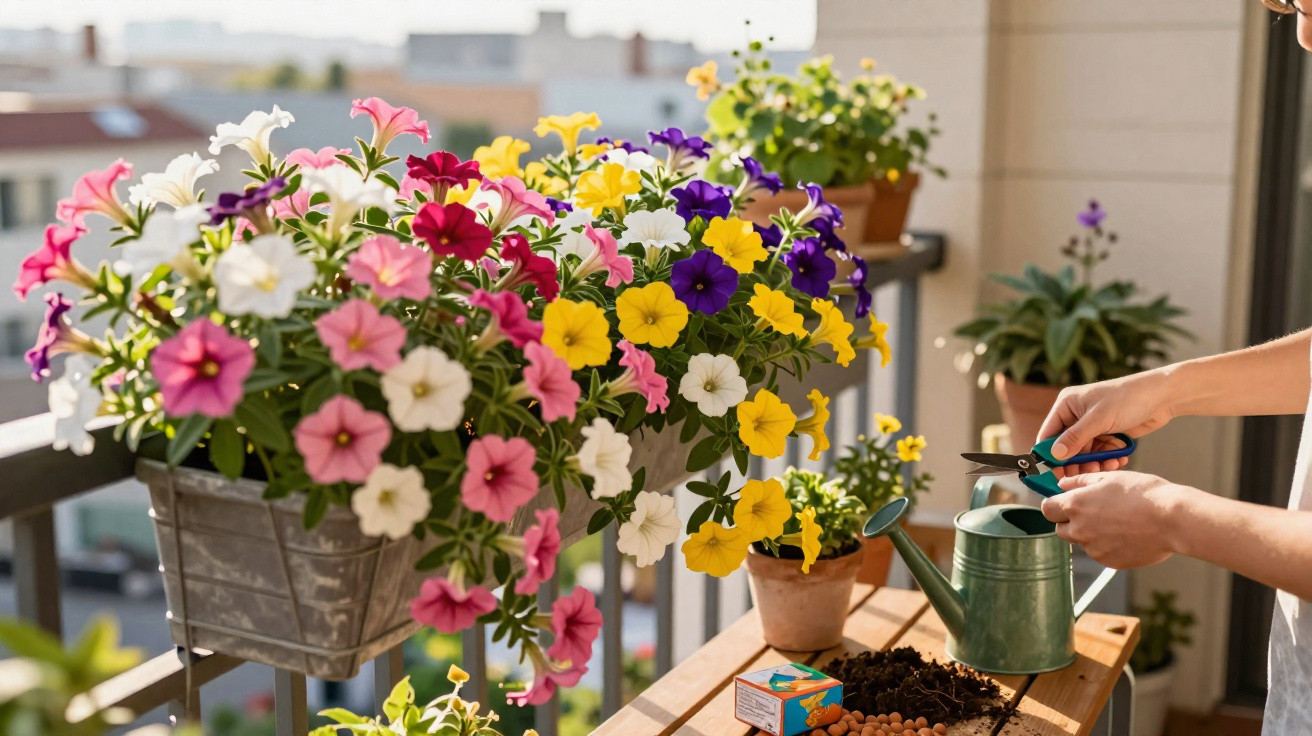
If you want a dense cascade of colourful flowers spilling over your balcony in July and August, now is the time to act. One trailing plant that is still often overlooked in garden centres can turn ordinary planters into true fountains of bloom – provided it is planted at the right time and cared for consistently.
The unassuming star plant: what creates the waterfall of flowers
Many of those lavishly overflowing balcony planters owe their appearance to a plant with a slightly cumbersome name: Calibrachoa. In garden centres, it is often sold under names such as “Million Bells” or “mini petunia”. It resembles a petunia, but its flowers are smaller, more numerous and packed more closely along the stems.
Calibrachoa develops into a compact, semi-spherical mound. It usually grows to around 15 to 30 centimetres tall while spreading freely to 30 to 60 centimetres wide. In balcony planters and hanging baskets, this means the shoots initially grow outwards before becoming long enough to tumble over the edge, creating the characteristic curtain of flowers.
“From spring until the first frosts, Calibrachoa can produce hundreds of tiny bells – without demanding excessive care.”
There is an especially useful benefit for anyone who prefers low-maintenance planting: the plant cleans itself. Spent flowers dry out and drop off naturally, so there is no need to spend days picking off old blooms just to keep the display looking tidy.
Breeders introduce new varieties every year. So-called “chameleon varieties”, whose flowers change colour throughout the season, are particularly popular. One example is Superbells Magic Double Grapefruit: its double flowers shift between yellow, apricot and pink, making it appear as though several different plants are flowering in one pot.
The right time to plant in spring
Perhaps the most important consideration comes before any compost goes into the planter: timing. Calibrachoa is sensitive to cold and originates from warmer regions, so in central Europe it is generally grown as an annual seasonal plant.
As a general rule:
- Plant only when frost is no longer forecast
- Night-time temperatures should remain consistently above 8 to 10°C
- Depending on the region: usually from mid-April to late May
Planting too early can cause growth to stall. Young roots suffer in low temperatures, the plants become established only reluctantly and may fail to gain momentum for weeks. By contrast, filling the planter shortly after the last frosts allows the plants to use the whole spring to grow through.
During this stage, they form a strong root system and their stems lengthen day by day. By July, they will be hanging clearly over the edge, producing the distinctive “ball with a veil” effect that is so striking in balcony photographs.
Trial planting recommendations for a standard-width planter or medium-sized hanging basket are:
- 3 to 4 young plants per container for a dense, continuous display
- Space the plants slightly apart so they can branch out sideways
Preparing the planter: drainage instead of waterlogging
Calibrachoa enjoys water but hates having wet feet. Waterlogging quickly leads to root rot; stems then collapse and the formerly luxuriant planter loses its shape.
The container should have the following:
- Large drainage holes in the base – drill extra holes if necessary
- A drainage layer of expanded clay, gravel or coarse grit at the bottom of the pot
- A loose, airy growing medium above it, ideally compost specially formulated for balcony planters or hanging baskets
A conventional bag of overly dense multipurpose compost from a discount shop often causes problems. A better choice is a mix that allows water to drain down quickly while still leaving sufficient air around the roots.
| Aspect | What Calibrachoa likes | What Calibrachoa tolerates poorly |
|---|---|---|
| Water | An evenly moist root ball | Constant waterlogging in the saucer |
| Growing medium | Light, free-draining, nutrient-rich | Heavy garden soil, pure compost |
| Position | Sun to bright partial shade | Permanent shade or wind tunnels |
Summer care: keeping the carpet of flowers full
To stop the planter from “falling apart” after only a few weeks, Calibrachoa needs two things: enough nutrients and reliable, but not excessive, watering.
Watering correctly – more often, but in moderation
Hanging baskets dry out extremely quickly at the height of summer. Watering once a day is often insufficient on hot days, yet the planter must not be left standing in water. A few simple rules are helpful:
- Two-finger test: feel the top two centimetres of compost and water only once they are dry.
- Water in the morning, then water again in the evening if needed on very hot days.
- Empty saucers after 20 minutes so that no standing water remains.
Automatic watering systems or self-watering planters can make day-to-day care much easier if you are away frequently. Anyone who travels often should opt for larger containers, as they hold more water.
Feeding: fuel for continuous flowering
Calibrachoa is among the plants known as heavy feeders. It produces flowers for months, requiring a continual supply of nutrients to do so.
A proven approach is:
- Work a slow-release fertiliser or organic base fertiliser into the compost when planting.
- From the third or fourth week after planting, add liquid fertiliser every two weeks for flowering plants to the watering water.
- Increase the fertiliser application slightly if flowering visibly becomes less abundant or the leaves turn pale.
“Those who fertilise consistently will be rewarded with an almost unbroken cover of flowers until the first frosts.”
A light trim for a second flush of flowers
By high summer, often around mid-July, some plants begin to look slightly tired. Their shoots become very long, gaps appear in the centre and the number of flowers declines. This is when a brief, targeted intervention can help.
Shorten several stems by around one centimetre. This is not a drastic cut, but more of a light tidy-up. The plant responds by branching again and producing fresh flower buds. Within a few weeks, the planter will once more look dense and colourful.
Which Calibrachoa varieties suit each balcony
A broad range of colours is available in shops, from pure white through yellow, orange and red to purple and almost black. Some varieties have a light eye in the centre of the flower, while others look as though they have been painted with stripes.
Different types are better suited to different positions:
- Full sun: Strongly coloured, heat-tolerant varieties that do not immediately wilt in the midday sun.
- Bright partial shade: Pastel and bicolour varieties, where their delicate markings are shown to better effect.
- Windy locations: More compact-growing Calibrachoa, so the stems do not continually snap.
Mixed planting can be particularly effective, for example by combining a chameleon variety with a single-coloured companion plant. This creates a lively, contemporary look that does not resemble a standard DIY-shop window box.
Tips for beginners and common mistakes
People growing Calibrachoa for the first time often encounter the same pitfalls. It is worth checking the usual mistakes:
- Containers that are too small: The root ball can dry out within hours, leaving the plant under continual stress.
- Planting too densely: More than four plants in a standard planter compete with one another for light and air.
- No fertiliser: Everything flowers at first, but after six weeks the plant has run out of energy – without extra nutrients, there will be no continuous flowering.
- Constantly wet compost: With over-cautious watering, the planter quickly deteriorates; roots rot and the stems become glassy.
Anyone who keeps these points in mind and chooses the spring planting date carefully has a good chance of growing a trailing plant that visually outshines many geraniums. Calibrachoa remains frost-sensitive and will not survive winter outdoors, but in a single season it provides a floral display that can completely transform balconies and terraces from May into autumn.


Comments
No comments yet. Be the first to comment!
Leave a Comment