
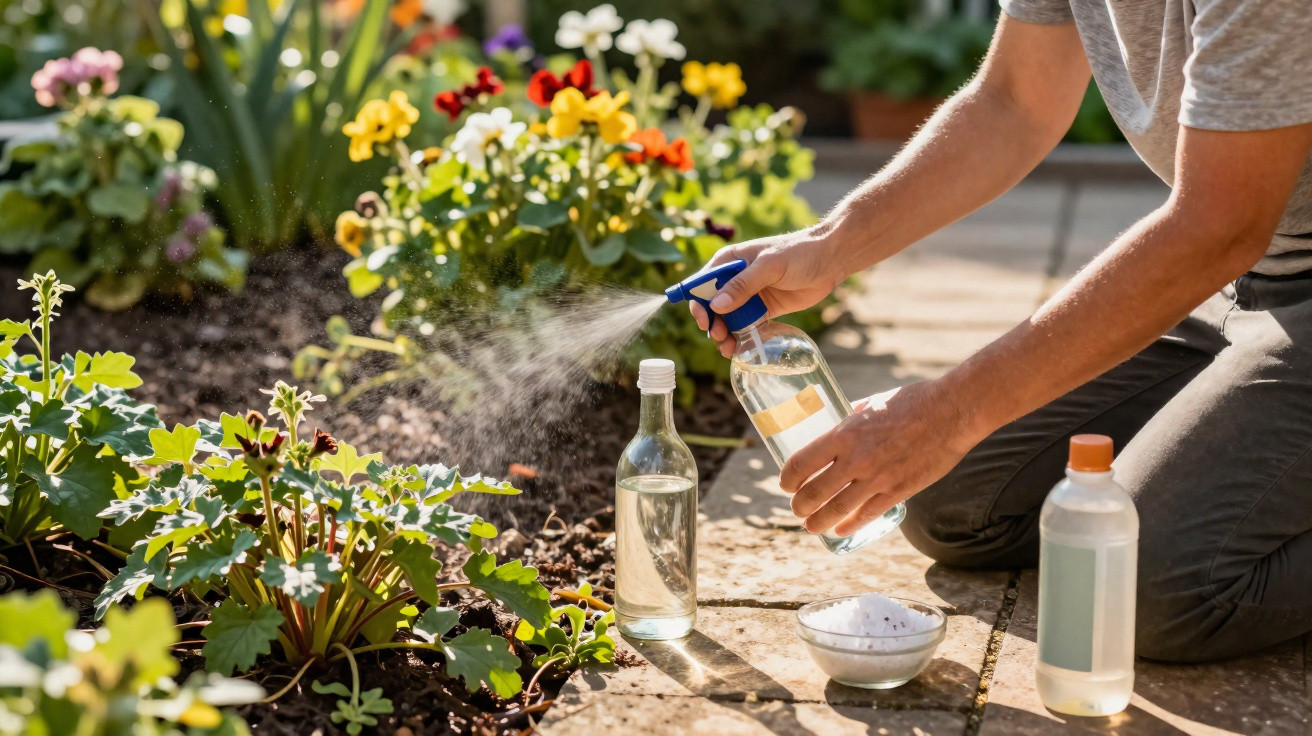
Weed control in patios and paved areas is often an ongoing challenge for people who look after gardens. These unwanted plants readily establish themselves in gaps between paving slabs and concrete blocks, returning even after regular hand weeding. This makes manual work tiring and raises questions about using chemical products and their effects on health, ornamental plants, pets and insects moving around the garden.
What is a natural herbicide and why is it used in the garden?
A natural herbicide is any household-based or minimally processed mixture or product used to control or kill weeds, without the same synthetic composition as many agricultural pesticides. In domestic settings, it is mainly used on patios, driveways and outdoor paving, where invasive plants emerge through joints and cracks.
Its purpose is to reduce the use of long-lasting compounds and limit exposure for pets, children and beneficial insects. In these solutions, ingredients such as white vinegar, table salt and mild washing-up liquid act on contact, dehydrating the visible part of the weed. This makes them better suited to hard surfaces and less appropriate for direct use in productive beds.
Watch a video on the Horta do Ditinho YouTube channel explaining how to make a powerful homemade natural herbicide to remove weeds without using poison:
https://www.youtube.com/watch?v=rX_jY8dK2aM
How does the vinegar, salt and washing-up liquid mixture work as a natural herbicide?
A widely used combination contains white vinegar, table salt and washing-up liquid in a spray bottle, creating a fast-acting treatment for young leaves and tender shoots. The vinegar provides acidity, salt helps dehydrate plant tissue, and the washing-up liquid breaks down the waxy leaf coating, allowing the solution to penetrate more easily.
In general, the mixture uses a simple proportion that can be easily prepared at home:
- 500 ml of white vinegar intended for culinary use;
- 2 tablespoons of salt of ordinary table salt;
- 2 teaspoons of mild washing-up liquid;
- 1 clean spray bottle for application.
Mix the vinegar and salt until the salt has fully dissolved, then add the washing-up liquid. Spray the solution directly onto the leaves on a dry, sunny day, avoiding rain dilution and encouraging rapid drying. This makes later manual removal considerably less laborious.
How can natural herbicide be applied safely and effectively?
Although it is made from household items, this type of mixture still requires care. Salt can build up in soil, while vinegar may raise local acidity and affect nearby roots. For this reason, it is best used on paving slabs, stones, block paving and concrete cracks, where little exposed soil is present.
It is advisable to test it on a small area first, especially on pale or delicate paving, to check for staining or residue. Pets should also be kept away while the product is being sprayed and until the surfaces are completely dry, reducing the chance of accidental contact with the wet mixture.
Does natural herbicide completely replace chemical products?
In many gardens, the vinegar, salt and washing-up liquid mixture works well on surface weeds, but it cannot by itself deal with very deep roots or compacted ground, both of which can encourage regrowth. In these circumstances, it is best to combine targeted use of the solution with hand weeding and improvements to the jointing material, creating ongoing management of the gaps.
Some gardeners report good results from combining frequent sweeping, replacing sand between blocks and using the natural herbicide sparingly only during periods of heavier infestation. With this approach, patios and paths are likely to stay cleaner throughout the year, reducing the need for harsh products while retaining practical weed control.

Comments
No comments yet. Be the first to comment!
Leave a Comment