
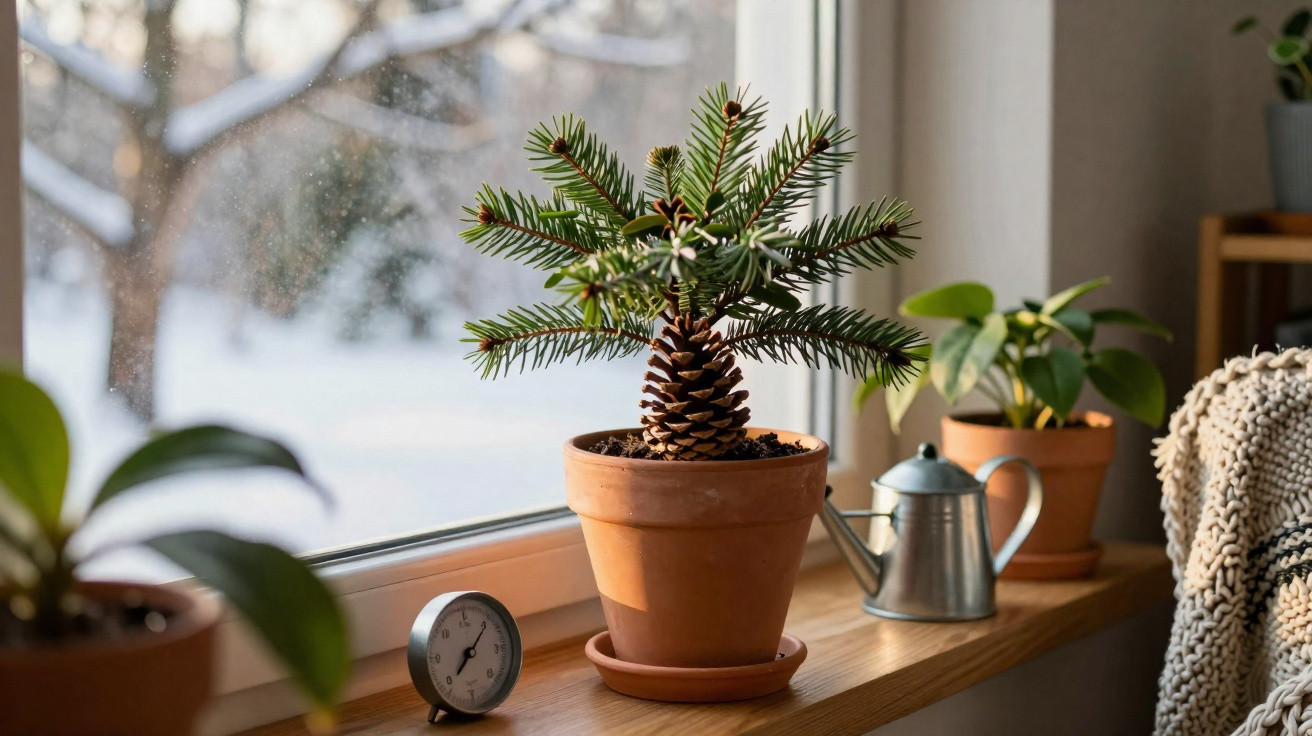
Many hobby gardeners assume in January that their plants are suffering from a lack of light or water. Yet the real issue is often entirely different: the roots are quietly suffocating in waterlogged compost. An old gardening rule therefore suggests placing a simple pine cone on the soil. It may sound decorative, but it has a surprisingly practical purpose.
Why houseplants so often struggle in winter
During winter, the conditions in a living room are far from “natural”. The heating is on, the air becomes dry, and rooms are often aired only rarely. For plants, this combination can be deceptive.
- Heated air dries the surface of the compost very quickly.
- Gardeners conclude that the plant needs watering.
- However, the compost in the centre of the pot remains damp or even wet.
- Roots receive too little oxygen and begin to rot.
The result is yellowing leaves that droop and look “limp”. Many people instinctively respond by adding more water, making the problem worse. Waterlogging inside the pot increases further, while the surface dries out again rapidly and creates the impression that the plant is thirsty.
At the same time, windows tend to remain closed in winter. Air sits still above the compost. Where there is no air movement, moisture stays on the substrate for longer, creating ideal conditions for mould fungi. At first, there may be barely any visible signs, but root rot may already be starting around the roots.
The real winter problem for houseplants is often not too little water, but permanently excessive moisture around the roots.
The surprising role of a pine cone in a flowerpot
This is where the pine cone trick comes in, a method that many older gardeners once used as a matter of course. A dry pine cone is made from hard, porous wood. This material can absorb moisture from its surroundings – a property known as hygroscopic action.
When the cone is placed directly on the compost, two things happen at once:
- It absorbs surplus moisture from the upper layer of compost.
- It forms a kind of “protective cap”, structuring the surface and slowing down direct overwatering in that area.
It therefore acts like a small, natural drainage layer on the surface. Mould finds it harder to spread across the compost. The white, fluffy coating that many people notice on pots in winter occurs far less often. Chemical fungicides are no longer needed.
A dry pine cone placed on the compost works like a free miniature moisture regulator – entirely without chemicals.
The pine cone as a living moisture gauge
Another characteristic is even more interesting: the cone’s scales visibly respond to humidity. The pine cone “works” according to the level of moisture.
Open scales: a sign of dry, well-aerated compost
If the scales are spread widely apart and look loose, this is a positive sign. The air above the substrate is relatively dry, as is the compost surface. The plant can breathe and the risk of mould is low. In this state, the cone is effectively saying: “Everything is fine here, there is no rush to water.”
Gardeners can take an open cone as a green light – though not as a signal to water immediately, but as an indication that there is currently no moisture problem.
Closed scales: a warning of excess moisture
If the pine cone closes almost completely and appears compact and smooth, the humidity immediately above the compost is high. This indicates a very wet substrate.
A closed pine cone in the pot means: put the watering can aside and do not use it again until the cone opens.
This makes the cone more useful than any “finger in the soil” test. Instead of watering blindly by instinct, it provides a clear signal that is visible at all times.
How to choose and position the right pine cone
Suitable pine cones can be found in parks, woods or your own garden. There are a few points to bear in mind:
- Pick up only dry, open cones.
- Avoid specimens with resin residue or visible insect damage.
- Briefly brush them clean at home, then allow them to dry further somewhere warm for a few days.
Once the cone is ready, place it on the compost – ideally close to the plant stem, but without touching or pressing against the plant. This lets it measure moisture at the crucial point: the transition between the stem and the root area.
For large containers or long balcony planters, a small “cone battery” is useful:
- 1 cone for small pots up to around 15 centimetres in diameter
- 2–3 cones for medium-sized containers
- 4 or more cones for long planter boxes
This makes it easier to identify different moisture zones, for example when one side is closer to a radiator than the other.
Which plants benefit particularly from pine cones
Species that are particularly sensitive to waterlogging gain noticeably more stability from using pine cones. These include, for example:
- Rubber plants and Ficus species
- Succulents and cacti
- Monstera and other fashionable plants with large leaves
- Mediterranean container plants in their winter quarters
Succulents in particular can look dry at the surface while their roots are still standing in wet compost. In this case, a closed cone prevents you from reaching for the watering can too soon.
Common winter watering mistakes and how the pine cone prevents them
Gardeners make three mistakes especially often in winter:
| Mistake | Consequence | How the pine cone helps |
|---|---|---|
| Watering to a schedule | Too much water on dull, cool days | A closed cone signals: take a break |
| Looking only at the dry surface | Root rot despite apparently dry compost | The cone responds to overall moisture, not just the top layer |
| No checks after watering | Moisture builds up over several days | Changes in the cone make the development visible |
Anyone who keeps an eye on the cone will gradually adopt a more attentive watering routine. Rather than watering “once a week because that is what you do”, the actual condition of the substrate becomes the focus.
Sustainable plant protection without chemicals
This method is ideally suited to an environmentally conscious approach to houseplant care. Rather than using sprays against fungal growth, it reduces the trigger: overly damp compost at the surface. Fungi that live on permanently wet substrate lose the conditions they need.
Plants also get through winter with less stress. Protecting roots from constant moisture encourages stronger new growth in spring. The plant does not then need to use energy to regenerate damaged roots, but can grow and form buds straight away.
Further useful tips for healthy houseplants in winter
A pine cone is not a replacement for basic care; it complements it. A few additional measures greatly increase the effect:
- Fertilise far less often in winter, or stop altogether.
- Do not position plants directly above radiators.
- Air rooms regularly and briefly to remove still, humid air.
- Empty saucers after watering so that waterlogging cannot develop.
If you are unsure, you can also use a simple wooden stick: push it deep into the compost, then pull it out again after a few minutes. If soil clings to it, the pot is still damp inside. At the same time, the cone indicates the conditions at the surface – together, the two methods give a very clear picture.
This “natural technique” can also be used elsewhere. Pine cones have long served as a kind of sensor in cellars or larders: when they become damp and close, humidity is rising. Around plants, the same principle works on a smaller scale, directly in the pot.
Ultimately, a simple walk in the park can bring a surprisingly useful reward: a free, sustainable tool that protects roots from drowning, limits mould and, as an added benefit, helps your own indoor jungle cope much better with the grey winter.
Comments
No comments yet. Be the first to comment!
Leave a Comment