
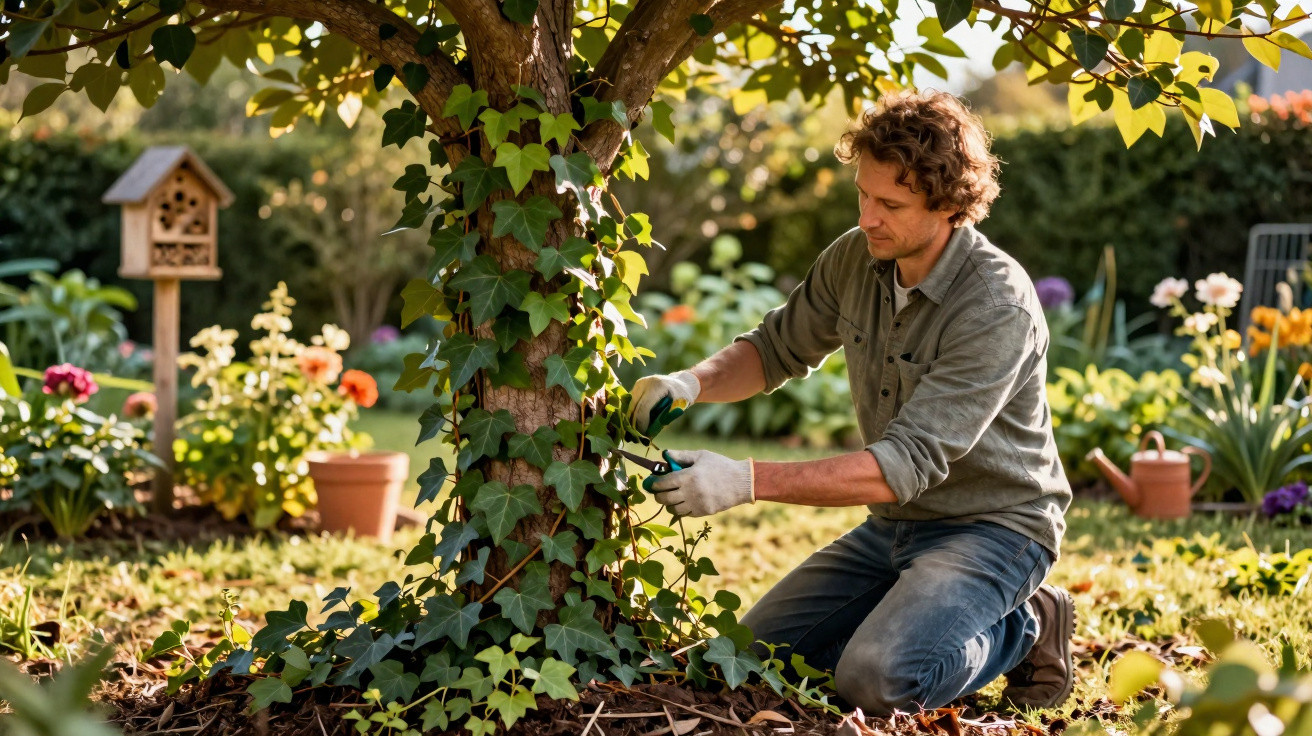
Experts warn that what appears to be good maintenance is often a serious misconception.
As soon as ivy starts climbing a tree trunk or a façade, many people immediately reach for the hedge trimmer. This climbing plant is widely seen as dangerous: a quiet destroyer of walls and mature trees. Specialists take a far more nuanced view, explaining why forceful removal can cause greater damage than the ivy itself.
Ivy is not a vampire: how the plant actually grows
At first glance, ivy can look like a parasite draining strength from its host. That is not the case. It draws its water and nutrients from the soil. The clinging roots that attach to a trunk or wall serve primarily as anchors.
“Ivy does not tap into a tree – it clings to it rather than living off it.”
This makes ivy fundamentally different from true parasites such as mistletoe. Provided a tree is healthy, structurally sound and receives sufficient light, ivy has little effect on its vitality. Tearing it off aggressively in this situation often damages the bark, creating entry points for fungi, rot and pests.
A protective coat rather than an enemy: how ivy supports trees
On a sturdy trunk, ivy acts like a green coat. Its dense layer of foliage performs several functions:
- It cushions intense sunlight and helps prevent cracks forming in the bark.
- It reduces the impact of cold, hail and pronounced temperature changes.
- It retains some moisture near the bark without drowning the tree.
- It provides shelter for birds, small mammals and countless insect species.
Ecologists stress that ivy is among the most important features for biodiversity in many gardens. It flowers very late in the year, providing nectar when other food sources have long since disappeared. Its berries also provide winter food for many bird species.
When ivy can genuinely cause problems for trees
Ivy becomes a risk chiefly when a tree is already weakened. Typical higher-risk cases include:
- very old trees with decayed branches
- young trees and fruit trees with still-thin canopies
- trees that are leaning or already show substantial damage
In these circumstances, ivy can create an additional burden. Its shoots compete for light in the canopy, conceal diseased areas and form an extra sail surface in the wind. During a storm, this increases the likelihood of branches breaking or the entire tree toppling over.
“The issue is usually not ivy alone, but the combination of a weakened tree and additional weight.”
However, indiscriminately cutting everything away also deprives the tree of its leafy protective cover. A more sensible approach is to limit the growth selectively, for example by thinning only the upper sections while allowing the lower trunk to remain covered.
The crumbling façade myth: what ivy really does to a house wall
Ivy also prompts heated debate on house walls. The idea that masonry crumbles beneath its clinging roots remains persistent. Experts make clear that damage is generally unlikely on an intact façade.
A solid wall without cracks, with high-quality render or well-pointed brickwork, tolerates ivy surprisingly well. The clinging roots do not penetrate deeply in these conditions; they remain on the surface. The plant forms a second skin over the wall and can offer real benefits:
- protection from driving rain
- less heat build-up in summer
- slightly improved thermal insulation in winter
- a filtering effect for dust and fine particulate matter in the air
The situation differs where masonry has already been damaged. Ivy finds ideal points of entry in crumbling mortar joints, flaking render and existing hairline cracks. Its clinging roots can then enter small gaps and gradually enlarge them through wind pressure and moisture.
When ivy on a façade becomes a genuine hazard
Older homes that have never been renovated deserve particularly close inspection. Common warning signs include:
- open or crumbling joints in brick masonry
- cracks in the render, including fine hairline cracks
- moisture damage already visible indoors
- blocked gutters caused by ivy shoots and leaves
In such cases, the growth can genuinely increase renovation costs. Rainwater enters through weakened areas, bricks become loose and minor defects can expand substantially over the years.
“Before blaming ivy, the condition of the façade should be checked – the real problem is often old masonry.”
Experts recommend assessing the building’s condition first, repairing damaged areas and then deciding where ivy is acceptable and where it is not.
How to manage ivy selectively instead of removing it radically
Anyone who wants neither uncontrolled ivy growth nor to eradicate it entirely needs a clear strategy. This can broadly be divided into two stages: assess the condition, then determine the appropriate level of growth.
Managing ivy correctly on trees
Proceed as follows:
- Assess the tree’s stability: is it upright, does the canopy appear vigorous, and are there no major areas of decay visible?
- For a vigorous, healthy tree: leave the ivy in place and prune it every two to three years so that it does not reach the outer canopy.
- For a weak, leaning or severely damaged tree: thin the ivy substantially, cut back shoots in the upper canopy and reduce the weight.
- For very young trees, especially fruit trees: avoid growth around the trunk where possible so that the canopy can develop without restriction.
When removing it, never pull large sections away from the bark. Instead, cut the stems close to the trunk and allow the upper section to dry out first. It will then come away more easily later.
Allowing ivy to grow in a controlled way on façades
A clear initial check is equally useful for house walls:
- Check the condition of the wall: mortar joints, render, connections around windows and doors, and the plinth area.
- For an intact façade: allow ivy to grow, but prune it regularly to keep windows, gutters and ventilation openings clear.
- For a damaged façade: remove the ivy gradually first, renovate the masonry and then reconsider whether to allow growth.
Those who value this green covering can train ivy deliberately on trellises or tension wires. This keeps it away from sensitive building elements such as eaves and downpipes, while it can still provide shade and habitat.
More than decoration: ivy as a component of climate-resilient gardens
With heatwaves and heavy rainfall in mind, ivy is increasingly being viewed differently. Its robust, evergreen structure helps shade surfaces, cover soil and reduce erosion. Together with trees, it creates a small-scale microclimate that benefits birds, insects and small mammals.
At the same time, the debate around ivy highlights a key principle of modern garden maintenance: not every measure intended to make a space look tidy automatically creates order and safety. Some actions that appear neat strip a property of its natural protective mechanisms, later increasing the work involved in maintenance, watering and renovation.
Anyone aiming to keep their garden stable over the long term can regard ivy as a useful tool. Used properly, the plant protects trees and façades, supports biodiversity and makes areas more resilient to extreme weather. This requires careful observation and a willingness not to cut back every green plant that starts climbing somewhere.






Comments
No comments yet. Be the first to comment!
Leave a Comment